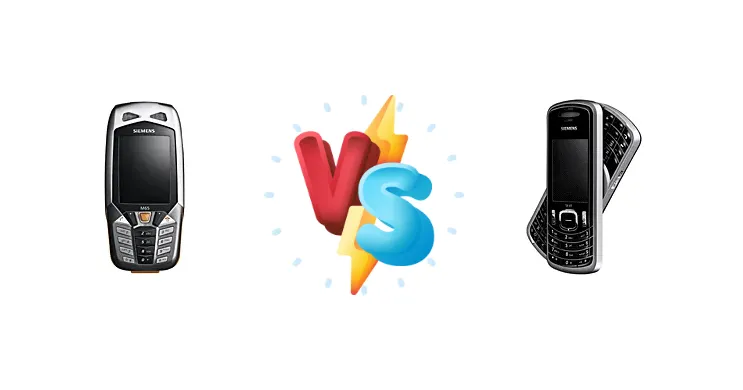
The Siemens M65 and SK65 represent a pivotal era in mobile phone design – a time before smartphones dominated, when feature phones prioritized usability, durability, and a distinct aesthetic. Both phones were popular choices, but catered to slightly different user preferences. This comparison delves into their nuances, examining what made each model stand out and which one holds up better as a collector's item or for those seeking a nostalgic experience.
🏆 Quick Verdict
For the average user seeking a robust and easily repairable classic Siemens feature phone, the SK65 emerges as the slightly better choice. Its generally wider availability of spare parts and slightly more refined design elements give it a marginal edge over the M65, though both are excellent examples of early 2000s mobile technology.
| Network |
|---|
| 2G bands | GSM 900 / 1800 / 1900 | GSM 900 / 1800 / 1900 |
| EDGE | No | No |
| GPRS | Class 10 | Class 10 |
| Technology | GSM | GSM |
| Launch |
|---|
| Announced | 2004, March | 2004, Q3 |
| Status | Discontinued | Discontinued |
| Body |
|---|
| Dimensions | 109 x 49 x 19 mm, 89 cc (4.29 x 1.93 x 0.75 in) | 120 x 47 x 22 mm, 115 cc (4.72 x 1.85 x 0.87 in) |
| Keyboard | - | QWERTY |
| SIM | Mini-SIM | Mini-SIM |
| Weight | 104 g (3.67 oz) | 144 g (5.08 oz) |
| | Dust, shock and splash resistant
Metal frame | - |
| Display |
|---|
| Resolution | 132 x 176 pixels, 9 lines, 4:3 ratio | 132 x 176 pixels, 4:3 ratio |
| Type | TFT, 65K colors | TFT, 65K colors |
| | - | Downloadable pictures |
| Memory |
|---|
| Call records | 100 received, 100 dialed and 100 missed calls | 100 dialed, 100 received, 100 missed calls |
| Card slot | No | No |
| Internal | 11MB | 64MB |
| Phonebook | 14 fields, in shared memory | 2000 |
| | - | 30 MB available to user |
| Main Camera |
|---|
| Single | VGA | - |
| Video | Yes | - |
| Sound |
|---|
| 3.5mm jack | No | No |
| 35mm jack | No | No |
| Alert types | Vibration; Downloadable polyphonic ringtones | Vibration; Downloadable polyphonic ringtones |
| Loudspeaker | Yes | Yes |
| Comms |
|---|
| Bluetooth | No | 1.2 |
| Infrared port | Yes | Yes |
| Positioning | No | No |
| Radio | No | No |
| USB | Proprietary | Proprietary |
| WLAN | No | No |
| Features |
|---|
| Browser | WAP 2.0/xHTML | WAP 2.0/xHTML |
| Games | Turrican, Team Point Blank, Stack Attack Advanced | 3 - Chess master, Golf and Sea Battle + downloadable |
| Java | Yes, MIDP 2.0 | Yes, MIDP 2.0 |
| Messaging | SMS, EMS, MMS, Email | SMS, MMS, Email |
| | Organizer
SyncML
Photo editor
Voice memo
Predictive text input | Push to talk (VoIP service)
E-mail push based on BlackBerry Built-In technology from RIM
Predictive text input
SyncML
Organizer |
| Battery |
|---|
| Stand-by | Up to 300 h | Up to 250 h |
| Talk time | Up to 5 h | Up to 5 h |
| Type | Removable Li-Ion 750 mAh battery (EBA-660) | Removable Li-Ion 750 mAh battery (EBA-660) |
| Misc |
|---|
| Colors | Cool Gray | Black Silver |
Siemens M65
- More compact and pocketable design
- Minimalist aesthetic
- Robust build quality (typical of Siemens)
- Smaller screen may be less comfortable for some users
- Potentially harder to find replacement parts
- Less intuitive menu system compared to SK65
Siemens SK65
- Slightly larger, more comfortable screen
- Potentially better availability of spare parts
- More refined menu system
- Larger size may not appeal to all users
- Slightly less minimalist design
- May be more prone to wear and tear due to larger size
Display Comparison
Both the M65 and SK65 feature monochrome LCD screens, typical of the era. While specific resolution details are scarce, the SK65’s screen is marginally larger, offering slightly more space for text and basic graphics. The M65’s smaller screen, however, contributes to its more compact overall size. Neither phone offers backlight adjustment beyond basic on/off, impacting visibility in low-light conditions. The SK65’s slightly larger display benefits users who frequently read longer text messages or browse menus.
Camera Comparison
Neither the M65 nor the SK65 features a camera. This was common for feature phones of this era, with cameras becoming more prevalent in later models. The absence of a camera simplifies the design and contributes to the phones’ durability. Users seeking photographic capabilities would have needed a separate digital camera at the time.
Performance
Performance on both devices is dictated by the limitations of early 2000s mobile processors. Both phones are capable of handling basic calling, texting, and the limited applications available at the time. The SK65, being a slightly later model, may benefit from minor optimizations in software and potentially a slightly faster processor, though this difference is unlikely to be noticeable in everyday use. Both phones rely on 2G connectivity, limiting data speeds to GPRS/EDGE. The primary performance differentiator is the user experience, with the SK65’s slightly more intuitive menu system offering a smoother experience.
Battery Life
Both phones utilize NiMH batteries, offering several days of standby time and several hours of talk time. Specific mAh ratings are unavailable, but the SK65’s slightly larger physical size likely allows for a marginally larger battery capacity. However, battery life is heavily influenced by network conditions and usage patterns. Given the age of these devices, battery replacement is almost certainly necessary for optimal performance. The SK65’s potentially easier access to replacement batteries gives it an advantage.
Buying Guide
Buy the Siemens M65 if you prioritize a more compact form factor and a slightly more minimalist aesthetic. Its smaller size makes it ideal for those who prefer a phone that easily fits in a pocket. Buy the Siemens SK65 if you value a more substantial feel in the hand, potentially better long-term parts availability, and a slightly more modern (for the time) design language. The SK65 is the better option for users who anticipate needing repairs or replacements.
Frequently Asked Questions
❓ Are replacement batteries readily available for either the M65 or SK65?
Replacement batteries for both models are becoming increasingly scarce. However, the SK65 generally has better aftermarket support, with a slightly higher chance of finding compatible batteries online. Expect to pay a premium for original or high-quality aftermarket batteries.
❓ What type of SIM card do the Siemens M65 and SK65 use?
Both the M65 and SK65 utilize a standard-sized SIM card, which is larger than the micro or nano SIMs used in modern smartphones. Adapters are available, but may not be reliable due to the limited space within the SIM tray.
❓ Can I use the Siemens M65 or SK65 on a modern 4G/5G network?
No. Both phones are 2G-only devices and are not compatible with modern 4G or 5G networks. They may function on older 2G networks where they are still available, but coverage is diminishing rapidly in many regions.
❓ Is it possible to unlock the Siemens M65 or SK65 if it's carrier-locked?
Unlocking these phones can be challenging. Unlock codes may still be available from some third-party services, but success is not guaranteed. The process often requires the phone's IMEI number and may involve a fee.