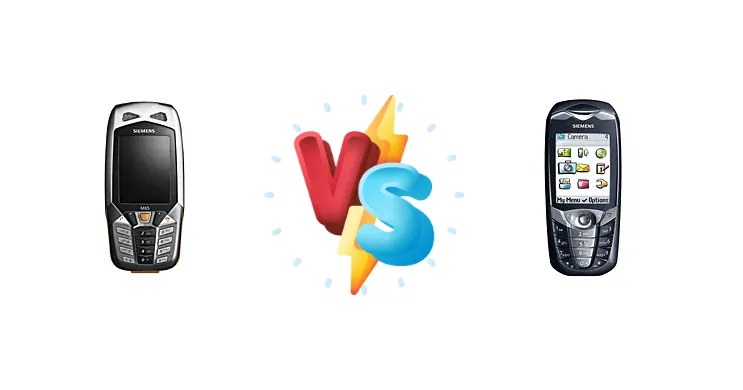
The early 2000s saw Siemens as a major player in the mobile phone market, offering innovative designs and features. The M65 and CX70 represent two distinct approaches from Siemens – the M65 a more conventional clamshell, and the CX70 a slider. This comparison revisits these phones, analyzing their strengths and weaknesses in the context of their time.
🏆 Quick Verdict
For the average user seeking a robust and reliable feature phone, the Siemens CX70 edges out the M65. Its slider mechanism offered a more modern aesthetic and potentially better screen real estate, while both phones shared similar core functionality. The CX70’s design was simply more forward-thinking.
| Network |
|---|
| 2G bands | GSM 900 / 1800 / 1900 | GSM 900 / 1800 / 1900 |
| EDGE | No | No |
| GPRS | Class 10 | Class 10 |
| Technology | GSM | GSM |
| Launch |
|---|
| Announced | 2004, March | 2004, Q3 |
| Status | Discontinued | Discontinued |
| Body |
|---|
| Dimensions | 109 x 49 x 19 mm, 89 cc (4.29 x 1.93 x 0.75 in) | 108 x 46 x 18 mm (4.25 x 1.81 x 0.71 in) |
| SIM | Mini-SIM | Mini-SIM |
| Weight | 104 g (3.67 oz) | 90 g (3.17 oz) |
| | Dust, shock and splash resistant
Metal frame | - |
| Display |
|---|
| Resolution | 132 x 176 pixels, 9 lines, 4:3 ratio | 132 x 176 pixels, 9 lines, 4:3 ratio |
| Type | TFT, 65K colors | TFT, 65K colors |
| | - | 5-way joystick
Downloadable logos |
| Memory |
|---|
| Call records | 100 received, 100 dialed and 100 missed calls | 100 dialed, 100 received, 100 missed calls |
| Card slot | No | No |
| Internal | 11MB | 9.5MB |
| Phonebook | 14 fields, in shared memory | 14 fields, in shared memory, Photo call |
| Main Camera |
|---|
| Single | VGA | VGA |
| Video | Yes | Yes |
| Sound |
|---|
| 3.5mm jack | No | No |
| 35mm jack | No | No |
| Alert types | Vibration; Downloadable polyphonic ringtones | Vibration; Downloadable polyphonic ringtones |
| Loudspeaker | Yes | Yes |
| Comms |
|---|
| Bluetooth | No | No |
| Infrared port | Yes | Yes |
| Positioning | No | No |
| Radio | No | No |
| USB | Proprietary | Proprietary |
| WLAN | No | No |
| Features |
|---|
| Browser | WAP 2.0/xHTML | WAP 2.0/xHTML |
| Games | Turrican, Team Point Blank, Stack Attack Advanced | Yes + downloadable |
| Java | Yes, MIDP 2.0 | Yes |
| Messaging | SMS, EMS, MMS, Email | SMS, MMS, Email |
| | Organizer
SyncML
Photo editor
Voice memo
Predictive text input | Push-To-Talk
Predictive text input
Stopwatch
Organizer
Voice dial, command
Clip-it covers |
| Battery |
|---|
| Stand-by | Up to 300 h | Up to 250 h |
| Talk time | Up to 5 h | Up to 5 h |
| Type | Removable Li-Ion 750 mAh battery (EBA-660) | Removable Li-Ion 750 mAh battery |
Siemens M65
- Classic clamshell design for durability
- Compact and pocketable form factor
- Simple and intuitive user interface
- Smaller screen size compared to CX70
- Less modern aesthetic
- Limited camera capabilities
Siemens CX70
- More contemporary slider design
- Potentially larger screen for improved readability
- Slightly more premium feel
- Slider mechanism could be prone to wear and tear
- Potentially larger and less pocketable
- Similar limited camera capabilities to M65
Display Comparison
Given the era, both the M65 and CX70 featured small color LCD screens. The CX70, being a slider, likely offered a slightly larger display area when extended, potentially improving readability for text messages and basic WAP browsing. The M65’s clamshell design prioritized compactness, meaning a smaller screen. Neither phone featured any advanced display technology like OLED or high refresh rates, common limitations of the time. The CX70’s slider mechanism, however, allowed for a more ergonomic viewing angle when the phone was open.
Camera Comparison
Both the Siemens M65 and CX70 were equipped with basic VGA cameras (approximately 0.3 megapixels). Image quality was limited by the sensor size, lens quality, and lack of image stabilization. These cameras were primarily intended for novelty use and capturing low-resolution images for MMS messaging. The CX70’s slider design *might* have allowed for a slightly more stable shooting position, but the difference would have been minimal. Neither phone offered features like autofocus or flash, making them unsuitable for serious photography.
Performance
Both phones relied on the processing power available in early 2000s feature phones, which was primarily focused on voice calls and basic messaging. Performance differences would have been negligible in everyday use. The M65 and CX70 likely utilized similar chipsets, optimized for low power consumption and extended battery life. The user experience would have been defined by menu navigation speed and the responsiveness of basic applications, areas where both phones likely performed similarly. The lack of a complex OS meant that RAM capacity was less critical than it is in modern smartphones.
Battery Life
Both phones utilized NiMH (Nickel-Metal Hydride) batteries, typical for the era. Battery life was a key selling point for feature phones, and both the M65 and CX70 likely offered several days of standby time and a reasonable amount of talk time. The M65, with its smaller form factor, may have had a slightly smaller battery capacity, but its simpler design likely consumed less power. Charging times were significantly longer than modern smartphones, typically requiring several hours to fully charge.
Buying Guide
Buy the Siemens M65 if you prioritize a classic, durable clamshell design and a potentially more compact form factor. It’s ideal for collectors seeking a representative example of early 2000s Siemens. Buy the Siemens CX70 if you prefer a more contemporary slider design, potentially larger screen, and a phone that felt more 'premium' for its time. It appeals to users who appreciated a touch of innovation in their mobile experience.
Frequently Asked Questions
❓ Are replacement batteries still available for the Siemens M65 or CX70?
Finding original NiMH batteries can be challenging. Third-party replacement batteries may be available online, but quality and compatibility can vary. Collectors often seek out well-preserved original batteries, but their capacity may have diminished over time.
❓ What kind of network connectivity did the Siemens M65 and CX70 support?
Both phones supported 2G GSM networks, the standard for mobile communication in the early 2000s. They were not compatible with 3G, 4G, or 5G networks. Data connectivity was limited to GPRS and EDGE, offering slow internet speeds for basic WAP browsing.
❓ Can I still use these phones on a modern mobile network?
Due to the sunsetting of 2G networks in many countries, using these phones on a modern network is becoming increasingly difficult or impossible. Some carriers may still support 2G for basic voice calls and SMS, but data connectivity will likely be unavailable.