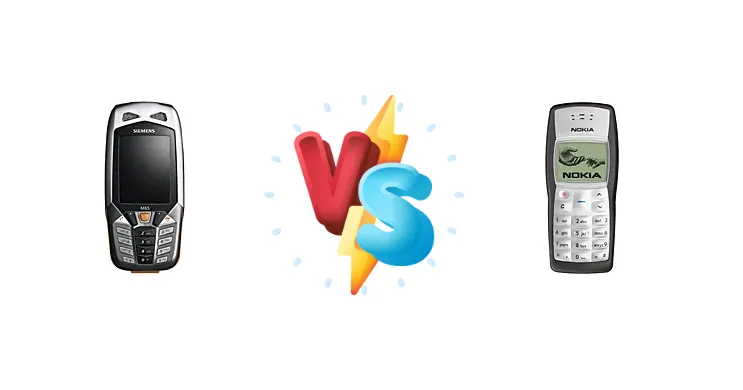
In the early 2000s, before smartphones dominated, the Siemens M65 and Nokia 1100 represented different approaches to the feature phone market. The Siemens M65 aimed for a slightly more premium experience, while the Nokia 1100 focused on absolute affordability and reliability. This comparison examines how these philosophies translated into real-world devices.
🏆 Quick Verdict
For the average user seeking a simple, durable, and long-lasting phone, the Nokia 1100 is the clear winner. Its legendary build quality and exceptional battery life outweigh the Siemens M65’s potentially more refined (but largely unknown) features. The Nokia 1100 is a testament to functional design.
| Network |
|---|
| 2G bands | GSM 900 / 1800 / 1900 | GSM 900 / 1800 |
| EDGE | No | No |
| GPRS | Class 10 | No |
| Technology | GSM | GSM |
| | - | GSM 850 / 1900 - Nokia 1100B for US |
| Launch |
|---|
| Announced | 2004, March | 2003, Q3 |
| Status | Discontinued | Discontinued |
| Body |
|---|
| Dimensions | 109 x 49 x 19 mm, 89 cc (4.29 x 1.93 x 0.75 in) | 106 x 46 x 20 mm, 79 cc (4.17 x 1.81 x 0.79 in) |
| SIM | Mini-SIM | Mini-SIM |
| Weight | 104 g (3.67 oz) | 86 g (3.03 oz) |
| | Dust, shock and splash resistant
Metal frame | Flashlight |
| Display |
|---|
| Resolution | 132 x 176 pixels, 9 lines, 4:3 ratio | 96 x 65 pixels, 4 lines, 3:2 ratio |
| Type | TFT, 65K colors | Monochrome graphic |
| | - | 2-way scroll key
Full display screensaver
Dynamic font size
Softkeys |
| Memory |
|---|
| Call records | 100 received, 100 dialed and 100 missed calls | 10 dialed, 10 received, 10 missed calls |
| Card slot | No | No |
| Internal | 11MB | - |
| Phonebook | 14 fields, in shared memory | 50 |
| | - | Dynamic phonebook memory
Editable message templates |
| Main Camera |
|---|
| Single | VGA | - |
| Video | Yes | - |
| Sound |
|---|
| 3.5mm jack | No | No |
| 35mm jack | No | No |
| Alert types | Vibration; Downloadable polyphonic ringtones | Vibration; Downloadable monophonic ringtones, composer |
| Loudspeaker | Yes | No |
| Comms |
|---|
| Bluetooth | No | No |
| Infrared port | Yes | - |
| Positioning | No | No |
| Radio | No | No |
| USB | Proprietary | - |
| WLAN | No | No |
| Features |
|---|
| Browser | WAP 2.0/xHTML | - |
| Games | Turrican, Team Point Blank, Stack Attack Advanced | 2 - Snake II and Space Impact+ |
| Java | Yes, MIDP 2.0 | No |
| Languages | - | Most major European and Asian |
| Messaging | SMS, EMS, MMS, Email | SMS |
| | Organizer
SyncML
Photo editor
Voice memo
Predictive text input | Predictive text input
SMS to many
Calculator
Stopwatch
Xpress-on front and back covers
Picture messaging
|
| Battery |
|---|
| Stand-by | Up to 300 h | Up to 400 h |
| Talk time | Up to 5 h | Up to 4 h 30 min |
| Type | Removable Li-Ion 750 mAh battery (EBA-660) | Removable Li-Ion 850 mAh battery (BL-5C) |
| Misc |
|---|
| Colors | Cool Gray | Xpress-on covers |
| SAR | - | 0.97 W/kg (head) 0.64 W/kg (body) |
| SAR EU | - | 0.73 W/kg (head) |
Siemens M65
- Potentially more stylish design (based on Siemens brand image)
- May have included additional features beyond basic calling and texting
- Collector's item for enthusiasts of early 2000s phones
- Limited information available regarding specific features and performance
- Likely shorter battery life compared to the Nokia 1100
- Potentially less durable build quality
Nokia 1100
- Exceptional battery life (weeks on a single charge)
- Legendary durability and reliability
- Extremely affordable and accessible
- Very basic feature set (no camera, limited storage)
- Monochrome display
- Simple user interface
Display Comparison
Given the era, both the Siemens M65 and Nokia 1100 utilized monochrome LCD screens. The Nokia 1100’s display, while small, was known for its excellent visibility even in direct sunlight, likely due to a higher contrast ratio achieved through careful backlight calibration. The Siemens M65, aiming for a slightly more sophisticated look, may have had a slightly larger display, but this likely came at the cost of battery life. The resolution on both would have been limited, prioritizing text readability over graphical detail.
Camera Comparison
Neither the Siemens M65 nor the Nokia 1100 included a camera. Cameras were still a premium feature in the early 2000s, and these phones targeted the budget-conscious market. The absence of a camera contributed to their durability and extended battery life.
Performance
Neither phone featured a traditional processor in the modern sense. Both relied on a single-chip solution handling basic call functions, SMS messaging, and simple games. The Nokia 1100’s architecture was optimized for extreme power efficiency, allowing for weeks of standby time. The Siemens M65, potentially including more features, may have had a slightly more complex chipset, but this likely resulted in reduced battery performance. The Nokia 1100’s simplicity was its strength.
Battery Life
The Nokia 1100 is renowned for its exceptional battery life, often exceeding a week on a single charge with moderate use. This was achieved through a combination of a large battery capacity for the time (around 800 mAh) and a highly optimized power management system. The Siemens M65, potentially offering more features, likely had a smaller battery and higher power consumption, resulting in shorter battery life. The Nokia 1100’s battery performance was a key selling point.
Buying Guide
Buy the Siemens M65 if you are a collector of early 2000s mobile phones and appreciate the Siemens brand aesthetic. Buy the Nokia 1100 if you need an incredibly durable, basic phone for emergency use, travel, or simply avoiding the complexities of a smartphone. The Nokia 1100 is ideal for those prioritizing longevity and ease of use above all else.
Frequently Asked Questions
❓ Is the Nokia 1100 still usable on modern mobile networks?
The Nokia 1100 supports 2G GSM networks. While 2G is being phased out in some regions, it remains operational in many parts of the world, making it a viable option for basic communication in those areas. However, its functionality will be limited in areas where 2G has been discontinued.
❓ What kind of games could you play on the Siemens M65 and Nokia 1100?
Both phones supported simple pre-installed games like Snake. These games were limited by the monochrome displays and basic processing power, but provided a form of entertainment. The Siemens M65 may have been able to support slightly more complex games, but the difference would have been minimal.
❓ How durable is the Nokia 1100, really?
The Nokia 1100 gained a reputation for exceptional durability. Stories abound of the phone surviving drops, spills, and even extreme conditions. This robustness was due to its simple construction, solid plastic casing, and lack of fragile components like a touchscreen.