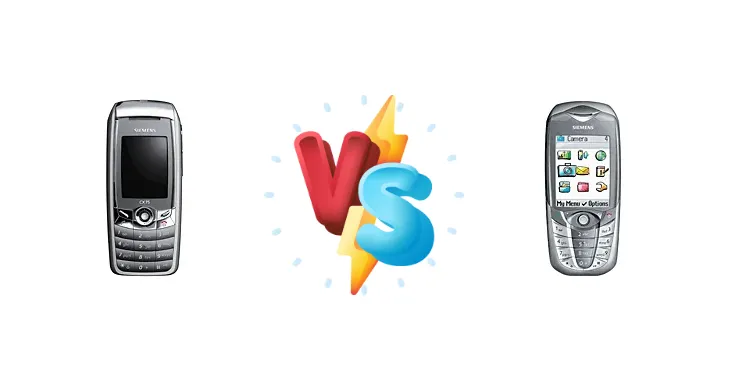
The Siemens CX65 has been a mainstay in the mid-range market for some time, offering a balance of features and affordability. The CX75 appears to be its successor, but without concrete specifications, we must analyze potential improvements based on typical generational upgrades and Siemens' brand positioning. This comparison will dissect what a CX75 upgrade *likely* entails, and who benefits most from each device.
🏆 Quick Verdict
Without definitive specs, the Siemens CX75 is likely the better choice for users prioritizing performance and future-proofing, assuming it features a newer chipset and more RAM. However, the CX65 remains a compelling option for budget-conscious buyers seeking a reliable daily driver.
| Network |
|---|
| 2G bands | GSM 900 / 1800 / 1900 | GSM 900 / 1800 / 1900 |
| EDGE | No | No |
| GPRS | Class 10 | Class 10 |
| Technology | GSM | GSM |
| | - | GSM 850 / 1800 / 1900 - Siemens CX66 |
| Launch |
|---|
| Announced | 2005, Q1 | 2004, February |
| Status | Discontinued | Discontinued |
| Body |
|---|
| Dimensions | 112 x 48 x 19 mm, 90 cc (4.41 x 1.89 x 0.75 in) | 108 x 46 x 18 mm (4.25 x 1.81 x 0.71 in) |
| SIM | Mini-SIM | Mini-SIM |
| Weight | 98 g (3.46 oz) | 90 g (3.17 oz) |
| Display |
|---|
| Resolution | 132 x 176 pixels, 4:3 ratio (~116 ppi density) | 132 x 176 pixels, 9 lines, 4:3 ratio (~105 ppi density) |
| Size | 1.9 inches, 28 x 38 mm, 11.2 cm2 (~20.8% screen-to-body ratio) | 2.1 inches, 13.7 cm2 (~27.5% screen-to-body ratio) |
| Type | TFT, 256K colors | TFT, 65K colors |
| | - | 5-way joystick
Download assistant for logos |
| Memory |
|---|
| Call records | 10 dialed, 10 received, 10 missed calls | 100 received, 100 dialed and 100 missed calls |
| Card slot | RS-MMC | No |
| Internal | 14MB | 11MB |
| Phonebook | 1000 x 20 fields, Photo call | 14 fields, in mem, PhotoCall |
| Main Camera |
|---|
| Single | 1.3 MP | VGA |
| Video | QCIF | Yes |
| Sound |
|---|
| 3.5mm jack | No | No |
| 35mm jack | No | No |
| Alert types | Vibration; Downloadable polyphonic, MP3 ringtones | Vibration; Downloadable polyphonic ringtones |
| Loudspeaker | Yes | Yes |
| Comms |
|---|
| Bluetooth | 1.2 | No |
| Infrared port | Yes | Yes |
| Positioning | No | No |
| Radio | No | No |
| USB | Proprietary | Proprietary |
| WLAN | No | No |
| Features |
|---|
| Browser | WAP 2.0/xHTML | WAP 2.0/xHTML |
| Games | Yes + downloadable | Yes |
| Java | Yes, MIDP 2.0 | Yes |
| Messaging | SMS, MMS, EMail, Instant Messaging | SMS, MMS, Email |
| | Push and Talk
MP3/AAC player
Predictive text input
Organizer
SyncML | Predictive text input
Organizer
Stopwatch
Voice memo
Clip-it covers
User profiles
SyncML |
| Battery |
|---|
| Stand-by | Up to 250 h | Up to 250 h |
| Talk time | Up to 5 h | Up to 5 h |
| Type | Removable Li-Ion 750 mAh battery | Removable Li-Ion 750 mAh battery (EBA-660) |
| Misc |
|---|
| Colors | Titan grey, Sand silver | Cool Silver |
Siemens CX75
- Likely faster processor for improved performance
- Potential for a better camera system with larger sensor
- Possible display upgrades (brightness, LTPO)
- Potentially higher price point
- May not offer a dramatically different experience if upgrades are incremental
Siemens CX65
- More affordable price
- Proven reliability and established user base
- Sufficient for basic smartphone tasks
- Likely slower processor and less RAM
- Potentially outdated camera technology
- May receive fewer software updates
Display Comparison
Given the CX75 is positioned as a newer model, it's reasonable to expect a display upgrade. This could manifest as a higher peak brightness (measured in nits) for improved outdoor visibility, or a move to a more efficient panel technology like LTPO for adaptive refresh rates and better battery life. The CX65 likely utilizes a standard AMOLED panel. Bezels are also a key differentiator; a reduction in bezel size on the CX75 would contribute to a more immersive viewing experience. Color accuracy, measured by Delta-E values, is another area where the CX75 could improve, offering more faithful color reproduction.
Camera Comparison
Camera improvements are expected in the CX75. This doesn't necessarily mean a higher megapixel count, but rather a larger sensor size for the main camera, allowing it to capture more light and produce better low-light images. Optical Image Stabilization (OIS) is a critical feature; if the CX65 lacks OIS, the CX75 likely includes it, resulting in sharper photos and smoother videos. Lens apertures (lower f-number is better) also play a role in low-light performance. Image processing algorithms are another area for improvement; the CX75 could feature more advanced computational photography techniques. We can safely assume any 'macro' cameras on either device are of limited utility.
Performance
The core difference between these devices will likely reside in their chipsets. The CX75 probably features a newer System-on-Chip (SoC) than the CX65, potentially moving from a MediaTek Dimensity series to a Snapdragon equivalent, or a newer generation Dimensity chip. This translates to faster CPU and GPU performance, benefiting demanding tasks like gaming and video editing. RAM speed (LPDDR4x vs LPDDR5) is also crucial; faster RAM reduces latency and improves multitasking. Thermal management is key – a more efficient chipset in the CX75 could mean less throttling during sustained workloads. The CX65 likely prioritizes efficiency over raw power.
Battery Life
Battery capacity (mAh) is important, but not the whole story. The CX75 could feature a slightly larger battery, but more importantly, a more efficient chipset and display panel could lead to significantly improved real-world battery life. Charging wattage is another key factor; the CX75 likely supports faster wired charging than the CX65, reducing 0-100% charge times. Wireless charging, if present on either device, would be a differentiating feature. The combination of battery size, chipset efficiency, and charging speed determines the overall user experience.
Buying Guide
Buy the Siemens CX75 if you need a phone capable of handling demanding applications, enjoy mobile gaming, and appreciate the benefits of a potentially faster processor and improved software support. Buy the Siemens CX65 if you prioritize affordability, require a dependable phone for basic tasks like calling, texting, and social media, and are comfortable with a potentially older chipset and less frequent updates.
Frequently Asked Questions
❓ Will the CX75 receive more software updates than the CX65?
Given the CX75 is a newer device, it's highly probable it will receive a longer period of software support, including Android version updates and security patches. This is crucial for maintaining security and accessing new features.
❓ Is the CX75 likely to overheat during extended gaming sessions?
If the CX75 features a more powerful chipset, thermal management becomes critical. A well-designed cooling system and efficient chipset architecture are necessary to prevent overheating. Without specific details, it's impossible to say definitively, but a newer generation chip *could* be more efficient and generate less heat.
❓ How much faster can I expect the CX75 to be compared to the CX65 in everyday tasks?
The performance difference will be most noticeable in demanding applications like games and video editing. For basic tasks like browsing, social media, and messaging, the difference may be less significant, but the CX75 should still offer a smoother and more responsive experience due to its likely faster processor and RAM.
❓ Does the CX65 still hold up as a viable option in [current year]?
Yes, the CX65 remains a viable option for users with basic smartphone needs and a limited budget. It can reliably handle everyday tasks, but it may struggle with more demanding applications or future software updates.