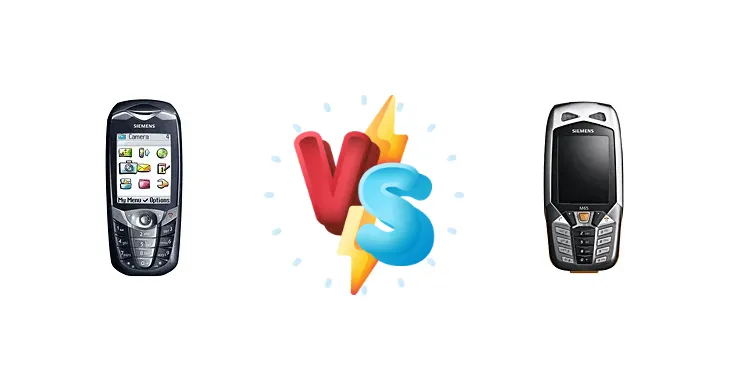
The early 2000s saw Siemens as a major player in the mobile phone market, offering innovative designs and features. The CX70 and M65 represent two distinct approaches from Siemens: the CX70, with its focus on multimedia and a more stylish aesthetic, and the M65, a robust and business-oriented device. This comparison revisits these classics, analyzing their strengths and weaknesses in the context of their time.
🏆 Quick Verdict
For the average user seeking a blend of style and functionality, the Siemens CX70 emerges as the slightly stronger choice. Its more advanced multimedia capabilities and sleeker design offered a more compelling experience, despite the M65’s superior build quality and battery life.
| Network |
|---|
| 2G bands | GSM 900 / 1800 / 1900 | GSM 900 / 1800 / 1900 |
| EDGE | No | No |
| GPRS | Class 10 | Class 10 |
| Technology | GSM | GSM |
| Launch |
|---|
| Announced | 2004, Q3 | 2004, March |
| Status | Discontinued | Discontinued |
| Body |
|---|
| Dimensions | 108 x 46 x 18 mm (4.25 x 1.81 x 0.71 in) | 109 x 49 x 19 mm, 89 cc (4.29 x 1.93 x 0.75 in) |
| SIM | Mini-SIM | Mini-SIM |
| Weight | 90 g (3.17 oz) | 104 g (3.67 oz) |
| | - | Dust, shock and splash resistant
Metal frame |
| Display |
|---|
| Resolution | 132 x 176 pixels, 9 lines, 4:3 ratio | 132 x 176 pixels, 9 lines, 4:3 ratio |
| Type | TFT, 65K colors | TFT, 65K colors |
| | 5-way joystick
Downloadable logos | - |
| Memory |
|---|
| Call records | 100 dialed, 100 received, 100 missed calls | 100 received, 100 dialed and 100 missed calls |
| Card slot | No | No |
| Internal | 9.5MB | 11MB |
| Phonebook | 14 fields, in shared memory, Photo call | 14 fields, in shared memory |
| Main Camera |
|---|
| Single | VGA | VGA |
| Video | Yes | Yes |
| Sound |
|---|
| 3.5mm jack | No | No |
| 35mm jack | No | No |
| Alert types | Vibration; Downloadable polyphonic ringtones | Vibration; Downloadable polyphonic ringtones |
| Loudspeaker | Yes | Yes |
| Comms |
|---|
| Bluetooth | No | No |
| Infrared port | Yes | Yes |
| Positioning | No | No |
| Radio | No | No |
| USB | Proprietary | Proprietary |
| WLAN | No | No |
| Features |
|---|
| Browser | WAP 2.0/xHTML | WAP 2.0/xHTML |
| Games | Yes + downloadable | Turrican, Team Point Blank, Stack Attack Advanced |
| Java | Yes | Yes, MIDP 2.0 |
| Messaging | SMS, MMS, Email | SMS, EMS, MMS, Email |
| | Push-To-Talk
Predictive text input
Stopwatch
Organizer
Voice dial, command
Clip-it covers | Organizer
SyncML
Photo editor
Voice memo
Predictive text input |
| Battery |
|---|
| Stand-by | Up to 250 h | Up to 300 h |
| Talk time | Up to 5 h | Up to 5 h |
| Type | Removable Li-Ion 750 mAh battery | Removable Li-Ion 750 mAh battery (EBA-660) |
Siemens CX70
- More stylish and modern design
- Enhanced multimedia capabilities (video playback)
- Potentially better camera software
- Shorter battery life
- Potentially slower performance with multitasking
- Less durable build quality
Siemens M65
- Exceptional battery life
- Robust and durable build quality
- Optimized software for business use
- Less appealing aesthetic
- Limited multimedia features
- Smaller display contrast
Display Comparison
Both the CX70 and M65 featured small, monochrome displays typical of the era. However, the CX70’s display likely benefited from slightly higher contrast ratios due to its focus on multimedia, making images and videos marginally clearer. The M65’s display prioritized readability under direct sunlight, a crucial feature for business users. Bezels were substantial on both devices, a limitation of the technology at the time, but the CX70’s design attempted to minimize their visual impact with a more curved form factor.
Camera Comparison
Both the CX70 and M65 included basic cameras for their time, likely VGA resolution. Image quality was heavily dependent on lighting conditions and the limitations of the sensor technology. The CX70’s camera was marketed more heavily, suggesting a slightly more refined user interface and potentially better image processing algorithms. However, neither camera could compete with even basic digital cameras of the same era. The focus was more on novelty than image quality.
Performance
Performance on both devices was dictated by the limitations of early 2G networks and processor technology. The M65, geared towards business users, likely had optimized software for faster contact loading and call handling. The CX70, with its multimedia features, may have experienced slightly slower performance when multitasking due to the increased processing demands of image and video playback. RAM capacity was limited on both, impacting the number of applications that could run concurrently.
Battery Life
The Siemens M65 excelled in battery life, thanks to its efficient design and focus on core functionality. Its larger battery capacity, combined with less demanding software, allowed for several days of use on a single charge. The CX70, with its multimedia features and potentially brighter display, suffered from comparatively shorter battery life, requiring more frequent charging. This trade-off was typical for devices prioritizing features over longevity.
Buying Guide
Buy the Siemens CX70 if you prioritize a more modern aesthetic, enjoy experimenting with early mobile multimedia features like video playback, and appreciate a phone that stood out from the crowd. Buy the Siemens M65 if you need a durable, reliable device with exceptional battery life, and value a more traditional, business-focused design. The M65 is the better choice for users who prioritized practicality and longevity over flashy features.
Frequently Asked Questions
❓ Was the Siemens CX70’s video playback truly usable given the small screen size?
While technically capable of playing video, the CX70’s video playback experience was limited by the small screen and low resolution. It was more of a novelty feature than a practical one, best suited for short clips.
❓ How durable was the Siemens M65 compared to other phones of its era?
The Siemens M65 was renowned for its robust build quality. Its solid construction and durable materials made it significantly more resistant to drops and everyday wear and tear than many of its competitors.
❓ Did either phone support expandable storage via memory cards?
Yes, both the CX70 and M65 supported expandable storage via MMC cards, allowing users to increase the available memory for storing contacts, messages, and multimedia files. However, MMC card capacity was limited at the time.