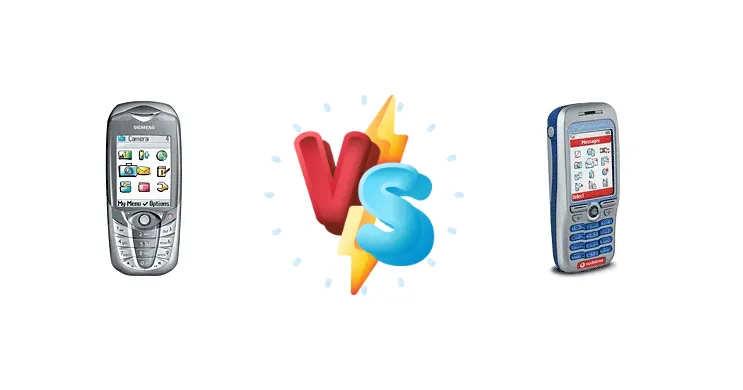
The mid-2000s were a golden age for feature phones, bridging the gap between basic voice communication and the smartphones to come. The Siemens CX65 and Sony Ericsson F500i were two prominent contenders, each aiming to deliver a compelling experience. This comparison revisits these devices, analyzing their strengths and weaknesses in the context of their time.
🏆 Quick Verdict
For the average user seeking a robust and reliable feature phone, the Sony Ericsson F500i likely offered a more appealing package. Its focus on multimedia capabilities, particularly the camera, and broader market availability gave it an edge over the Siemens CX65, which was often region-locked.
| Network |
|---|
| 2G bands | GSM 900 / 1800 / 1900 | GSM 900 / 1800 / 1900 |
| EDGE | No | No |
| GPRS | Class 10 | Class 10 |
| Technology | GSM | GSM |
| | GSM 850 / 1800 / 1900 - Siemens CX66 | - |
| Launch |
|---|
| Announced | 2004, February | 2004, Q2 |
| Status | Discontinued | Discontinued |
| Body |
|---|
| Dimensions | 108 x 46 x 18 mm (4.25 x 1.81 x 0.71 in) | 102 x 46 x 14 mm (4.02 x 1.81 x 0.55 in) |
| SIM | Mini-SIM | Mini-SIM |
| Weight | 90 g (3.17 oz) | 80 g (2.82 oz) |
| Display |
|---|
| Resolution | 132 x 176 pixels, 9 lines, 4:3 ratio (~105 ppi density) | 128 x 160 pixels (~108 ppi density) |
| Size | 2.1 inches, 13.7 cm2 (~27.5% screen-to-body ratio) | 1.9 inches, 30 x 37 mm, 11.4 cm2 (~24.2% screen-to-body ratio) |
| Type | TFT, 65K colors | TFT, 65K colors |
| | 5-way joystick
Download assistant for logos | Wallpapers, 3D animations and pictures |
| Memory |
|---|
| Call records | 100 received, 100 dialed and 100 missed calls | 30 received, dialed and missed calls |
| Card slot | No | No |
| Internal | 11MB | 12MB |
| Phonebook | 14 fields, in mem, PhotoCall | 500 x 8 fields, Photo call |
| Main Camera |
|---|
| Single | VGA | VGA |
| Video | Yes | Yes |
| Sound |
|---|
| 3.5mm jack | No | No |
| 35mm jack | No | No |
| Alert types | Vibration; Downloadable polyphonic ringtones | Vibration; Downloadable polyphonic ringtones, composer |
| Loudspeaker | Yes | No |
| Comms |
|---|
| Bluetooth | No | No |
| Infrared port | Yes | Yes |
| Positioning | No | No |
| Radio | No | No |
| USB | Proprietary | - |
| WLAN | No | No |
| Features |
|---|
| Browser | WAP 2.0/xHTML | WAP 2.0/xHTML |
| Games | Yes | Yes + downloadable |
| Java | Yes | Yes, MIDP 2.0 |
| Messaging | SMS, MMS, Email | SMS, EMS, MMS, Email, Instant Messaging |
| | Predictive text input
Organizer
Stopwatch
Voice memo
Clip-it covers
User profiles
SyncML | MP3/MP4 player
Predictive text input
Organizer
Photo editor
Voice dial |
| Battery |
|---|
| Stand-by | Up to 250 h | Up to 300 h |
| Talk time | Up to 5 h | Up to 7 h |
| Type | Removable Li-Ion 750 mAh battery (EBA-660) | Removable Li-Ion battery |
| Misc |
|---|
| Colors | Cool Silver | 3 |
| SAR EU | - | 0.82 W/kg (head) |
Siemens CX65
- Compact and durable design
- Potentially superior call quality
- Minimalist user interface
- Limited features compared to competitors
- Region-locked availability
- Likely lacked a dedicated camera
Sony Ericsson F500i
- Integrated VGA camera
- Multimedia playback capabilities
- Wider network compatibility
- Potentially less durable build quality
- Larger size compared to CX65
- Proprietary memory card format
Display Comparison
Given the era, both the Siemens CX65 and Sony Ericsson F500i featured small color displays, likely utilizing TFT LCD technology. The CX65, known for its compact form factor, probably had a slightly smaller screen, prioritizing portability. The F500i, with its emphasis on multimedia, likely had a marginally larger display to enhance video playback and photo viewing. Resolution would have been limited to around 176x220 pixels on both, making image clarity a secondary concern. The F500i’s display likely benefited from Sony’s image processing expertise, potentially offering slightly more vibrant colors.
Camera Comparison
The Sony Ericsson F500i was marketed heavily on its camera capabilities, boasting a VGA (0.3MP) sensor – a significant feature for the time. While image quality would be rudimentary by today’s standards, it offered a tangible advantage over the CX65, which likely lacked a dedicated camera or featured a lower-resolution option. The F500i’s camera likely included basic features like digital zoom and limited video recording. The lens aperture and sensor size would have been small on both, resulting in poor low-light performance, but the F500i’s marketing focused on this feature, making it a key differentiator.
Performance
Performance in these devices wasn't dictated by GHz or core counts, but by the efficiency of the baseband processor and the amount of available memory. Siemens, with its engineering background, likely focused on optimizing the CX65’s processor for call quality and network stability. Sony Ericsson, leveraging its consumer electronics experience, likely prioritized multimedia processing capabilities in the F500i. Both would have relied on proprietary operating systems, limiting app availability and customization. The F500i’s inclusion of a memory stick duo slot suggests a greater emphasis on storing multimedia content, implying a more robust memory management system.
Battery Life
Both phones would have utilized NiMH or Li-Ion batteries, offering several days of standby time and hours of talk time. The CX65’s smaller size likely meant a smaller battery capacity, potentially resulting in slightly shorter usage times. The F500i, with its multimedia features, likely had a more efficient power management system to compensate for the increased energy demands. Charging times would have been slow, typically requiring several hours via a proprietary charger. Battery life was a critical factor for users in this era, and both manufacturers would have prioritized maximizing standby time.
Buying Guide
Buy the Siemens CX65 if you prioritize a minimalist design and potentially a more durable build quality, typical of Siemens products. Buy the Sony Ericsson F500i if you value a better camera, broader multimedia features like music playback, and wider network compatibility, making it a more versatile daily driver.
Frequently Asked Questions
❓ Was the Siemens CX65 known for being particularly robust or durable?
Siemens phones, in general, had a reputation for solid build quality and reliability. The CX65 likely benefited from this, potentially offering a more durable construction than the F500i, though specific drop test data is unavailable. This was a key selling point for Siemens at the time.
❓ How did the camera on the Sony Ericsson F500i compare to other VGA camera phones of the era?
While a VGA camera seems primitive today, the F500i’s camera was competitive for its time. Sony Ericsson’s image processing expertise likely resulted in slightly better image quality than some rivals. However, users should expect limited detail and poor performance in low-light conditions.
❓ Did either phone support expandable storage beyond what was built-in?
The Sony Ericsson F500i supported expandable storage via Memory Stick Duo cards, allowing users to store more photos, videos, and ringtones. The Siemens CX65 likely had limited or no expandable storage options, relying solely on its internal memory.