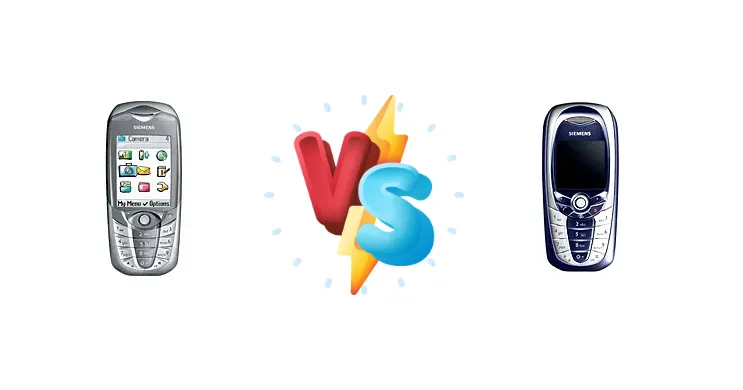
The Siemens CX65 and C65 represent a pivotal era in mobile phone design – the transition from basic handsets to feature-rich devices. Both phones were popular choices in the early 2000s, but catered to slightly different user preferences. This comparison delves into their nuances, examining design, features, and overall user experience to understand their place in mobile history.
🏆 Quick Verdict
For the collector or enthusiast seeking a more visually striking and potentially more durable device, the Siemens CX65 is the better choice. Its clamshell design offers screen protection, and its overall build quality appears more robust. However, the C65’s simpler candybar form factor may appeal to those prioritizing ease of use.
| Network |
|---|
| 2G bands | GSM 900 / 1800 / 1900 | GSM 900 / 1800 / 1900 |
| EDGE | No | No |
| GPRS | Class 10 | Class 10 |
| Technology | GSM | GSM |
| | GSM 850 / 1800 / 1900 - Siemens CX66 | GSM 850 / 1800 / 1900 - Siemens C66 |
| Launch |
|---|
| Announced | 2004, February | 2004, March |
| Status | Discontinued | Discontinued |
| Body |
|---|
| Dimensions | 108 x 46 x 18 mm (4.25 x 1.81 x 0.71 in) | 105 x 45 x 16 mm, 76 cc (4.13 x 1.77 x 0.63 in) |
| SIM | Mini-SIM | Mini-SIM |
| Weight | 90 g (3.17 oz) | 86 g (3.03 oz) |
| Display |
|---|
| Resolution | 132 x 176 pixels, 9 lines, 4:3 ratio (~105 ppi density) | 130 x 130 pixels, 1:1 ratio |
| Size | 2.1 inches, 13.7 cm2 (~27.5% screen-to-body ratio) | - |
| Type | TFT, 65K colors | CSTN, 65K colors |
| | 5-way joystick
Download assistant for logos | Download assistant for logos |
| Memory |
|---|
| Call records | 100 received, 100 dialed and 100 missed calls | 100 dialed, 100 received, 100 missed calls |
| Card slot | No | No |
| Internal | 11MB | 10MB |
| Phonebook | 14 fields, in mem, PhotoCall | 14 fields, in shared memory |
| Main Camera |
|---|
| Single | VGA | CIF |
| Video | Yes | No |
| Sound |
|---|
| 3.5mm jack | No | No |
| 35mm jack | No | No |
| Alert types | Vibration; Downloadable polyphonic ringtones | Vibration; Downloadable polyphonic ringtones |
| Loudspeaker | Yes | Yes |
| Comms |
|---|
| Bluetooth | No | No |
| Infrared port | Yes | Yes |
| Positioning | No | No |
| Radio | No | No |
| USB | Proprietary | Proprietary |
| WLAN | No | No |
| Features |
|---|
| Browser | WAP 2.0/xHTML | WAP 2.0/xHTML |
| Games | Yes | Photopet + downloadable |
| Java | Yes | Yes, MIDP 2.0 |
| Messaging | SMS, MMS, Email | SMS, EMS, MMS |
| | Predictive text input
Organizer
Stopwatch
Voice memo
Clip-it covers
User profiles
SyncML | Predictive text input
Stopwatch
Organizer
SyncML
Clip-it covers |
| Battery |
|---|
| Stand-by | Up to 250 h | Up to 250 h |
| Talk time | Up to 5 h | Up to 6 h |
| Type | Removable Li-Ion 750 mAh battery (EBA-660) | Removable Li-Ion 600 mAh battery (EBA-670) |
| Misc |
|---|
| Colors | Cool Silver | Blue Shadow |
Siemens CX65
- Clamshell design offers screen protection
- Potentially more durable build quality
- Distinctive and visually appealing design
- Hinge mechanism could be a point of failure
- Slightly bulkier than the C65
Siemens C65
- Simple and easy-to-use candybar design
- More compact and pocketable
- Direct access to key functions
- Exposed screen is prone to scratches
- Less visually distinctive
Display Comparison
Given the era, both the CX65 and C65 feature small, monochrome LCD screens. The CX65’s clamshell design inherently provides screen protection when closed, a significant advantage over the C65’s exposed display. While neither phone boasts high resolution, the CX65’s screen size, though similar, benefits from the protective enclosure, reducing the likelihood of scratches. The C65’s display, being directly exposed, was more susceptible to damage during everyday carry.
Camera Comparison
Neither the CX65 nor the C65 are known for their photographic capabilities. Both feature very low-resolution cameras (likely VGA or below), primarily intended for novelty use rather than serious photography. Image quality is expected to be poor by modern standards. The C65’s simpler design may offer slightly easier access to the camera function, but the overall experience is comparable – limited by sensor technology and processing power.
Performance
Both phones operate on limited processing power typical of the early 2000s. Performance differences are negligible, as both are primarily limited by the speed of their internal components and the constraints of 2G network connectivity. The CX65’s clamshell design might necessitate slightly more complex hinge mechanisms, potentially impacting long-term durability, but this doesn’t translate to a noticeable performance difference in daily use. Both phones prioritize call quality and basic messaging over complex multitasking.
Battery Life
Battery life on both devices is a key strength, owing to their low-power displays and limited functionality. Both phones likely offer several days of standby time and reasonable talk time on a single charge. The CX65’s clamshell design may offer a slight advantage in battery conservation when closed, as the screen is off. However, the difference is likely minimal, and both phones provide significantly better battery life than contemporary smartphones.
Buying Guide
Buy the Siemens CX65 if you value a more secure, protected screen and appreciate a distinctive clamshell design. This phone is ideal for collectors interested in a visually unique piece of mobile history. Buy the Siemens C65 if you prefer a straightforward, easy-to-use candybar phone with a focus on simplicity and quick access to core functions. It’s a good option for those who prioritize practicality over aesthetics.
Frequently Asked Questions
❓ Are replacement batteries still available for the Siemens CX65 and C65?
Finding original replacement batteries can be challenging. Third-party batteries may be available, but their quality and compatibility are not guaranteed. Collectors often seek out well-preserved original batteries or explore battery refurbishment services.
❓ What network compatibility do the Siemens CX65 and C65 offer?
Both phones are 2G (GSM) devices and may have limited or no compatibility with modern 3G, 4G, or 5G networks. Their functionality is largely dependent on the continued operation of 2G infrastructure in specific regions.
❓ Can I use modern SIM cards with the Siemens CX65 and C65?
While physically the SIM card slot accepts standard-sized SIMs, compatibility with modern SIM cards can be an issue. Some newer SIM cards may not be recognized due to differences in protocols or security features. Adapters may be required, but success isn't guaranteed.