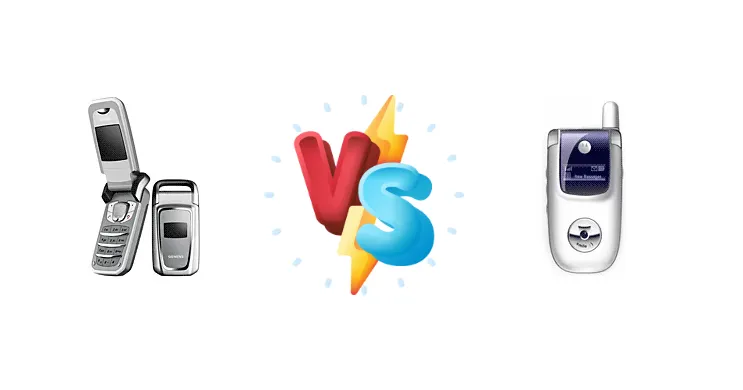
The early 2000s saw a rapid evolution in mobile phone technology, moving beyond basic voice calls to include SMS, rudimentary games, and customizable ringtones. The Siemens CF62 and Motorola V220 were key players in this era, representing distinct approaches to design and functionality. This comparison revisits these iconic devices, analyzing their strengths and weaknesses in the context of their time.
🏆 Quick Verdict
For the average user seeking a durable and reliable feature phone in the early 2000s, the Motorola V220 likely offered broader appeal due to its established brand recognition and generally more accessible user interface. However, the Siemens CF62 potentially appealed to users prioritizing a more compact and arguably more sophisticated aesthetic.
| Network |
|---|
| 2G bands | GSM 900 / 1800 / 1900 | GSM 900 / 1800 / 1900 |
| EDGE | No | No |
| GPRS | Class 10 | Class 10 |
| Technology | GSM | GSM |
| | GSM 850 / 1800 / 1900 - Siemens CF63 | - |
| Launch |
|---|
| Announced | 2004, February | 2003, Q4 |
| Status | Discontinued | Discontinued |
| Body |
|---|
| Dimensions | 82 x 45 x 22 mm, 78 cc (3.23 x 1.77 x 0.87 in) | 85.5 x 44 x 24 mm, 80 cc (3.37 x 1.73 x 0.94 in) |
| SIM | Mini-SIM | Mini-SIM |
| Weight | 85 g (3.00 oz) | 100 g (3.53 oz) |
| Display |
|---|
| Resolution | 130 x 130 pixels, 1:1 ratio | 128 x 128 pixels, 1:1 ratio |
| Type | CSTN, 65K colors | CSTN, 65K colors |
| | Second external monochrome display (blue illuminated)
4-way navi key
Screensavers
| Second external display 96 x 32 pixels
Screensavers and wallpapers
Downloadable logos |
| Memory |
|---|
| Call records | 10 dialed, 20 received, 20 missed calls | 10 dialed, 10 received, 10 missed calls |
| Card slot | No | No |
| Internal | - | 1.8MB |
| Phonebook | 500 x 15 fields | 500 entries, Photo call |
| | 100 short messages | - |
| Main Camera |
|---|
| Single | - | VGA |
| Video | - | No |
| Sound |
|---|
| 3.5mm jack | No | No |
| 35mm jack | No | No |
| Alert types | Vibration; Downloadable polyphonic ringtones | Vibration; Downloadable polyphonic, MP3 ringtones, composer |
| Loudspeaker | Yes | Yes |
| Comms |
|---|
| Bluetooth | No | No |
| Positioning | No | No |
| Radio | No | No |
| USB | - | Proprietary |
| WLAN | No | No |
| Features |
|---|
| Browser | WAP 1.2.1 | WAP 2.0/xHTML |
| Games | Yes + downloadable | Hungry Fish, OptItOut |
| Java | Yes | Yes, MIDP 2.0 |
| Messaging | SMS, EMS, MMS | SMS, EMS, MMS |
| | Predictive text input
Organizer
Optional digital camera | Predictive text input(iTAP)
Organizer
Voice mail |
| Battery |
|---|
| Stand-by | Up to 220 h | Up to 216 h |
| Talk time | Up to 5 h | Up to 5 h |
| Type | Removable Li-Ion 600 mAh battery (EBA-670) | Removable Li-Ion 860 mAh battery (BX200) |
| Misc |
|---|
| Colors | 2 - Cool Grey, Cool Cashmere | Silver |
Siemens CF62
- Compact and refined design
- Potentially robust build quality (Siemens reputation)
- Unique aesthetic appeal
- Less brand recognition than Motorola
- Potentially less intuitive user interface
- Limited accessory availability
Motorola V220
- Strong brand recognition and trust
- Simple and user-friendly interface
- Wider availability of accessories and support
- Larger and less refined design
- Potentially less durable build quality
- Less distinctive aesthetic
Display Comparison
Given the era, both the Siemens CF62 and Motorola V220 featured small, monochrome LCD screens. The V220’s display was slightly larger, offering marginally more space for text and basic graphics. However, neither device boasted any advanced display technology like color screens or high resolutions, focusing instead on maximizing battery life. The CF62’s smaller footprint likely resulted in a slightly higher pixel density, potentially offering marginally sharper text, but this difference would be minimal to the naked eye.
Camera Comparison
Neither the Siemens CF62 nor the Motorola V220 included a built-in camera. Cameras were still a premium feature reserved for higher-end devices during this period. The absence of a camera simplifies the comparison, as image quality and features are non-factors. Users wanting mobile photography would have needed a separate digital camera.
Performance
Performance in these devices is defined not by GHz or RAM, but by the efficiency of the baseband processor and the responsiveness of the user interface. Motorola, with its larger market share, likely benefited from economies of scale in chip production, potentially leading to slightly optimized power consumption in the V220. Siemens, while known for engineering prowess, was a smaller player in the mobile market, potentially resulting in a less refined software experience on the CF62. Both phones relied on 2G networks, limiting data speeds to GPRS, which was sufficient for basic WAP browsing.
Battery Life
Battery life was a critical factor for feature phones, and both the CF62 and V220 aimed for several days of standby time. The Motorola V220, with its slightly larger physical size, likely accommodated a marginally larger battery capacity. However, the Siemens CF62’s potentially more efficient chipset and software optimization could have offset this difference. Real-world battery performance would have varied significantly based on network conditions and usage patterns (frequency of calls and SMS messages).
Buying Guide
Buy the Siemens CF62 if you valued a smaller, more refined design and potentially a more robust build quality, typical of Siemens engineering. Buy the Motorola V220 if you prioritized brand familiarity, a simpler user experience, and wider availability of accessories and support. Both phones catered to users needing basic communication features – voice and SMS – but differed in their target aesthetic and usability.
Frequently Asked Questions
❓ Was the Siemens CF62 known for any specific durability features?
While specific drop-test data isn't available, Siemens generally had a reputation for solid engineering. The CF62's compact size and potentially robust construction suggest it may have been more resistant to everyday wear and tear than some competitors, but this is largely anecdotal.
❓ Did the Motorola V220 support polyphonic ringtones?
Yes, the Motorola V220 was one of the first widely available phones to support polyphonic ringtones, allowing users to customize their alerts with more complex sounds than the basic monophonic tones of earlier models. This was a significant selling point at the time.
❓ Could either phone be used with a hands-free headset?
Both the Siemens CF62 and Motorola V220 supported the use of a standard 2.5mm headset jack, allowing for hands-free calling. This was a common feature on feature phones of this era, enhancing convenience and safety.