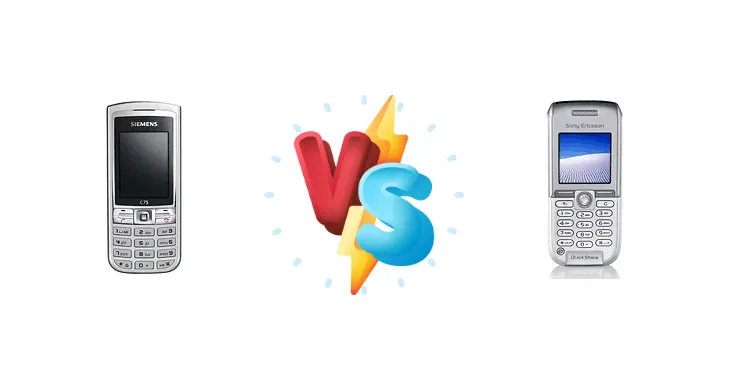
The early 2000s saw a fierce battle for dominance in the feature phone market. The Siemens C75 and Sony Ericsson K300 were two key contenders, representing distinct approaches to design and functionality. This comparison revisits these iconic devices, analyzing their strengths and weaknesses to understand their lasting impact.
🏆 Quick Verdict
For the average user seeking a reliable and stylish feature phone of the era, the Sony Ericsson K300 emerges as the slightly stronger choice. Its more compact design, coupled with a generally more user-friendly interface, provided a better overall experience despite the Siemens C75's potentially more robust build quality.
| Network |
|---|
| 2G bands | GSM 900 / 1800 / 1900 | GSM 900 / 1800 / 1900 |
| EDGE | No | No |
| GPRS | Class 10 | Class 8 |
| Technology | GSM | GSM |
| Launch |
|---|
| Announced | 2005, May | 2004, Q4 |
| Status | Discontinued | Discontinued |
| Body |
|---|
| Dimensions | 103 x 44 x 17 mm (4.06 x 1.73 x 0.67 in) | 99.9 x 45.2 x 19.4 mm (3.93 x 1.78 x 0.76 in) |
| SIM | Mini-SIM | Mini-SIM |
| Weight | 85 g (3.00 oz) | 85 g (3.00 oz) |
| Display |
|---|
| Resolution | 132 x 176 pixels, 9 lines, 4:3 ratio | 128 x 128 pixels, 1:1 ratio (~113 ppi density) |
| Size | - | 1.6 inches, 29 x 29 mm, 8.3 cm2 (~18.3% screen-to-body ratio) |
| Type | TFT, 65K colors | CSTN, 65K colors |
| | 5-way joystick
Download assistant for logos | Wallpapers, 3D animations and pictures |
| Memory |
|---|
| Call records | 100 received, 100 dialed and 100 missed calls | 30 received, dialed and missed calls |
| Card slot | No | No |
| Internal | 10MB | 12MB |
| Phonebook | 1000 x 20 fields, Photo call | 500 x 8 fields, Photo call |
| | 100 short messages | - |
| Main Camera |
|---|
| Single | VGA | VGA |
| Video | Yes | Yes |
| Sound |
|---|
| 3.5mm jack | No | No |
| 35mm jack | No | No |
| Alert types | Vibration; Downloadable polyphonic ringtones | Vibration; Downloadable polyphonic, MP3 ringtones, composer |
| Loudspeaker | Yes | No |
| Comms |
|---|
| Bluetooth | No | No |
| Infrared port | Yes | Yes |
| Positioning | No | No |
| Radio | No | No |
| USB | Proprietary | Proprietary |
| WLAN | No | No |
| Features |
|---|
| Browser | WAP 2.0/xHTML | WAP 2.0/xHTML |
| Games | Yes | 2 - Darts and TicTacToe + downloadable |
| Java | Yes | Yes, MIDP 2.0 |
| Messaging | SMS, EMS, MMS, Email, Instant Messaging | SMS, EMS, MMS, Email, Instant Messaging |
| | Predictive text input
Stopwatch
Organizer
Voice memo
Clip-it covers
User profiles
SyncML | MP3/MP4 player
SyncML
Predictive text input
Organizer
Photo editor
Voice dial
Voice memo |
| Battery |
|---|
| Stand-by | Up to 300 h | Up to 300 h |
| Talk time | Up to 5 h 30 min | Up to 7 h |
| Type | Removable Li-Ion 750 mAh battery | Removable Li-Ion 670 mAh battery (BST-30) |
| Misc |
|---|
| Colors | Palladium and Light Silver | 2 - Visual Blue and Smooth Silver |
| Price | - | About 90 EUR |
| SAR EU | - | 0.96 W/kg (head) |
Siemens C75
- Potentially more robust build quality
- Slightly larger form factor for easier grip
- Siemens brand recognition for reliability
- Likely less aesthetically refined design
- Potentially less intuitive user interface
- Larger size may be less pocketable
Sony Ericsson K300
- More compact and stylish design
- User-friendly interface
- Sony’s imaging expertise for slightly better camera performance
- Potentially less durable build quality
- Smaller size may be less comfortable for some users
- Smaller battery capacity (potentially)
Display Comparison
Given the era, both the Siemens C75 and Sony Ericsson K300 utilized small, low-resolution color LCD screens. The K300 likely benefited from Sony Ericsson’s expertise in display technology, potentially offering slightly better color reproduction and viewing angles, though both would be limited by the technology of the time. The C75, being a slightly larger phone, may have had a marginally larger screen size, but this wouldn't necessarily translate to a superior viewing experience. Bezels were substantial on both devices, as was standard for the period.
Camera Comparison
Both the Siemens C75 and Sony Ericsson K300 featured basic VGA cameras (approximately 0.3 megapixels). Image quality was extremely limited by the sensor size and lack of optical image stabilization. The K300, benefiting from Sony’s imaging expertise, likely had slightly better image processing algorithms, resulting in marginally sharper and more vibrant photos. However, neither camera was intended for serious photography; their primary function was novelty and basic image capture for MMS messaging.
Performance
Performance on both devices was dictated by the limitations of the processors available in the early 2000s. Neither phone was capable of complex multitasking. The Siemens C75, as a slightly more premium offering, *may* have had a marginally faster processor, but the difference would be negligible in real-world usage. Both relied heavily on efficient software to manage limited resources. The user experience was focused on core functions like calling, texting, and basic organizer features.
Battery Life
Battery life was a key selling point for feature phones. Both the C75 and K300 offered several days of standby time and a reasonable number of talk minutes on a single charge. The K300’s smaller size likely meant a slightly smaller battery capacity, but its more efficient design and software optimization could have offset this difference. Real-world battery performance would have varied significantly based on usage patterns, particularly the frequency of camera use and network signal strength.
Buying Guide
Buy the Siemens C75 if you prioritize a potentially more durable build and a slightly larger form factor, potentially offering a more substantial feel in the hand. Buy the Sony Ericsson K300 if you prefer a more pocketable and aesthetically refined design, along with a simpler, more intuitive user experience geared towards everyday communication.
Frequently Asked Questions
❓ Was the Siemens C75 known for any specific durability features?
While specific durability certifications are unavailable, Siemens phones of this era were generally regarded as being well-built. The C75’s slightly larger size likely contributed to a more robust feel, potentially offering better resistance to accidental drops compared to the more compact K300.
❓ How did the user interface differ between the Siemens C75 and Sony Ericsson K300?
Sony Ericsson’s user interface was generally considered more intuitive and user-friendly, focusing on simplicity and ease of navigation. Siemens’ interface, while functional, could be more complex and less visually appealing. This difference in UI design likely contributed to the K300’s broader appeal.
❓ Could either phone be used for basic internet browsing?
Both phones supported WAP (Wireless Application Protocol) browsing, but the experience was extremely limited due to slow data speeds and the small screen size. Browsing was primarily restricted to text-based content and simple graphics. It was a far cry from the modern mobile web experience.