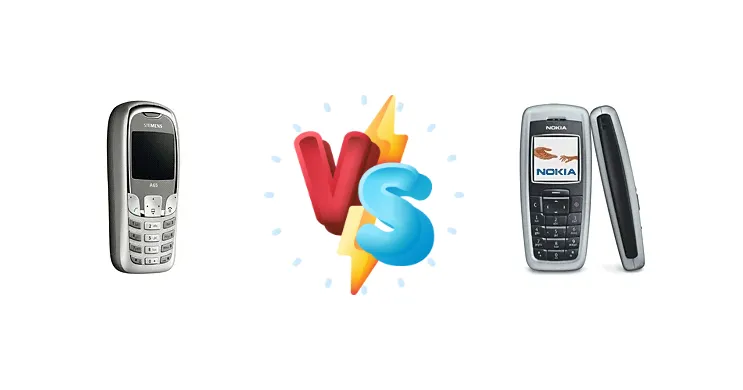
In an era dominated by smartphones, the Siemens A65 and Nokia 2600 represent a return to simplicity and reliability. Both phones emerged during a period where durability and long battery life were paramount. This comparison examines how these two devices stack up, focusing on build quality, user experience, and lasting appeal for those seeking a no-frills mobile experience.
🏆 Quick Verdict
For the user prioritizing sheer durability and a potentially longer lifespan due to Siemens' build reputation, the A65 is the slight winner. However, the Nokia 2600’s widespread availability of parts and established brand recognition for basic phones make it a strong contender, especially for cost-conscious buyers.
| Network |
|---|
| 2G bands | GSM 900 / 1800 / 1900 | GSM 900 / 1800 |
| EDGE | No | No |
| GPRS | Class 8 | - |
| Technology | GSM | GSM |
| | - | GSM 850 / 1900 - US version |
| Launch |
|---|
| Announced | 2004, July | 2004, Q2 |
| Status | Discontinued | Discontinued |
| Body |
|---|
| Dimensions | 101 x 45 x 19 mm, 72 cc (3.98 x 1.77 x 0.75 in) | 107 x 46 x 20 mm, 80 cc (4.21 x 1.81 x 0.79 in) |
| SIM | Mini-SIM | Mini-SIM |
| Weight | 75 g (2.65 oz) | 94 g (3.32 oz) |
| Display |
|---|
| Resolution | 101 x 80 pixels | 128 x 128 pixels, 1:1 ratio (~121 ppi density) |
| Size | - | 1.5 inches, 7.3 cm2 (~14.7% screen-to-body ratio) |
| Type | CSTN, 4096 colors | CSTN, 4096 colors |
| | Download assistant for logos | 4-way navi key
Screensavers |
| Memory |
|---|
| Call records | 10 dialed, 10 received, 10 missed calls | 10 dialed, 10 received, 10 missed calls |
| Card slot | No | No |
| Internal | 1.5MB | 4MB |
| Phonebook | 50 entries | 200 entries |
| Sound |
|---|
| 3.5mm jack | No | No |
| 35mm jack | No | No |
| Alert types | Vibration; Downloadable polyphonic ringtones | Vibration; Downloadable polyphonic, monophonic ringtones, composer |
| Loudspeaker | No | Yes |
| Comms |
|---|
| Bluetooth | No | No |
| Positioning | No | No |
| Radio | No | No |
| WLAN | No | No |
| Features |
|---|
| Browser | WAP 1.2.1 | - |
| Games | Stack Attack Jr, Wappo, Magic Picture + downloadable | 3 - Mobile Soccer, Bounce, Nature Park |
| Java | Yes, MIDP 2.0 | No |
| Languages | - | Major European and Asia-Pacific languages |
| Messaging | SMS, EMS, MMS | SMS, EMS |
| | Predictive text input
Currency converter
Calculator
Stopwatch
Reminder list
Optional digital camera | Predictive text input
Stopwatch
Organizer
Changeable front and back covers |
| Battery |
|---|
| Stand-by | Up to 260 h | Up to 250 h |
| Talk time | Up to 2 h | Up to 3 h 30 min |
| Type | Removable Li-Ion 700 mAh battery (EBA-510) | Removable Li-Ion 820 mAh battery (BR-5C) |
| Misc |
|---|
| Colors | Sparkling Silver and Mystery Silver | Iron blue, Tree green |
| SAR | - | 1.43 W/kg (head) 0.75 W/kg (body) |
| SAR EU | - | 0.85 W/kg (head) |
Siemens A65
- Potentially more robust build quality (Siemens reputation)
- Slightly more premium design aesthetic
- Potentially optimized chipset for smoother UI
- Parts availability may be limited
- Brand recognition less strong than Nokia
Nokia 2600
- Excellent parts availability and repairability
- Strong brand recognition and trust
- Optimized software for long battery life
- Build quality potentially less robust than Siemens
- Design may appear dated compared to some contemporaries
Display Comparison
Given the era, both the Siemens A65 and Nokia 2600 likely utilized monochrome LCD displays. The A65, positioned as a slightly more premium offering within Siemens’ range, may have featured a slightly higher resolution display, potentially offering marginally sharper text. However, the practical difference in viewing experience would be minimal for typical feature phone use – primarily making calls and reading SMS messages. Both displays would have prioritized power efficiency over brightness or color accuracy.
Camera Comparison
Neither the Siemens A65 nor the Nokia 2600 were marketed for their camera capabilities. If either device included a camera, it would have been a very low-resolution sensor (likely VGA or below) intended for basic image capture. Image quality would have been poor by modern standards, and the cameras were primarily a novelty feature rather than a core selling point. The absence of optical image stabilization (OIS) or advanced image processing algorithms is a given.
Performance
Performance, in the context of these phones, is dictated by the efficiency of the baseband processor and the responsiveness of the user interface. Siemens, known for its engineering prowess, likely implemented a more optimized chipset in the A65, potentially resulting in slightly faster menu navigation and call setup times. However, the Nokia 2600 benefited from Nokia’s economies of scale and highly refined software, ensuring a smooth and reliable user experience despite potentially less raw processing power. Both phones would have been limited by the available RAM, impacting multitasking capabilities (virtually non-existent).
Battery Life
Battery life was a key differentiator for feature phones. Both the A65 and 2600 would have offered several days of standby time and hours of talk time on a single charge. The Nokia 2600, benefiting from Nokia’s expertise in power management, likely achieved slightly longer battery life due to optimized software and potentially a more efficient battery chemistry. Charging times would have been slow by modern standards, requiring several hours to fully charge the battery via the proprietary charger.
Buying Guide
Buy the Siemens A65 if you need a phone known for robust construction and potentially better long-term reliability, even if finding parts proves challenging. Buy the Nokia 2600 if you prefer a widely available, easily repairable device with a strong reputation for basic functionality and affordability. The Nokia 2600 is ideal for emergency use or as a secondary device.
Frequently Asked Questions
❓ Is it possible to find replacement batteries for either the Siemens A65 or Nokia 2600 today?
Replacement batteries for the Nokia 2600 are readily available from various online retailers. Finding a replacement battery for the Siemens A65 will be significantly more challenging due to its age and limited production run. Sourcing a compatible battery may require specialized electronics suppliers or online auction sites.
❓ Which phone is easier to repair if the screen or keypad breaks?
The Nokia 2600 is considerably easier to repair. Nokia designed their feature phones for simple disassembly and repair, and replacement parts are widely available. The Siemens A65, while potentially more durable initially, is likely to be more difficult to disassemble and find replacement components for.
❓ Can either of these phones be used with modern mobile networks (3G/4G)?
Neither the Siemens A65 nor the Nokia 2600 support 3G or 4G networks. They are limited to 2G (GSM) connectivity. While 2G networks still exist in many parts of the world, their coverage is diminishing, and they may not be reliable for all users.