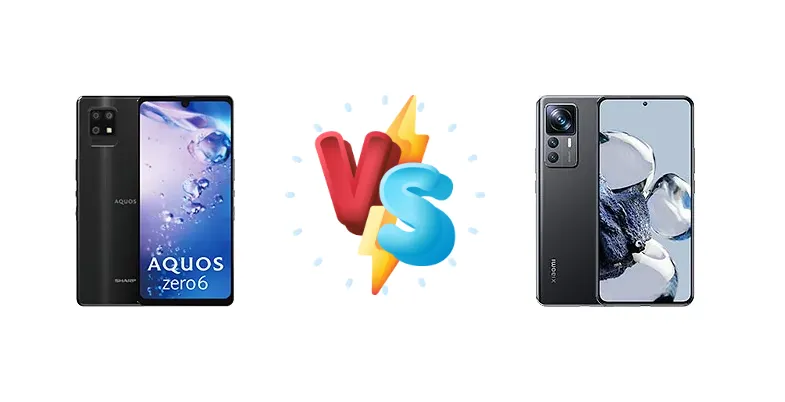
The Sharp Aquos zero6 and Xiaomi 12T Pro represent distinct approaches to the smartphone market. The Aquos zero6 aims for a balance of features and affordability, powered by the Snapdragon 750G. Conversely, the Xiaomi 12T Pro throws down the gauntlet with a flagship Snapdragon 8+ Gen 1, aiming for uncompromising performance. This comparison dissects their key differences to determine which device best suits your needs.
🏆 Quick Verdict
For most users, the Xiaomi 12T Pro is the superior choice. Its Snapdragon 8+ Gen 1 chipset delivers significantly faster performance, and the 120W charging is a game-changer. While the Aquos zero6 offers a more economical option, the performance gap is too substantial to ignore for power users.
| Network |
|---|
| 2G bands | GSM 850 / 900 / 1800 / 1900 | GSM 850 / 900 / 1800 / 1900 |
| 3G bands | HSDPA 900 / 2100 | HSDPA 800 / 850 / 900 / 1700(AWS) / 1900 / 2100 |
| 4G bands | 1, 3, 7, 8, 28, 38, 41 | 1, 2, 3, 4, 5, 7, 8, 12, 13, 17, 18, 19, 20, 25, 26, 28, 32, 38, 39, 40, 41, 42, 48, 66 |
| 5G bands | 1, 3, 28, 78, 257 SA/NSA/mmWave | 1, 3, 5, 7, 8, 20, 28, 38, 40, 41, 66, 77, 78, 75 SA/NSA |
| Speed | HSPA, LTE, 5G | HSPA, LTE, 5G |
| Technology | GSM / HSPA / LTE / 5G | GSM / HSPA / LTE / 5G |
| Launch |
|---|
| Announced | 2021, October 14. Released 2021, October 14 | 2022, October 04 |
| Status | Discontinued | Available. Released 2022, October 06 |
| Body |
|---|
| Dimensions | 158 x 73 x 7.9 mm (6.22 x 2.87 x 0.31 in) | 163.1 x 75.9 x 8.6 mm (6.42 x 2.99 x 0.34 in) |
| SIM | Nano-SIM + eSIM | · Nano-SIM + eSIM· Nano-SIM + Nano-SIM |
| Weight | 146 g (5.15 oz) | 205 g (7.23 oz) |
| | IPX5/IP6X/IPX8 water/dust resistant (up to 1.5m for 30 min) | IP53, dust and splash resistant |
| Display |
|---|
| Protection | Corning Gorilla Glass Victus | Corning Gorilla Glass 5 |
| Resolution | 1080 x 2340 pixels, 19.5:9 ratio (~403 ppi density) | 1220 x 2712 pixels, 20:9 ratio (~446 ppi density) |
| Size | 6.4 inches, 100.5 cm2 (~87.2% screen-to-body ratio) | 6.67 inches, 107.4 cm2 (~86.7% screen-to-body ratio) |
| Type | OLED, 1B colors, 240Hz | AMOLED, 68B colors, 120Hz, Dolby Vision, HDR10+, 500 nits (typ), 900 nits (peak) |
| Platform |
|---|
| CPU | Octa-core (2x2.2 GHz Kryo 570 & 6x1.8 GHz Kryo 570) | Octa-core (1x3.19 GHz Cortex-X2 & 3x2.75 GHz Cortex-A710 & 4x2.0 GHz Cortex-A510) |
| Chipset | Qualcomm SM7225 Snapdragon 750G 5G (8 nm) | Qualcomm SM8475 Snapdragon 8+ Gen 1 (4 nm) |
| GPU | Adreno 619 | Adreno 730 |
| OS | Android 11 | Android 12, upgradable to Android 14, HyperOS |
| Memory |
|---|
| Card slot | microSDXC | No |
| Internal | 128GB 8GB RAM | 128GB 8GB RAM, 256GB 8GB RAM, 256GB 12GB RAM |
| | - | UFS 3.1 |
| Main Camera |
|---|
| Features | LED flash, HDR, panorama | Color spectrum sensor, Dual-LED dual-tone flash, HDR, panorama |
| Triple | 48 MP, f/1.8, (wide), AF
8 MP, f/2.4, (telephoto), AF, 2x optical zoom
8 MP, f/2.4, 120˚ (ultrawide)
TOF 3D (depth) | 200 MP, f/1.7, (wide), 1/1.22", 0.64µm, PDAF, OIS
8 MP, f/2.2, 120˚ (ultrawide), 1/4.0", 1.12µm
2 MP (macro) |
| Video | 1080p@30fps | 8K@24fps, 4K@30/60fps, 1080p@30/60/120/240fps, HDR10+ |
| Selfie camera |
|---|
| Features | - | HDR, panorama |
| Single | 12.6 MP | 20 MP, f/2.2, (wide), 1/3.47", 0.8µm |
| Video | 1080p@30fps | 1080p@30/60fps, HDR |
| Sound |
|---|
| 3.5mm jack | Yes | No |
| 35mm jack | Yes | No |
| Loudspeaker | Yes | Yes, with stereo speakers |
| | - | Tuned by Harman Kardon
24-bit/192kHz audio |
| Comms |
|---|
| Bluetooth | 5.1, A2DP, LE | 5.2, A2DP, LE, aptX HD |
| Infrared port | - | Yes |
| NFC | Yes | Yes (market/region dependent) |
| Positioning | GPS, GLONASS, BDS, GALILEO, QZSS | GPS (L1+L5), GLONASS (L1), BDS (B1I+B1c+B2a), GALILEO (E1+E5a), QZSS (L1+L5), NavIC (L5) |
| Radio | No | No |
| USB | USB Type-C | USB Type-C 2.0, OTG |
| WLAN | Wi-Fi 802.11 a/b/g/n/ac, dual-band, Wi-Fi Direct | Wi-Fi 802.11 a/b/g/n/ac/6, dual-band, Wi-Fi Direct |
| Features |
|---|
| Sensors | Fingerprint (under display, optical), accelerometer | Fingerprint (under display, optical), accelerometer, gyro, proximity, compass |
| Battery |
|---|
| Charging | - | 120W wired, 100% in 19 min |
| Type | Li-Ion 4010 mAh | Li-Po 5000 mAh |
| Misc |
|---|
| Colors | Swan Black | Black, Silver, Blue |
| Models | - | 22081212UG, 22081212G |
| Price | About 400 EUR | $ 208.76 / € 167.62 |
| SAR | - | 1.08 W/kg (head) 1.07 W/kg (body) |
| SAR EU | - | 1.00 W/kg (head) 1.00 W/kg (body) |
| Tests |
|---|
| Battery life | - | Endurance rating 91h |
| Camera | - | Photo / Video |
| Display | - | Contrast ratio: Infinite (nominal) |
| Loudspeaker | - | -24.1 LUFS (Very good) |
| Performance | - | AnTuTu: 1032185 (v9)
GeekBench: 4081 (v5.1)
GFXBench: 65fps (ES 3.1 onscreen) |
Sharp Aquos zero6
- More affordable price point
- Potentially lighter and more compact design (speculation based on brand history)
- Decent battery endurance
- Significantly weaker performance compared to the 12T Pro
- Less detailed display specifications
- Slower charging speeds (assumed)
Xiaomi 12T Pro
- Flagship-level performance with Snapdragon 8+ Gen 1
- Ultra-fast 120W charging (0-100% in 19 minutes)
- Brighter and potentially more advanced display
- Higher price tag
- Potentially more heat generation under heavy load
- Larger size and weight (likely)
Display Comparison
The Xiaomi 12T Pro boasts a significantly brighter display, reaching a measured 913 nits, compared to an unspecified brightness for the Aquos zero6. While both displays have an 'infinite' contrast ratio (typical for OLED/AMOLED panels), the 12T Pro’s higher peak brightness translates to better visibility in direct sunlight. The Aquos zero6’s display specifications are less detailed, suggesting a more standard panel, potentially lacking features like LTPO for adaptive refresh rates found in higher-end Xiaomi models. This impacts power efficiency and smoothness.
Camera Comparison
Both devices offer photo and video capabilities, but details are limited. Without specific sensor sizes or aperture information for the Aquos zero6, it’s difficult to make a direct comparison. The Xiaomi 12T Pro likely benefits from the more powerful ISP (Image Signal Processor) within the Snapdragon 8+ Gen 1, enabling faster image processing and potentially better low-light performance. The absence of details regarding OIS (Optical Image Stabilization) on either device makes it hard to assess video stability. We can assume the 12T Pro will have a more sophisticated camera system overall, given its flagship positioning.
Performance
The core difference lies in the chipsets. The Xiaomi 12T Pro’s Snapdragon 8+ Gen 1 (4nm) is a generational leap ahead of the Aquos zero6’s Snapdragon 750G (8nm). The 8+ Gen 1 features a Cortex-X2 prime core clocked at 3.19 GHz, alongside Cortex-A710 and A510 cores, offering substantially higher CPU and GPU performance. The 750G’s Kryo 570 cores, while efficient, simply cannot compete. The 4nm process node of the 8+ Gen 1 also contributes to better thermal efficiency, minimizing throttling during sustained workloads. This means the 12T Pro will maintain higher performance for longer periods, crucial for gamers and power users.
Battery Life
Both phones achieve an endurance rating of 91 hours, suggesting similar real-world battery life despite the performance disparity. However, the Xiaomi 12T Pro’s 120W wired charging is a massive advantage, achieving a full charge in just 19 minutes. The Aquos zero6’s charging speed is not specified, but is almost certainly slower. This rapid charging capability significantly reduces downtime and provides a more convenient user experience. The efficiency gains from the 4nm process in the 12T Pro likely offset the higher power draw of the more powerful chipset.
Buying Guide
Buy the Sharp Aquos zero6 if you prioritize a more budget-friendly option and don't require top-tier gaming or demanding application performance. It's a solid choice for everyday tasks and media consumption. Buy the Xiaomi 12T Pro if you demand flagship-level speed, exceptional charging capabilities, and are willing to pay a premium for a smoother, more responsive experience, especially for gaming and content creation.
Frequently Asked Questions
❓ Is the Snapdragon 750G in the Aquos zero6 sufficient for playing demanding games like Genshin Impact?
While the Snapdragon 750G can run Genshin Impact, you'll likely need to lower graphics settings to achieve a smooth frame rate. It's not optimized for sustained high-performance gaming like the Snapdragon 8+ Gen 1 in the 12T Pro.
❓ How does the 120W charging of the Xiaomi 12T Pro affect battery health over the long term?
Xiaomi employs technologies to mitigate the potential impact of fast charging on battery health, such as optimized charging algorithms and temperature control. While all batteries degrade over time, the 120W charging doesn't necessarily accelerate this process significantly, and the convenience often outweighs the minor long-term effect.
❓ Does the Xiaomi 12T Pro get excessively hot during prolonged gaming sessions?
The Snapdragon 8+ Gen 1 is more efficient than previous generations, but it can still generate heat under sustained load. The 12T Pro incorporates cooling solutions, but some throttling may occur during extended gaming. However, it's generally well-managed and shouldn't lead to significant performance drops.