
Sharp Aquos zero6 vs Samsung Galaxy Note9: A Clash of Generations
| Phones Images | |||||
|---|---|---|---|---|---|
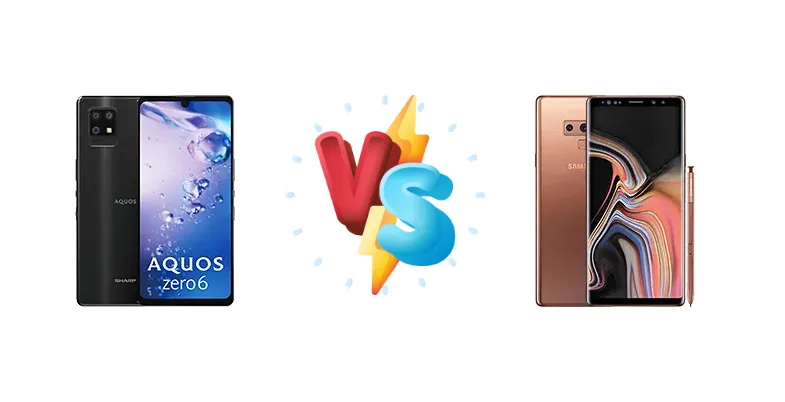
|
🏆 Quick Verdict
The Note9 boasts a more powerful chipset and a mature software experience, while the zero6 offers a more modern design and 5G connectivity. For raw power and S Pen functionality, the Note9 wins. However, if you prioritize a sleek design and future-proofing, the zero6 is a compelling choice.
| PHONES | ||
|---|---|---|
| Phone Names | Sharp Aquos zero6 | Samsung Galaxy Note9 |
| Network | ||
|---|---|---|
| 2G bands | GSM 850 / 900 / 1800 / 1900 | GSM 850 / 900 / 1800 / 1900 |
| 3G bands | HSDPA 900 / 2100 | HSDPA 850 / 900 / 1700(AWS) / 1900 / 2100 |
| 4G bands | 1, 3, 7, 8, 28, 38, 41 | 1, 2, 3, 4, 5, 7, 8, 12, 13, 17, 18, 19, 20, 25, 26, 28, 32, 38, 39, 40, 41, 66, 71 - Global |
| 5G bands | 1, 3, 28, 78, 257 SA/NSA/mmWave | - |
| Speed | HSPA, LTE, 5G | HSPA 42.2/5.76 Mbps, LTE (5CA) Cat18 1200/200 Mbps |
| Technology | GSM / HSPA / LTE / 5G | GSM / CDMA / HSPA / EVDO / LTE |
| - | 1, 2, 3, 4, 5, 7, 8, 12, 13, 14, 17, 18, 19, 20, 25, 26, 28, 29, 30, 38, 39, 40, 41, 46, 66, 71 - USA | |
| Launch | ||
|---|---|---|
| Announced | 2021, October 14. Released 2021, October 14 | 2018, August 09. Released 2018, August 24 |
| Status | Discontinued | Discontinued |
| Body | ||
|---|---|---|
| Build | - | Glass front (Gorilla Glass 5), glass back (Gorilla Glass 5), aluminum frame |
| Dimensions | 158 x 73 x 7.9 mm (6.22 x 2.87 x 0.31 in) | 161.9 x 76.4 x 8.8 mm (6.37 x 3.01 x 0.35 in) |
| SIM | Nano-SIM + eSIM | · Nano-SIM· Nano-SIM + Nano-SIM |
| Weight | 146 g (5.15 oz) | 201 g (7.09 oz) |
| IPX5/IP6X/IPX8 water/dust resistant (up to 1.5m for 30 min) | IP68 dust/water resistant (up to 1.5m for 30 min) Stylus (Bluetooth integration) | |
| Display | ||
|---|---|---|
| Protection | Corning Gorilla Glass Victus | Corning Gorilla Glass 5 |
| Resolution | 1080 x 2340 pixels, 19.5:9 ratio (~403 ppi density) | 1440 x 2960 pixels, 18.5:9 ratio (~516 ppi density) |
| Size | 6.4 inches, 100.5 cm2 (~87.2% screen-to-body ratio) | 6.4 inches, 103.2 cm2 (~83.4% screen-to-body ratio) |
| Type | OLED, 1B colors, 240Hz | Super AMOLED, HDR10 |
| - | Always-on display | |
| Platform | ||
|---|---|---|
| CPU | Octa-core (2x2.2 GHz Kryo 570 & 6x1.8 GHz Kryo 570) | Octa-core (4x2.7 GHz Mongoose M3 & 4x1.8 GHz Cortex-A55) - EMEAOcta-core (4x2.8 GHz Kryo 385 Gold & 4x1.7 GHz Kryo 385 Silver) - USA/LATAM, China |
| Chipset | Qualcomm SM7225 Snapdragon 750G 5G (8 nm) | Exynos 9810 (10 nm) - EMEAQualcomm SDM845 Snapdragon 845 (10 nm) - USA/LATAM, China |
| GPU | Adreno 619 | Mali-G72 MP18 - EMEAAdreno 630 - USA/LATAM, China |
| OS | Android 11 | Android 8.1 (Oreo), upgradable to Android 10, One UI 2.5 |
| Memory | ||
|---|---|---|
| Card slot | microSDXC | microSDXC (uses shared SIM slot) |
| Internal | 128GB 8GB RAM | 128GB 6GB RAM, 128GB 8GB RAM, 512GB 8GB RAM |
| - | UFS 2.1 | |
| Main Camera | ||
|---|---|---|
| Dual | - | 12 MP, f/1.5-2.4, 26mm (wide), 1/2.55", 1.4µm, dual pixel PDAF, OIS 12 MP, f/2.4, 52mm (telephoto), 1/3.4", 1.0µm, AF, OIS, 2x optical zoom |
| Features | LED flash, HDR, panorama | LED flash, auto-HDR, panorama |
| Triple | 48 MP, f/1.8, (wide), AF 8 MP, f/2.4, (telephoto), AF, 2x optical zoom 8 MP, f/2.4, 120˚ (ultrawide) TOF 3D (depth) | - |
| Video | 1080p@30fps | 4K@60fps (no OIS/EIS), 4K@30fps, 1080p@30/60/240fps, 720p@960fps, HDR, stereo sound rec., gyro-EIS & OIS |
| Selfie camera | ||
|---|---|---|
| Dual | - | 8 MP, f/1.7, 25mm (wide), 1/3.6", 1.22µm, AF 2 MP (dedicated iris scanner camera) |
| Features | - | HDR |
| Single | 12.6 MP | - |
| Video | 1080p@30fps | 1440p@30fps |
| Sound | ||
|---|---|---|
| 3.5mm jack | Yes | Yes |
| 35mm jack | Yes | Yes |
| Loudspeaker | Yes | Yes, with stereo speakers |
| - | 32-bit/384kHz audio | |
| Comms | ||
|---|---|---|
| Bluetooth | 5.1, A2DP, LE | 5.0, A2DP, LE, aptX |
| NFC | Yes | Yes |
| Positioning | GPS, GLONASS, BDS, GALILEO, QZSS | GPS, GLONASS, BDS, GALILEO |
| Radio | No | No |
| USB | USB Type-C | USB Type-C 3.1 |
| WLAN | Wi-Fi 802.11 a/b/g/n/ac, dual-band, Wi-Fi Direct | Wi-Fi 802.11 a/b/g/n/ac, dual-band, Wi-Fi Direct |
| Features | ||
|---|---|---|
| Sensors | Fingerprint (under display, optical), accelerometer | Iris scanner, fingerprint (rear-mounted), accelerometer, gyro, proximity, compass, barometer, heart rate, SpO2 |
| - | Samsung DeX (desktop experience support) ANT+ Bixby natural language commands and dictation Samsung Pay (Visa, MasterCard certified) | |
| Battery | ||
|---|---|---|
| Charging | - | 15W wired Wireless (Qi) (market dependent) |
| Type | Li-Ion 4010 mAh | Li-Ion 4000 mAh, non-removable |
| Misc | ||
|---|---|---|
| Colors | Swan Black | Metallic Copper, Lavender Purple, Ocean Blue, Midnight Black, Pure White, Alpine White |
| Models | - | SM-N960F, SM-N9600, SM-N960F, SM-N960U, SM-N960U1, SM-N960N, SM-N960W, SM-N960X, SCV40 |
| Price | About 400 EUR | About 430 EUR |
| SAR | - | 1.29 W/kg (head) 1.03 W/kg (body) |
| SAR EU | - | 0.38 W/kg (head) 1.51 W/kg (body) |
| Tests | ||
|---|---|---|
| Audio quality | - | Noise -93.7dB / Crosstalk -94.1dB |
| Battery life | - | Endurance rating 97h |
| Camera | - | Photo / Video |
| Display | - | Contrast ratio: Infinite (nominal), 4.531 (sunlight) |
| Loudspeaker | - | Voice 71dB / Noise 74dB / Ring 80dB |
| Performance | - | AnTuTu: 248823 (v7), 315447 (v8) GeekBench: 9026 (v4.4), 2092 (v5.1) GFXBench: 15fps (ES 3.1 onscreen) |
Sharp Aquos zero6
- Modern Design
- 5G Connectivity
- Vibrant OLED Display
- Potentially Higher Refresh Rate Display
- Less Powerful Chipset
- Camera Performance Unknown
- Slower Charging
- Limited Availability
Samsung Galaxy Note9
- Powerful Processor (Snapdragon 845 or Exynos 9810)
- S Pen Stylus
- Mature Software
- Excellent Camera
- Long Battery Life
- Older Design
- No 5G
- Slower Charging
- Outdated Software Updates
Display Comparison
The Aquos zero6 features a vibrant OLED display, likely with a high refresh rate (spec sheet doesn't confirm, but typical for the series), offering excellent color accuracy and contrast. The Note9's Super AMOLED display is also fantastic, known for its vivid colors and deep blacks. Both offer excellent sunlight visibility with a reported contrast ratio of 4.531. The zero6 likely has a slightly more modern panel, but the Note9's display remains top-tier.
Camera Comparison
Camera performance is a complex area. The Note9's camera is well-regarded, offering versatile shooting options and good image quality. The Aquos zero6's camera is likely competent, but likely won't match the Note9's overall capabilities, especially in low light. Specific camera specs are missing for the zero6, making a direct comparison difficult.
Performance
The Note9, depending on region, has either the Snapdragon 845 or Exynos 9810, both significantly more powerful than the Snapdragon 750G in the zero6. While the zero6's CPU is adequate for everyday tasks, the Note9 handles demanding games and multitasking with greater ease. The Note9's RAM (typically 6GB or 8GB) also gives it an edge.
Battery Life
Both phones boast impressive battery life, with the Note9 claiming an endurance rating of 97 hours. The zero6's battery capacity is likely smaller, but its efficient chipset should still provide all-day usage. Charging speeds are slower on the Note9 (15W wired) compared to modern standards.
Buying Guide
Who should buy the Sharp Aquos zero6? Users seeking a stylish, 5G-enabled phone with a good display and decent performance at a mid-range price. Who should buy the Samsung Galaxy Note9? Users who value raw power, the S Pen stylus, and a proven software ecosystem, even if it means sacrificing some modern features.