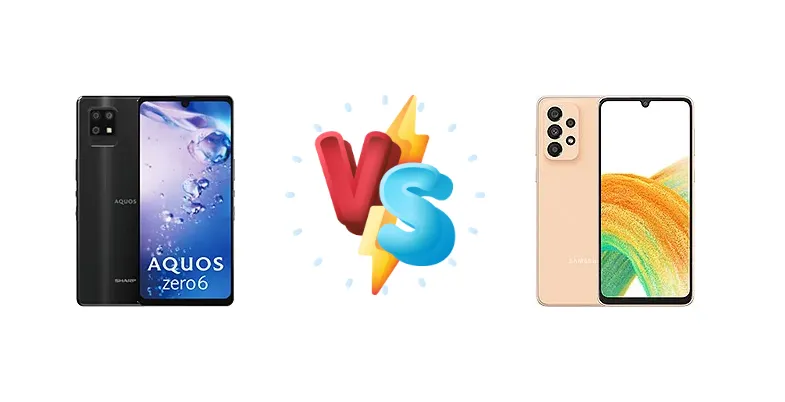
The smartphone market is overflowing with options, making it tough to choose. Today, we're pitting two compelling mid-range 5G phones against each other: the Sharp Aquos zero6 and the Samsung Galaxy A33 5G. Let's dive into a detailed comparison to see which one comes out on top.
🏆 Quick Verdict
The Samsung Galaxy A33 5G offers a more well-rounded package with its vibrant display, reliable performance, and strong software support. While the Aquos zero6 boasts a unique design and potentially better audio, the A33's broader appeal and Samsung's ecosystem make it the slightly better choice for most users.
| Network |
|---|
| 2G bands | GSM 850 / 900 / 1800 / 1900 | GSM 850 / 900 / 1800 / 1900 |
| 3G bands | HSDPA 900 / 2100 | HSDPA 850 / 900 / 1700(AWS) / 1900 / 2100 |
| 4G bands | 1, 3, 7, 8, 28, 38, 41 | 1, 2, 3, 4, 5, 7, 8, 12, 17, 20, 26, 28, 32, 38, 40, 41, 66 |
| 5G bands | 1, 3, 28, 78, 257 SA/NSA/mmWave | 1, 3, 5, 7, 8, 20, 28, 38, 40, 41, 66, 78 SA/NSA/Sub6 |
| Speed | HSPA, LTE, 5G | HSPA, LTE, 5G |
| Technology | GSM / HSPA / LTE / 5G | GSM / HSPA / LTE / 5G |
| Launch |
|---|
| Announced | 2021, October 14. Released 2021, October 14 | 2022, March 17 |
| Status | Discontinued | Available. Released 2022, April 20 |
| Body |
|---|
| Build | - | Glass front (Gorilla Glass 5), plastic frame, plastic back |
| Dimensions | 158 x 73 x 7.9 mm (6.22 x 2.87 x 0.31 in) | 159.7 x 74 x 8.1 mm (6.29 x 2.91 x 0.32 in) |
| SIM | Nano-SIM + eSIM | · Nano-SIM· Nano-SIM + Nano-SIM |
| Weight | 146 g (5.15 oz) | 186 g (6.56 oz) |
| | IPX5/IP6X/IPX8 water/dust resistant (up to 1.5m for 30 min) | IP67 dust/water resistant (up to 1m for 30 min) |
| Display |
|---|
| Protection | Corning Gorilla Glass Victus | Corning Gorilla Glass 5 |
| Resolution | 1080 x 2340 pixels, 19.5:9 ratio (~403 ppi density) | 1080 x 2400 pixels, 20:9 ratio (~411 ppi density) |
| Size | 6.4 inches, 100.5 cm2 (~87.2% screen-to-body ratio) | 6.4 inches, 98.9 cm2 (~83.7% screen-to-body ratio) |
| Type | OLED, 1B colors, 240Hz | Super AMOLED, 90Hz |
| Platform |
|---|
| CPU | Octa-core (2x2.2 GHz Kryo 570 & 6x1.8 GHz Kryo 570) | Octa-core (2x2.4 GHz Cortex-A78 & 6x2.0 GHz Cortex-A55) |
| Chipset | Qualcomm SM7225 Snapdragon 750G 5G (8 nm) | Exynos 1280 (5 nm) |
| GPU | Adreno 619 | Mali-G68 |
| OS | Android 11 | Android 12, up to 4 major Android upgrades, One UI 8 |
| Memory |
|---|
| Card slot | microSDXC | microSDXC (uses shared SIM slot) |
| Internal | 128GB 8GB RAM | 128GB 4GB RAM, 128GB 6GB RAM, 128GB 8GB RAM, 256GB 8GB RAM |
| Main Camera |
|---|
| Features | LED flash, HDR, panorama | LED flash, panorama, HDR |
| Quad | - | 48 MP, f/1.8, 26mm (wide), 1/2.0", 0.8µm, PDAF, OIS
8 MP, f/2.2, 123˚, (ultrawide), 1/4.0", 1.12µm
5 MP (macro)
Auxiliary lens |
| Single | - | 13 MP, f/2.2, (wide), 1/3.1", 1.12µm |
| Triple | 48 MP, f/1.8, (wide), AF
8 MP, f/2.4, (telephoto), AF, 2x optical zoom
8 MP, f/2.4, 120˚ (ultrawide)
TOF 3D (depth) | - |
| Video | 1080p@30fps | 4K@30fps, 1080p@30/60fps |
| Selfie camera |
|---|
| Single | 12.6 MP | 13 MP, f/2.2, (wide), 1/3.1", 1.12µm |
| Video | 1080p@30fps | 4K@30fps, 1080p@30fps |
| Sound |
|---|
| 3.5mm jack | Yes | No |
| 35mm jack | Yes | No |
| Loudspeaker | Yes | Yes, with stereo speakers |
| Comms |
|---|
| Bluetooth | 5.1, A2DP, LE | 5.1, A2DP, LE |
| NFC | Yes | Yes (market/region dependent) |
| Positioning | GPS, GLONASS, BDS, GALILEO, QZSS | GPS, GLONASS, GALILEO, BDS |
| Radio | No | No |
| USB | USB Type-C | USB Type-C 2.0, OTG |
| WLAN | Wi-Fi 802.11 a/b/g/n/ac, dual-band, Wi-Fi Direct | Wi-Fi 802.11 a/b/g/n/ac, dual-band, Wi-Fi Direct |
| Features |
|---|
| Sensors | Fingerprint (under display, optical), accelerometer | Fingerprint (under display, optical), accelerometer, gyro, compass |
| | - | Virtual proximity sensing |
| Battery |
|---|
| Charging | - | 25W wired |
| Type | Li-Ion 4010 mAh | Li-Po 5000 mAh |
| Misc |
|---|
| Colors | Swan Black | Black, White, Blue, Peach |
| Models | - | SM-A336E, SM-A336B, SM-A336B/DS, SM-A336B/DSN, SM-A336E/DS, SM-A336M, SM-A3360 |
| Price | About 400 EUR | £ 174.99 / € 187.50 / ₹ 21,999 |
| SAR | - | 0.35 W/kg (head) |
| SAR EU | - | 0.57 W/kg (head) 1.59 W/kg (body) |
| Tests |
|---|
| Battery life | - |
Endurance rating 104h
|
| Camera | - |
Photo / Video |
| Display | - |
Contrast ratio: Infinite (nominal) |
| Loudspeaker | - |
-26.5 LUFS (Good)
|
| Performance | - |
AnTuTu: 354420 (v8), 394918 (v9)
GeekBench: 1900 (v5.1)
GFXBench: 20fps (ES 3.1 onscreen) |
Sharp Aquos zero6
- Unique minimalist design
- Potentially superior audio quality
- Compact size
- Japanese smartphone experience
- Less powerful chipset
- Limited availability outside Japan
- Unknown charging speed
- Potentially less versatile camera
Samsung Galaxy A33 5G
- Vibrant and bright display
- Strong performance with Exynos 1280
- Excellent battery life
- Samsung's software and ecosystem
- Good camera capabilities
- Design can be considered generic
- 25W charging is relatively slow
- Plastic build
Display Comparison
Both phones feature vibrant displays, but the Galaxy A33 5G's 728 nits max brightness gives it an edge in outdoor visibility. The A33's 'infinite' contrast ratio (nominal) suggests excellent blacks and vibrant colors, while the Aquos zero6's display, though likely good, lacks specific brightness figures. The A33 also likely has a higher resolution panel.
Camera Comparison
Camera performance is difficult to definitively assess without detailed testing. However, Samsung's camera software and processing are generally considered strong. The A33 likely offers more versatile camera features and potentially better low-light performance. The Aquos zero6's camera is likely competent but may lack the advanced features of the A33.
Performance
The Exynos 1280 in the Galaxy A33 5G, built on a 5nm process, generally outperforms the Snapdragon 750G (8nm) in the Aquos zero6. The Cortex-A78 cores in the A33 offer a significant performance boost over the Kryo 570 cores in the Aquos. Expect smoother multitasking and gaming on the A33.
Battery Life
Both phones boast impressive endurance ratings of 104h. This suggests excellent battery life for both devices, easily lasting a full day or more for most users. The A33's 25W wired charging is standard, while the Aquos zero6's charging speed is unknown, potentially being slower.
Buying Guide
The Sharp Aquos zero6 is ideal for users prioritizing a minimalist design, potentially superior audio quality (though this is speculative without detailed testing), and a unique Japanese smartphone experience. The Samsung Galaxy A33 5G is a great choice for those seeking a dependable, feature-rich phone with a vibrant display, long battery life, and the benefits of Samsung's software and ecosystem.
Frequently Asked Questions
❓ Is the Sharp Aquos zero6 available outside of Japan?
Availability is limited. It's primarily sold in Japan and may require importing, which can be costly and complex.
❓ Which phone has better software support?
Samsung generally provides longer software update support than Sharp, making the Galaxy A33 5G a more future-proof choice.