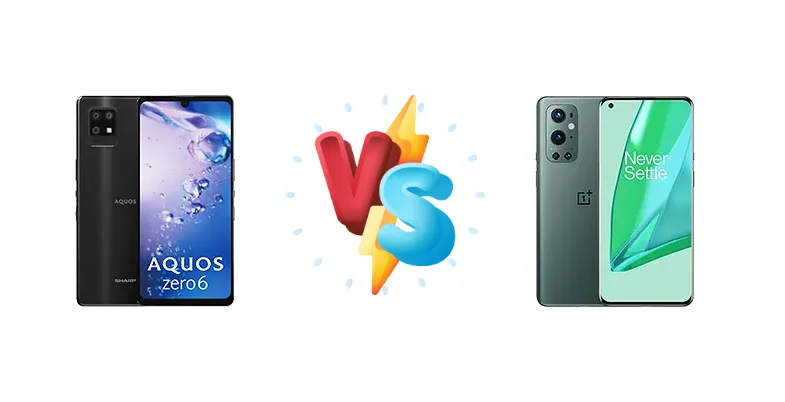
The smartphone landscape is increasingly segmented. The Sharp Aquos zero6 represents a compelling mid-range option aiming for flagship features at a lower price point, while the OnePlus 9 Pro, though now older, remains a potent flagship contender. This comparison dissects the key differences between the Snapdragon 750G-powered Aquos zero6 and the Snapdragon 888-equipped OnePlus 9 Pro, focusing on performance, camera capabilities, and battery life.
🏆 Quick Verdict
For the average user prioritizing raw performance and fast charging, the OnePlus 9 Pro is the clear winner. Its Snapdragon 888 chipset delivers significantly more processing power. However, the Aquos zero6 offers a compelling value proposition for those seeking a capable 5G device without the flagship price tag.
| Network |
|---|
| 2G bands | GSM 850 / 900 / 1800 / 1900 | GSM 850 / 900 / 1800 / 1900 |
| 3G bands | HSDPA 900 / 2100 | HSDPA 800 / 850 / 900 / 1700(AWS) / 1800 / 1900 / 2100 |
| 4G bands | 1, 3, 7, 8, 28, 38, 41 | 1, 2, 3, 4, 5, 7, 8, 12, 13, 17, 18, 19, 20, 25, 26, 28, 32, 38, 39, 40, 41, 66 - EU |
| 5G bands | 1, 3, 28, 78, 257 SA/NSA/mmWave | 1, 3, 5, 7, 8, 20, 28, 38, 40, 41, 66, 78 SA/NSA - EU |
| Speed | HSPA, LTE, 5G | HSPA 42.2/5.76 Mbps, LTE Cat20 2000/200 Mbps, 5G |
| Technology | GSM / HSPA / LTE / 5G | GSM / CDMA / HSPA / LTE / 5G |
| | - | 1, 3, 28, 41, 78, 79 SA/NSA - CN |
| Launch |
|---|
| Announced | 2021, October 14. Released 2021, October 14 | 2021, March 23 |
| Status | Discontinued | Available. Released 2021, March 30 |
| Body |
|---|
| Build | - | Glass front (Gorilla Glass 5), glass back (Gorilla Glass 5), aluminum frame |
| Dimensions | 158 x 73 x 7.9 mm (6.22 x 2.87 x 0.31 in) | 163.2 x 73.6 x 8.7 mm (6.43 x 2.90 x 0.34 in) |
| SIM | Nano-SIM + eSIM | · Nano-SIM· Nano-SIM + Nano-SIM |
| Weight | 146 g (5.15 oz) | 197 g (6.95 oz) |
| | IPX5/IP6X/IPX8 water/dust resistant (up to 1.5m for 30 min) | IP68 dust/water resistant (up to 1.5m for 30 min) |
| Display |
|---|
| Protection | Corning Gorilla Glass Victus | Corning Gorilla Glass 5 |
| Resolution | 1080 x 2340 pixels, 19.5:9 ratio (~403 ppi density) | 1440 x 3216 pixels, 20:9 ratio (~525 ppi density) |
| Size | 6.4 inches, 100.5 cm2 (~87.2% screen-to-body ratio) | 6.7 inches, 108.4 cm2 (~90.3% screen-to-body ratio) |
| Type | OLED, 1B colors, 240Hz | LTPO Fluid2 AMOLED, 1B colors, 120Hz, HDR10+, 1300 nits (peak) |
| | - | Always-on display |
| Platform |
|---|
| CPU | Octa-core (2x2.2 GHz Kryo 570 & 6x1.8 GHz Kryo 570) | Octa-core (1x2.84 GHz Cortex-X1 & 3x2.42 GHz Cortex-A78 & 4x1.80 GHz Cortex-A55 |
| Chipset | Qualcomm SM7225 Snapdragon 750G 5G (8 nm) | Qualcomm SM8350 Snapdragon 888 5G (5 nm) |
| GPU | Adreno 619 | Adreno 660 |
| OS | Android 11 | Android 11, upgradable to Android 14, OxygenOS 14 |
| Memory |
|---|
| Card slot | microSDXC | No |
| Internal | 128GB 8GB RAM | 128GB 8GB RAM, 256GB 8GB RAM, 256GB 12GB RAM |
| | - | UFS 3.1 |
| Main Camera |
|---|
| Features | LED flash, HDR, panorama | Laser AF, color spectrum sensor, Hasselblad Color Calibration, dual-LED flash, HDR, panorama |
| Quad | - | 48 MP, f/1.8, 23mm (wide), 1/1.43", 1.12µm, multi-directional PDAF, OIS
8 MP, f/2.4, 77mm (telephoto), 1.0µm, PDAF, OIS, 3.3x optical zoom
50 MP, f/2.2, 14mm (ultrawide), 1/1.56", 1.0µm, AF
2 MP, f/2.4, (monochrome) |
| Single | - | 16 MP, f/2.4, (wide), 1/3.06", 1.0µm |
| Triple | 48 MP, f/1.8, (wide), AF
8 MP, f/2.4, (telephoto), AF, 2x optical zoom
8 MP, f/2.4, 120˚ (ultrawide)
TOF 3D (depth) | - |
| Video | 1080p@30fps | 8K@30fps, 4K@30/60/120fps, 1080p@30/60/240fps, Auto HDR, gyro-EIS |
| Selfie camera |
|---|
| Features | - | HDR |
| Single | 12.6 MP | 16 MP, f/2.4, (wide), 1/3.06", 1.0µm |
| Video | 1080p@30fps | 1080p@30fps, gyro-EIS |
| Sound |
|---|
| 3.5mm jack | Yes | No |
| 35mm jack | Yes | No |
| Loudspeaker | Yes | Yes, with stereo speakers |
| | - | 24-bit/192kHz audio |
| Comms |
|---|
| Bluetooth | 5.1, A2DP, LE | 5.2, A2DP, LE, aptX HD |
| NFC | Yes | Yes |
| Positioning | GPS, GLONASS, BDS, GALILEO, QZSS | GPS (L1+L5), GLONASS (G1), BDS (B1), GALILEO (E1+E5a) |
| Radio | No | No |
| USB | USB Type-C | USB Type-C 3.1, OTG |
| WLAN | Wi-Fi 802.11 a/b/g/n/ac, dual-band, Wi-Fi Direct | Wi-Fi 802.11 a/b/g/n/ac/6, dual-band, Wi-Fi Direct, DLNA |
| Features |
|---|
| Sensors | Fingerprint (under display, optical), accelerometer | Fingerprint (under display, optical), accelerometer, gyro, proximity, compass |
| Battery |
|---|
| Charging | - | 65W wired, PD, 100% in 29 min
50W wireless, 100% in 43 min
5W reverse wireless |
| Type | Li-Ion 4010 mAh | Li-Po 4500 mAh |
| Misc |
|---|
| Colors | Swan Black | Morning Mist, Forest Green, Stellar Black |
| Models | - | LE2121, LE2125, LE2123, LE2120, LE2127 |
| Price | About 400 EUR | € 246.17 / $ 264.95 / £ 287.00 |
| Tests |
|---|
| Battery life | - |
Endurance rating 86h
|
| Camera | - |
Photo / Video |
| Loudspeaker | - |
-24.1 LUFS (Very good)
|
Sharp Aquos zero6
- More affordable price point
- Decent 5G connectivity with Snapdragon 750G
- Potentially lighter and more compact design (speculation based on market positioning)
- Significantly lower processing power compared to Snapdragon 888
- Likely less advanced camera system
- Slower charging speeds (estimated)
OnePlus 9 Pro
- Superior performance with Snapdragon 888
- Faster charging (65W wired, 50W wireless)
- More advanced camera system with Hasselblad partnership
- Higher price point
- Potentially larger and heavier design
- May experience more thermal throttling under sustained load (though mitigated by 5nm process)
Display Comparison
The OnePlus 9 Pro boasts a measured peak brightness of 859 nits, suggesting a more visible display in direct sunlight compared to the Aquos zero6 (brightness data unavailable). While both likely utilize OLED panels, the OnePlus 9 Pro’s flagship status suggests a higher-quality panel with potentially better color accuracy and wider color gamut coverage. The Aquos zero6’s display specifications are less detailed, making a direct comparison challenging, but it likely targets a balance between visual fidelity and cost.
Camera Comparison
Both phones feature capable camera systems, but the OnePlus 9 Pro likely holds an advantage due to its flagship positioning. While both are listed as having Photo/Video capabilities, the OnePlus 9 Pro benefits from a more sophisticated image signal processor (ISP) within the Snapdragon 888, enabling better noise reduction, dynamic range, and overall image quality. Sensor size and lens apertures are unknown for the Aquos zero6, but the OnePlus 9 Pro’s camera system, developed in partnership with Hasselblad, is known for its color science and detail capture. The Aquos zero6 likely focuses on providing a versatile camera experience, while the OnePlus 9 Pro aims for professional-grade results.
Performance
The core difference lies in the chipsets. The OnePlus 9 Pro’s Snapdragon 888 (5nm) is a significant leap over the Aquos zero6’s Snapdragon 750G (8nm). The 888 features a Cortex-X1 prime core clocked at 2.84 GHz, offering substantially higher single-core performance crucial for responsive UI and demanding applications. The 750G’s Kryo 570 cores, while efficient, cannot match the 888’s processing prowess. This translates to smoother multitasking, faster app loading times, and superior gaming performance on the OnePlus 9 Pro. The 5nm process node of the 888 also contributes to better thermal efficiency, reducing throttling during sustained workloads.
Battery Life
Both devices achieve an endurance rating of 86 hours, suggesting similar overall battery life despite the OnePlus 9 Pro’s more powerful chipset. This is likely due to optimizations in software and battery management. However, the OnePlus 9 Pro significantly outpaces the Aquos zero6 in charging speed, offering 65W wired charging (100% in 29 minutes) and 50W wireless charging (100% in 43 minutes), alongside 5W reverse wireless charging. The Aquos zero6’s charging specifications are unavailable, but it’s unlikely to match the OnePlus 9 Pro’s rapid charging capabilities.
Buying Guide
Buy the Sharp Aquos zero6 if you need a reliable 5G smartphone with decent performance for everyday tasks and moderate gaming, and prioritize value for money. Buy the OnePlus 9 Pro if you demand top-tier performance for demanding games and applications, require exceptionally fast charging (65W wired, 50W wireless), and value a more refined camera experience.
Frequently Asked Questions
❓ Is the Snapdragon 750G in the Aquos zero6 sufficient for playing demanding games like Genshin Impact?
While the Snapdragon 750G can handle Genshin Impact, you'll likely need to lower graphics settings to achieve a consistently smooth frame rate. The OnePlus 9 Pro’s Snapdragon 888 will provide a significantly better gaming experience with higher settings and more stable performance.
❓ How does the OnePlus 9 Pro’s charging speed compare to other flagship phones?
The OnePlus 9 Pro’s 65W wired charging is among the fastest available, rivaling only brands like Xiaomi and Oppo. It’s considerably faster than Samsung’s 25W charging and Apple’s slower charging speeds. The 50W wireless charging is also exceptionally fast, exceeding most competitors.
❓ Does the Aquos zero6 support carrier aggregation for faster 5G speeds?
The Snapdragon 750G does support 5G carrier aggregation, but the specific bands and capabilities will depend on the carrier and region. Check with your mobile provider to confirm compatibility and supported 5G features.
❓ What kind of software updates can I expect on the Aquos zero6?
Sharp’s software update track record is less consistent than OnePlus. While the Aquos zero6 will likely receive security updates, major Android version updates may be less frequent or delayed compared to the OnePlus 9 Pro, which benefits from OnePlus’s commitment to software support.