
Sharp Aquos zero6 vs Google Pixel 4: A Head-to-Head Showdown
| Phones Images | |||||
|---|---|---|---|---|---|
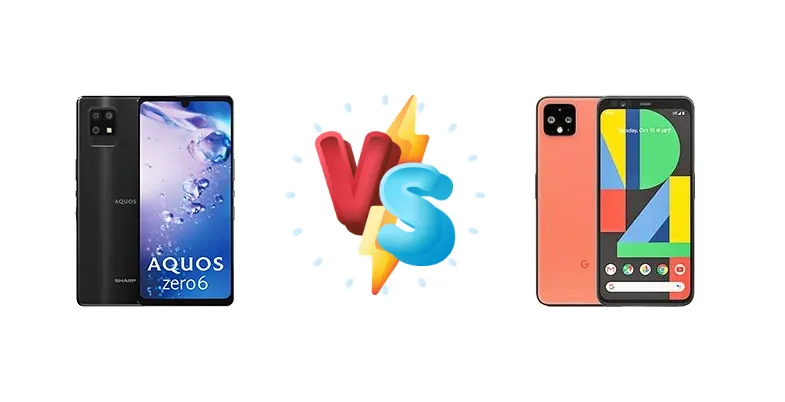
|
🏆 Quick Verdict
The Google Pixel 4 wins overall thanks to its superior chipset, camera processing, and software experience. While the Aquos zero6 boasts a beautiful design and potentially better battery life, the Pixel 4's performance and camera consistently deliver a premium experience.
| PHONES | ||
|---|---|---|
| Phone Names | Sharp Aquos zero6 | Google Pixel 4 |
| Network | ||
|---|---|---|
| 2G bands | GSM 850 / 900 / 1800 / 1900 | GSM 850 / 900 / 1800 / 1900 |
| 3G bands | HSDPA 900 / 2100 | HSDPA 850 / 900 / 1700(AWS) / 1900 / 2100 |
| 4G bands | 1, 3, 7, 8, 28, 38, 41 | 1, 2, 3, 4, 5, 7, 8, 12, 13, 17, 20, 25, 26, 28, 32, 38, 39, 40, 41, 66, 71 - Global |
| 5G bands | 1, 3, 28, 78, 257 SA/NSA/mmWave | - |
| Speed | HSPA, LTE, 5G | HSPA 42.2/5.76 Mbps, LTE (5CA) Cat18 1200/150 Mbps |
| Technology | GSM / HSPA / LTE / 5G | GSM / CDMA / HSPA / EVDO / LTE |
| - | 1, 2, 3, 4, 5, 7, 8, 12, 13, 14, 17, 18, 19, 20, 25, 26, 28, 29, 30, 38, 39, 40, 41, 46, 48, 66, 71 - USA | |
| Launch | ||
|---|---|---|
| Announced | 2021, October 14. Released 2021, October 14 | 2019, October 15 |
| Status | Discontinued | Available. Released 2019, October 22 |
| Body | ||
|---|---|---|
| Build | - | Glass front (Gorilla Glass 5), glass back (Gorilla Glass 5), aluminum frame |
| Dimensions | 158 x 73 x 7.9 mm (6.22 x 2.87 x 0.31 in) | 147.1 x 68.8 x 8.2 mm (5.79 x 2.71 x 0.32 in) |
| SIM | Nano-SIM + eSIM | Nano-SIM + eSIM |
| Weight | 146 g (5.15 oz) | 162 g (5.71 oz) |
| IPX5/IP6X/IPX8 water/dust resistant (up to 1.5m for 30 min) | IP68 dust/water resistant (up to 1.5m for 30 min) | |
| Display | ||
|---|---|---|
| Protection | Corning Gorilla Glass Victus | Corning Gorilla Glass 5 |
| Resolution | 1080 x 2340 pixels, 19.5:9 ratio (~403 ppi density) | 1080 x 2280 pixels, 19:9 ratio (~444 ppi density) |
| Size | 6.4 inches, 100.5 cm2 (~87.2% screen-to-body ratio) | 5.7 inches, 80.7 cm2 (~79.8% screen-to-body ratio) |
| Type | OLED, 1B colors, 240Hz | P-OLED, 90Hz, HDR |
| - | Always-on display | |
| Platform | ||
|---|---|---|
| CPU | Octa-core (2x2.2 GHz Kryo 570 & 6x1.8 GHz Kryo 570) | Octa-core (1x2.84 GHz Kryo 485 & 3x2.42 GHz Kryo 485 & 4x1.78 GHz Kryo 485) |
| Chipset | Qualcomm SM7225 Snapdragon 750G 5G (8 nm) | Qualcomm SM8150 Snapdragon 855 (7 nm) |
| GPU | Adreno 619 | Adreno 640 |
| OS | Android 11 | Android 10, upgradable to Android 13 |
| Memory | ||
|---|---|---|
| Card slot | microSDXC | No |
| Internal | 128GB 8GB RAM | 64GB 6GB RAM, 128GB 6GB RAM |
| - | UFS 2.1 | |
| Main Camera | ||
|---|---|---|
| Dual | - | 12.2 MP, f/1.7, 27mm (wide), 1/2.55", 1.4µm, dual pixel PDAF, OIS 16 MP, f/2.4, 50mm (telephoto), 1/3.6", 1.0µm, PDAF, OIS, 2x optical zoom |
| Features | LED flash, HDR, panorama | Dual-LED flash, Pixel Shift, Auto-HDR, panorama |
| Triple | 48 MP, f/1.8, (wide), AF 8 MP, f/2.4, (telephoto), AF, 2x optical zoom 8 MP, f/2.4, 120˚ (ultrawide) TOF 3D (depth) | - |
| Video | 1080p@30fps | 4K@30fps, 1080p@30/60/120fps, 1080p@30fps (gyro-EIS) |
| Selfie camera | ||
|---|---|---|
| Features | - | HDR |
| Single | 12.6 MP | 8 MP, f/2.0, 22mm (wide), 1.22µm, no AF TOF 3D, (depth/biometrics sensor) |
| Video | 1080p@30fps | 1080p@30fps |
| Sound | ||
|---|---|---|
| 3.5mm jack | Yes | No |
| 35mm jack | Yes | No |
| Loudspeaker | Yes | Yes, with stereo speakers |
| Comms | ||
|---|---|---|
| Bluetooth | 5.1, A2DP, LE | 5.0, A2DP, LE, aptX HD |
| NFC | Yes | Yes |
| Positioning | GPS, GLONASS, BDS, GALILEO, QZSS | GPS, GLONASS, BDS, GALILEO |
| Radio | No | No |
| USB | USB Type-C | USB Type-C 3.1 |
| WLAN | Wi-Fi 802.11 a/b/g/n/ac, dual-band, Wi-Fi Direct | Wi-Fi 802.11 a/b/g/n/ac, dual-band, Wi-Fi Direct, DLNA |
| Features | ||
|---|---|---|
| Sensors | Fingerprint (under display, optical), accelerometer | Face ID, accelerometer, gyro, proximity, compass, barometer |
| Battery | ||
|---|---|---|
| Charging | - | 18W wired, PD2.0 Wireless |
| Type | Li-Ion 4010 mAh | Li-Po 2800 mAh, non-removable |
| Misc | ||
|---|---|---|
| Colors | Swan Black | Clearly White, Just Black, Oh So Orange |
| Models | - | G020M, G020I, GA01188-US, GA01187-US, GA01189-US, GA01191-US, GA01189-US |
| Price | About 400 EUR | About 200 EUR |
| Tests | ||
|---|---|---|
| Audio quality | - | Noise -71.5dB / Crosstalk -69.8dB |
| Battery life | - | Endurance rating 62h |
| Camera | - | Photo / Video |
| Display | - | Contrast ratio: Infinite (nominal) |
| Loudspeaker | - | Voice 79dB / Noise 71dB / Ring 83dB |
| Performance | - | AnTuTu: 395351 (v8) GeekBench: 2542 (v5.1) GFXBench: 31fps (ES 3.1 onscreen) |
Sharp Aquos zero6
- Sleek, minimalist design
- Potentially longer battery life
- Unique Android experience
- High-quality OLED display
- Less powerful chipset
- Camera not as impressive as Pixel 4
- Limited availability outside of Japan
- Slower charging
Google Pixel 4
- Excellent camera performance
- Clean and fast Android updates
- Powerful Snapdragon 855 chipset
- Compact size
- Older model (limited software support in the future)
- Battery life could be better
- Display brightness could be higher
- Charging speed is relatively slow
Display Comparison
The Aquos zero6 features a vibrant OLED display, often praised for its narrow bezels and immersive viewing experience. The Pixel 4's display, while offering excellent contrast (infinite nominal), is slightly less bright (423 nits) compared to what some modern phones offer. Color accuracy is generally good on both, but the Aquos zero6's design gives it a slight edge in aesthetics.
Camera Comparison
The Pixel 4 is renowned for its exceptional camera capabilities, thanks to Google's computational photography prowess. While the Aquos zero6 has a capable camera, the Pixel 4 consistently produces better images, especially in challenging lighting conditions. Features like Night Sight and Portrait Mode are significantly more refined on the Pixel 4.
Performance
Here, the Pixel 4 takes a clear lead. Its Snapdragon 855 chipset is significantly more powerful than the Aquos zero6's Snapdragon 750G. Expect smoother multitasking, faster app loading times, and better gaming performance on the Pixel 4. The Aquos zero6 is still capable, but it won't match the Pixel 4's raw power.
Battery Life
Both phones are reported to have endurance ratings of 62h, suggesting comparable battery life. However, real-world usage can vary. The Aquos zero6's more efficient chipset *might* offer slightly better longevity under heavy use, but the Pixel 4's 18W charging is a bit faster than what the Aquos zero6 offers.
Buying Guide
The Sharp Aquos zero6 is ideal for users prioritizing a minimalist design, potentially longer battery life, and a more unique Android experience. The Google Pixel 4 is perfect for photography enthusiasts, those seeking a clean Android experience with timely updates, and users who value raw performance.