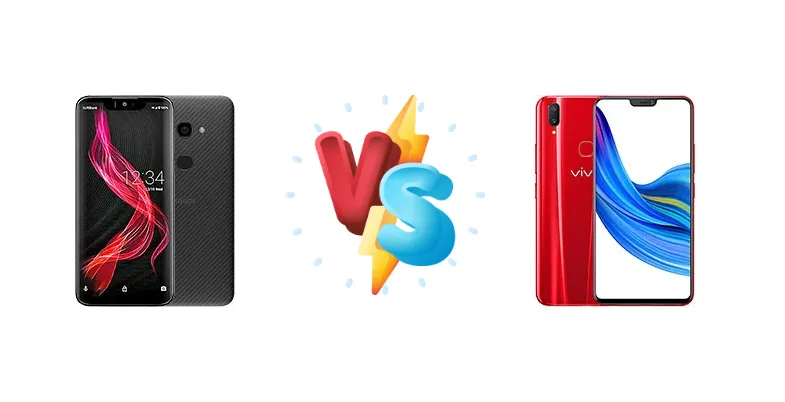
The Sharp Aquos Zero, originally a flagship device, now finds itself in a price bracket often occupied by phones like the vivo Z1. This comparison examines whether the Zero’s older, but more powerful, Snapdragon 845 still justifies its potential price premium over the Z1’s Snapdragon 660, focusing on real-world performance implications for the user.
🏆 Quick Verdict
For users prioritizing raw performance and future-proofing, the Sharp Aquos Zero is the clear winner. Its Snapdragon 845 offers a significant leap in processing power. However, the vivo Z1 presents a compelling value proposition for everyday tasks and budget-conscious buyers.
| Network |
|---|
| 2G bands | GSM 850 / 900 / 1800 / 1900 | GSM 850 / 900 / 1800 / 1900 |
| 3G bands | HSDPA 900 / 2100 | HSDPA 850 / 900 / 2100 |
| 4G bands | 1, 3, 7, 8, 28, 38 | 1, 3, 5, 8, 34, 38, 39, 40, 41 |
| Speed | HSPA 42.2/5.76 Mbps, LTE (3CA) Cat15 1024/50 Mbps | HSPA 42.2/5.76 Mbps, LTE (2CA) Cat6 300/50 Mbps |
| Technology | GSM / HSPA / LTE | GSM / CDMA / HSPA / LTE |
| | - | CDMA 800 & TD-SCDMA |
| Launch |
|---|
| Announced | 2019, January. Released 2019, January | 2018, May. Released 2018, June |
| Status | Discontinued | Discontinued |
| Body |
|---|
| Build | Glass front (Gorilla Glass 5), aluminum frame | Glass front, plastic back, plastic frame |
| Dimensions | 154 x 73 x 8.8 mm (6.06 x 2.87 x 0.35 in) | 154.8 x 75 x 7.9 mm (6.09 x 2.95 x 0.31 in) |
| SIM | Nano-SIM | Nano-SIM + Nano-SIM |
| Weight | 146 g (5.15 oz) | 149.3 g (5.26 oz) |
| | IP68 dust/water resistant (up to 1.5m for 30 mins) | - |
| Display |
|---|
| Protection | Corning Gorilla Glass 5 | - |
| Resolution | 1440 x 2992 pixels, 18.7:9 ratio (~536 ppi density) | 1080 x 2280 pixels, 19:9 ratio (~403 ppi density) |
| Size | 6.2 inches, 96.9 cm2 (~86.2% screen-to-body ratio) | 6.26 inches, 97.8 cm2 (~84.2% screen-to-body ratio) |
| Type | OLED, HDR10, Dolby Vision | IPS LCD |
| Platform |
|---|
| CPU | Octa-core (4x2.6 GHz Kryo 385 Gold & 4x1.7 GHz Kryo 385 Silver) | Octa-core (4x2.2 GHz Kryo 260 Gold & 4x1.8 GHz Kryo 260 Silver) |
| Chipset | Qualcomm SDM845 Snapdragon 845 (10 nm) | Qualcomm SDM660 Snapdragon 660 (14 nm) |
| GPU | Adreno 630 | Adreno 512 |
| OS | Android 9.0 (Pie) | Android 8.1 (Oreo), Funtouch 4 |
| Memory |
|---|
| Card slot | No | microSDXC (uses shared SIM slot) |
| Internal | 128GB 6GB RAM | 64GB 4GB RAM, 64GB 6GB RAM, 128GB 6GB RAM |
| | - | eMMC 5.1 |
| Main Camera |
|---|
| Dual | - | 13 MP, PDAF
Auxiliary lens |
| Features | LED flash, HDR, panorama | LED flash, HDR, panorama |
| Single | 22.6 MP, f/1.9, 22 mm, PDAF, OIS | - |
| Video | 4K@30fps, 1080p@30fps (gyro-EIS) | 4K@30fps, 1080p@30fps |
| Selfie camera |
|---|
| Features | HDR | - |
| Single | 8 MP, f/2.2, 23 mm | 12 MP, f/2.0, (wide), 1/2.8", 1.28µm |
| Video | 1080p@30fps | 1080p@30fps |
| Sound |
|---|
| 3.5mm jack | No | Yes |
| 35mm jack | No | Yes |
| Loudspeaker | Yes, with stereo speakers | Yes |
| |
24-bit/192kHz audio | - |
| Comms |
|---|
| Bluetooth | 5.0, A2DP, LE | 5.0, A2DP, LE |
| NFC | Yes | No |
| Positioning | GPS, GLONASS, GALILEO, QZSS | GPS, BDS |
| Radio | No | FM radio |
| USB | USB Type-C 2.0 | microUSB 2.0, OTG |
| WLAN | Wi-Fi 802.11 a/b/g/n/ac, dual-band, Wi-Fi Direct | Wi-Fi 802.11 a/b/g/n/ac, dual-band, WiFi Direct |
| Features |
|---|
| Sensors | Fingerprint (rear-mounted), accelerometer, gyro, proximity, compass | Fingerprint (rear-mounted), accelerometer, proximity, compass |
| Battery |
|---|
| Charging | 18W wired, PD2.0 | - |
| Type | Li-Ion 3130 mAh, non-removable | Li-Ion 3260 mAh, non-removable |
| Misc |
|---|
| Colors | Meteorite Black | Sapphire blue, Enamel blue, Hyun red, Enamel black, Black gold limited edition, Aurora Special Edition |
| Models | SH-Z10 | V1801A0 |
| Price | About 600 EUR | About 180 EUR |
Sharp Aquos Zero
- Significantly faster processor for demanding tasks
- Potentially better camera performance
- Faster charging with PD2.0
- Potentially shorter battery life under heavy load
- May be more expensive than the vivo Z1
vivo Z1
- More power-efficient processor for longer battery life
- More affordable price point
- Smooth performance for everyday tasks
- Slower processor for demanding games and apps
- Potentially lower camera quality
Display Comparison
Context data lacks display specifics for both devices. However, given the Aquos Zero’s flagship origins, it likely features a higher-quality panel with better color accuracy and potentially higher peak brightness compared to the Z1. The Z1, being a mid-range device, likely utilizes a standard LCD panel. The Aquos Zero’s potential for a higher refresh rate (though unconfirmed) would further enhance the user experience, particularly for gaming.
Camera Comparison
Without detailed camera specs, a direct comparison is limited. However, flagship devices like the Aquos Zero typically feature larger image sensors and more sophisticated image processing algorithms. This generally results in better low-light performance and dynamic range. The Z1, as a mid-range phone, likely prioritizes affordability over camera quality, potentially resulting in softer images and less detail in challenging lighting conditions. The presence or absence of Optical Image Stabilization (OIS) on the Aquos Zero would be a significant advantage.
Performance
The core difference lies in the chipsets. The Sharp Aquos Zero’s Snapdragon 845, built on a 10nm process, significantly outperforms the vivo Z1’s Snapdragon 660 (14nm). The 845’s Kryo 385 cores, clocked up to 2.6 GHz, deliver substantially faster CPU performance than the 660’s Kryo 260 cores at 2.2 GHz. This translates to quicker app launches, smoother multitasking, and a more responsive overall experience. The 10nm process also contributes to better thermal efficiency, potentially reducing throttling during sustained workloads. While both utilize an octa-core configuration, the architectural improvements in the 845 are substantial.
Battery Life
Battery capacity is not provided. However, the Snapdragon 660 in the vivo Z1, built on a 14nm process, is inherently more power-efficient than the Snapdragon 845 (10nm) under light loads. This means the Z1 could potentially offer longer battery life during typical daily use. The Aquos Zero’s 18W charging with PD2.0 support offers faster charging speeds, mitigating the potential for shorter battery life due to the more powerful processor. The Z1’s charging speed is unknown, but likely slower.
Buying Guide
Buy the Sharp Aquos Zero if you need a phone capable of handling demanding games, intensive multitasking, and benefit from faster app loading times. It’s ideal for power users and those who want a device that will remain responsive for years to come. Buy the vivo Z1 if you prioritize affordability, a smooth experience for basic tasks like browsing and social media, and a longer battery life due to the more efficient Snapdragon 660.
Frequently Asked Questions
❓ Will the Snapdragon 660 in the vivo Z1 struggle with graphically intensive games like PUBG or Genshin Impact?
The Snapdragon 660 can run PUBG, but likely at lower graphics settings and frame rates to maintain a smooth experience. Genshin Impact may be playable, but with significant compromises in visual fidelity. The Aquos Zero’s Snapdragon 845 will handle these games with ease at higher settings.
❓ Is the difference in performance between the Snapdragon 845 and 660 noticeable for everyday tasks like browsing and social media?
For basic tasks, the difference will be minimal. Both phones will provide a fluid experience. However, the 845 will feel snappier when switching between apps or loading complex web pages. The benefit is more apparent with multitasking.
❓ Given the age of the Aquos Zero, are there concerns about long-term software support?
This is a valid concern. Sharp’s software update track record isn’t as strong as brands like vivo. The Z1, being a more recent device, is more likely to receive continued software updates and security patches.