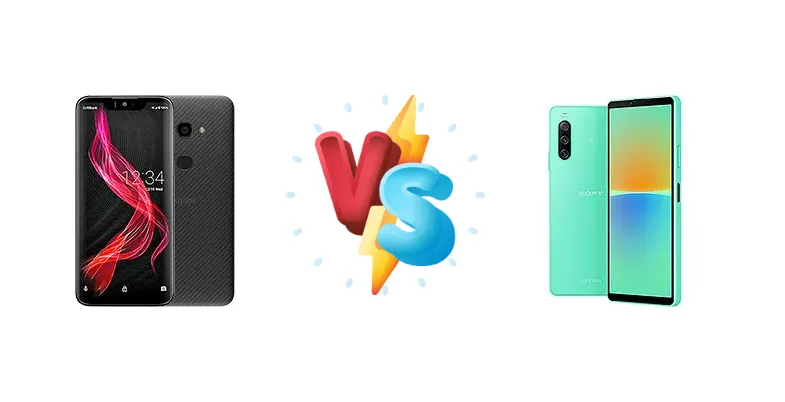
The Sharp Aquos Zero, released with a flagship Snapdragon 845, represents a bygone era of powerful, yet compact, Android devices. The Sony Xperia 10 IV, while positioned in the mid-range with a Snapdragon 695, prioritizes battery life and 5G connectivity. This comparison dissects these two phones, revealing which one best suits your needs in 2024.
🏆 Quick Verdict
For users prioritizing raw performance and who don't mind an older chipset, the Sharp Aquos Zero offers a significant speed advantage. However, the Sony Xperia 10 IV wins for most users due to its superior battery endurance, 5G connectivity, and more modern feature set, despite the performance gap.
| Network |
|---|
| 2G bands | GSM 850 / 900 / 1800 / 1900 | GSM 850 / 900 / 1800 / 1900 |
| 3G bands | HSDPA 900 / 2100 | HSDPA 850 / 900 / 1700(AWS) / 2100 |
| 4G bands | 1, 3, 7, 8, 28, 38 | 1, 3, 4, 5, 7, 8, 20, 28, 38, 39, 40, 41 |
| 5G bands | - | 1, 3, 7, 8, 28, 38, 41, 77, 78, 79 SA/NSA |
| Speed | HSPA 42.2/5.76 Mbps, LTE (3CA) Cat15 1024/50 Mbps | HSPA, LTE, 5G |
| Technology | GSM / HSPA / LTE | GSM / HSPA / LTE / 5G |
| Launch |
|---|
| Announced | 2019, January. Released 2019, January | 2022, May 11 |
| Status | Discontinued | Available. Released 2022, June 30 |
| Body |
|---|
| Build | Glass front (Gorilla Glass 5), aluminum frame | Glass front (Gorilla Glass Victus), plastic frame, plastic back |
| Dimensions | 154 x 73 x 8.8 mm (6.06 x 2.87 x 0.35 in) | 153 x 67 x 8.3 mm (6.02 x 2.64 x 0.33 in) |
| SIM | Nano-SIM | · Nano-SIM + eSIM· Nano-SIM + Nano-SIM |
| Weight | 146 g (5.15 oz) | 161 g (5.68 oz) |
| | IP68 dust/water resistant (up to 1.5m for 30 mins) | IP65/IP68 dust/water resistant (up to 1.5m for 30 min) |
| Display |
|---|
| Protection | Corning Gorilla Glass 5 | Corning Gorilla Glass Victus |
| Resolution | 1440 x 2992 pixels, 18.7:9 ratio (~536 ppi density) | 1080 x 2520 pixels, 21:9 ratio (~457 ppi density) |
| Size | 6.2 inches, 96.9 cm2 (~86.2% screen-to-body ratio) | 6.0 inches, 84.1 cm2 (~82.0% screen-to-body ratio) |
| Type | OLED, HDR10, Dolby Vision | OLED, 1B colors, HDR |
| | - | Triluminos display |
| Platform |
|---|
| CPU | Octa-core (4x2.6 GHz Kryo 385 Gold & 4x1.7 GHz Kryo 385 Silver) | Octa-core (2x2.2 GHz Kryo 660 Gold & 6x1.7 GHz Kryo 660 Silver) |
| Chipset | Qualcomm SDM845 Snapdragon 845 (10 nm) | Qualcomm SM6375 Snapdragon 695 5G (6 nm) |
| GPU | Adreno 630 | Adreno 619 |
| OS | Android 9.0 (Pie) | Android 12, upgradable to Android 14 |
| Memory |
|---|
| Card slot | No | microSDXC (uses shared SIM slot) |
| Internal | 128GB 6GB RAM | 128GB 6GB RAM |
| | - | UFS |
| Main Camera |
|---|
| Features | LED flash, HDR, panorama | LED flash, HDR, panorama |
| Single | 22.6 MP, f/1.9, 22 mm, PDAF, OIS | 8 MP, f/2.0, 27mm (wide), 1/4.0" |
| Triple | - | 12 MP, f/1.8, 27mm (wide), 1/2.8", PDAF, OIS
8 MP, f/2.2, 54mm (telephoto), 1/4.4", PDAF, 2x optical zoom
8 MP, f/2.2, 120˚, 16mm (ultrawide), 1/4.0" |
| Video | 4K@30fps, 1080p@30fps (gyro-EIS) | 1080p@30fps |
| Selfie camera |
|---|
| Features | HDR | HDR |
| Single | 8 MP, f/2.2, 23 mm | 8 MP, f/2.0, 27mm (wide), 1/4.0" |
| Video | 1080p@30fps | 1080p@30fps |
| Sound |
|---|
| 3.5mm jack | No | Yes |
| 35mm jack | No | Yes |
| Loudspeaker | Yes, with stereo speakers | Yes |
| |
24-bit/192kHz audio | 24-bit/192kHz audio
|
| Comms |
|---|
| Bluetooth | 5.0, A2DP, LE | 5.1, A2DP, LE, aptX HD, aptX Adaptive |
| NFC | Yes | Yes |
| Positioning | GPS, GLONASS, GALILEO, QZSS | GPS, GLONASS, GALILEO, BDS, QZSS |
| Radio | No | No |
| USB | USB Type-C 2.0 | USB Type-C 2.0, OTG |
| WLAN | Wi-Fi 802.11 a/b/g/n/ac, dual-band, Wi-Fi Direct | Wi-Fi 802.11 a/b/g/n/ac, dual-band, Wi-Fi Direct |
| Features |
|---|
| Sensors | Fingerprint (rear-mounted), accelerometer, gyro, proximity, compass | Fingerprint (side-mounted), accelerometer, proximity, compass |
| Battery |
|---|
| Charging | 18W wired, PD2.0 | 21W wired (unofficial rating), PD, QC |
| Type | Li-Ion 3130 mAh, non-removable | Li-Po 5000 mAh |
| Misc |
|---|
| Colors | Meteorite Black | Black, White, Mint, Lavender |
| Models | SH-Z10 | XQ-CC54, XQ-CC72, SOG07 |
| Price | About 600 EUR | £ 99.99 / € 112.89 |
| Tests |
|---|
| Battery life | - |
Endurance rating 163h
|
| Camera | - |
Photo / Video |
| Display | - |
Contrast ratio: Infinite (nominal) |
| Loudspeaker | - |
-30.6 LUFS (Below average)
|
| Performance | - |
AnTuTu: 396008 (v9)
GeekBench: 1908 (v5.1)
GFXBench: 16fps (ES 3.1 onscreen) |
Sharp Aquos Zero
- Superior peak performance with Snapdragon 845
- Potentially more compact form factor (typical of Aquos Zero line)
- May offer a lower price point due to its age
- Older chipset with limited software support
- Likely shorter battery life
- Slower charging speed (18W)
Sony Xperia 10 IV
- Excellent battery life (163h endurance rating)
- 5G connectivity with Snapdragon 695
- Faster charging (21W) with PD and QC
- Lower peak performance compared to Snapdragon 845
- May be larger and heavier than the Aquos Zero
- Mid-range chipset may struggle with demanding games
Display Comparison
The Sony Xperia 10 IV boasts a measured peak brightness of 683 nits, a substantial advantage over the Aquos Zero, which lacks published brightness data but likely falls short given its age. While both displays are described as having an 'infinite' contrast ratio (typical for OLED/AMOLED), the Xperia 10 IV’s larger size and modern panel technology likely deliver a more vibrant and immersive viewing experience. The Aquos Zero’s display tech is unknown, but its age suggests it may lack features like high refresh rates found in contemporary devices.
Camera Comparison
Both devices offer photo and video capabilities, but detailed camera specs are limited. The Aquos Zero’s camera system is largely unknown, but flagship devices of that era typically featured larger sensors and more advanced image processing. The Xperia 10 IV’s camera performance is likely more consistent due to modern image signal processing (ISP) within the Snapdragon 695. Without specific sensor size or aperture data, it’s difficult to definitively declare a winner, but the Xperia 10 IV’s more recent release suggests better overall image quality and features.
Performance
The core difference lies in the chipsets. The Sharp Aquos Zero’s Snapdragon 845 (10nm) features a powerful octa-core CPU with Kryo 385 Gold cores clocked at 2.6 GHz, offering significantly higher peak performance than the Sony Xperia 10 IV’s Snapdragon 695 (6nm). However, the 6nm process of the 695 provides better power efficiency. While the 845 excels in burst performance, the 695’s architecture is more modern and optimized for sustained tasks. The Aquos Zero’s age also means it likely lacks the software optimizations found in the Xperia 10 IV, potentially impacting real-world responsiveness.
Battery Life
The Sony Xperia 10 IV shines in battery endurance, achieving a remarkable 163-hour rating. While the Aquos Zero’s battery capacity is unknown, the Snapdragon 845’s power consumption, coupled with its age, likely results in significantly shorter battery life. The Xperia 10 IV supports 21W wired charging with PD and QC, while the Aquos Zero is limited to 18W with PD2.0. This means the Xperia 10 IV will likely charge faster and maintain its charge for a longer period.
Buying Guide
Buy the Sharp Aquos Zero if you absolutely need the fastest possible performance for demanding apps and occasional gaming, and are comfortable with a device that is no longer receiving software updates. Buy the Sony Xperia 10 IV if you prioritize all-day battery life, 5G connectivity, and a more balanced user experience with a modern chipset and software support.
Frequently Asked Questions
❓ Is the Snapdragon 695 in the Xperia 10 IV powerful enough for demanding games like Genshin Impact?
The Snapdragon 695 is a mid-range chipset and will struggle with graphically intensive games like Genshin Impact at high settings. You'll likely need to lower the graphics settings to achieve playable frame rates. The Aquos Zero's Snapdragon 845 will perform better, but both phones are aging and may exhibit thermal throttling during extended gaming sessions.
❓ Does the Aquos Zero still receive software updates, including security patches?
No, the Sharp Aquos Zero is an older device and is no longer receiving software updates from Sharp. This poses a security risk, as it's vulnerable to exploits that are patched in newer software versions. The Xperia 10 IV, being a more recent release, continues to receive updates.
❓ How does the 6nm process of the Snapdragon 695 impact real-world battery life compared to the 10nm Snapdragon 845?
The 6nm process is more efficient than 10nm, meaning the Snapdragon 695 consumes less power for the same level of performance. This translates directly to longer battery life in the Xperia 10 IV, even though the Aquos Zero might have a larger battery capacity. The 695's efficiency allows it to deliver comparable performance with less power draw.