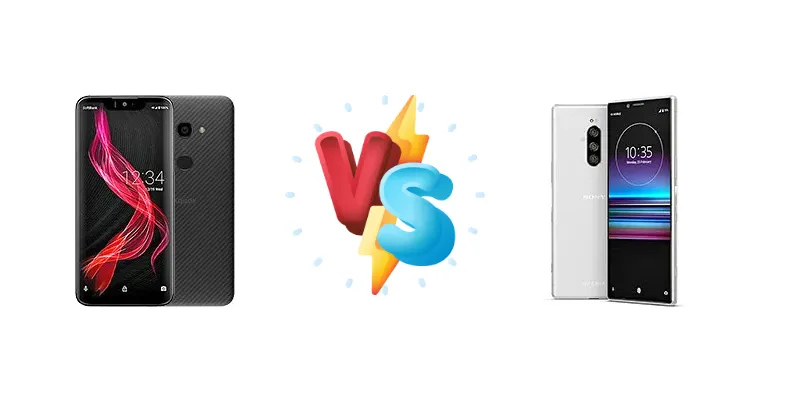
The Sharp Aquos Zero and Sony Xperia 1 represent distinct approaches to the 2019 flagship smartphone. The Aquos Zero prioritized a lightweight design and unique display technology, while the Xperia 1 aimed for a professional-grade multimedia experience. Both devices utilize Qualcomm Snapdragon processors, but a generation gap and differing design philosophies create significant distinctions.
🏆 Quick Verdict
For the average user prioritizing future-proofing and slightly better performance, the Sony Xperia 1 is the better choice. Its Snapdragon 855, built on a 7nm process, offers a modest performance advantage and potentially better thermal management. However, the Aquos Zero remains a compelling option for those seeking a lighter, more compact device.
| Network |
|---|
| 2G bands | GSM 850 / 900 / 1800 / 1900 | GSM 850 / 900 / 1800 / 1900 |
| 3G bands | HSDPA 900 / 2100 | HSDPA 800 / 850 / 900 / 1700(AWS) / 1900 / 2100 |
| 4G bands | 1, 3, 7, 8, 28, 38 | 1, 2, 3, 4, 5, 7, 8, 12, 13, 17, 19, 20, 26, 28, 29, 32, 38, 39, 40, 41, 46, 66 |
| Speed | HSPA 42.2/5.76 Mbps, LTE (3CA) Cat15 1024/50 Mbps | HSPA 42.2/5.76 Mbps, LTE Cat19 1600/150 Mbps |
| Technology | GSM / HSPA / LTE | GSM / HSPA / LTE |
| Launch |
|---|
| Announced | 2019, January. Released 2019, January | 2019, February 25. Released 2019, May 30 |
| Status | Discontinued | Discontinued |
| Body |
|---|
| Build | Glass front (Gorilla Glass 5), aluminum frame | Glass front (Gorilla Glass 6), glass back (Gorilla Glass 6), aluminum frame |
| Dimensions | 154 x 73 x 8.8 mm (6.06 x 2.87 x 0.35 in) | 167 x 72 x 8.2 mm (6.57 x 2.83 x 0.32 in) |
| SIM | Nano-SIM | · Nano-SIM· Nano-SIM + Nano-SIM |
| Weight | 146 g (5.15 oz) | 178 g (6.28 oz) |
| | IP68 dust/water resistant (up to 1.5m for 30 mins) | IP65/IP68 dust/water resistant (up to 1.5m for 30 mins) |
| Display |
|---|
| Protection | Corning Gorilla Glass 5 | Corning Gorilla Glass 6 |
| Resolution | 1440 x 2992 pixels, 18.7:9 ratio (~536 ppi density) | 1644 x 3840 pixels, 21:9 ratio (~643 ppi density) |
| Size | 6.2 inches, 96.9 cm2 (~86.2% screen-to-body ratio) | 6.5 inches, 98.6 cm2 (~82.0% screen-to-body ratio) |
| Type | OLED, HDR10, Dolby Vision | OLED, HDR BT.2020 |
| | - | Runs at 1096 x 2560 pixels except for select use cases
Triluminos display
X-Reality Engine |
| Platform |
|---|
| CPU | Octa-core (4x2.6 GHz Kryo 385 Gold & 4x1.7 GHz Kryo 385 Silver) | Octa-core (1x2.84 GHz Kryo 485 & 3x2.42 GHz Kryo 485 & 4x1.78 GHz Kryo 485) |
| Chipset | Qualcomm SDM845 Snapdragon 845 (10 nm) | Qualcomm SM8150 Snapdragon 855 (7 nm) |
| GPU | Adreno 630 | Adreno 640 |
| OS | Android 9.0 (Pie) | Android 9.0 (Pie), upgradable to Android 11 |
| Memory |
|---|
| Card slot | No | microSDXC (uses shared SIM slot) - dual SIM model only |
| Internal | 128GB 6GB RAM | 64GB 6GB RAM, 128GB 6GB RAM |
| | - | UFS 2.1 |
| Main Camera |
|---|
| Features | LED flash, HDR, panorama | Color spectrum sensor, LED flash, panorama, HDR, eye tracking |
| Single | 22.6 MP, f/1.9, 22 mm, PDAF, OIS | - |
| Triple | - | 12 MP, f/1.6, 26mm (wide), 1/2.55", 1.4µm, predictive dual pixel PDAF, 5-axis OIS
12 MP, f/2.4, 52mm (telephoto), 1/3.4", 1.0µm, predictive PDAF, 2x optical zoom, 5-axis OIS
12 MP, f/2.4, 16mm (ultrawide), 1/3.4", 1.0µm |
| Video | 4K@30fps, 1080p@30fps (gyro-EIS) | 4K@24/25/30fps HDR, 1080p@60fps, 1080p@30fps (5-axis gyro-EIS), 1080p@960fps |
| Selfie camera |
|---|
| Features | HDR | HDR |
| Single | 8 MP, f/2.2, 23 mm | 8 MP, f/2.0, 24mm (wide), 1/4.0", 1.12µm |
| Video | 1080p@30fps | 1080p@30fps (5-axis gyro-EIS) |
| Sound |
|---|
| 3.5mm jack | No | No |
| 35mm jack | No | No |
| Loudspeaker | Yes, with stereo speakers | Yes, with stereo speakers |
| |
24-bit/192kHz audio | 24-bit/192kHz audio
Dynamic vibration system |
| Comms |
|---|
| Bluetooth | 5.0, A2DP, LE | 5.0, A2DP, aptX HD, LE |
| NFC | Yes | Yes |
| Positioning | GPS, GLONASS, GALILEO, QZSS | GPS, GLONASS, BDS, GALILEO |
| Radio | No | No |
| USB | USB Type-C 2.0 | USB Type-C 3.1, OTG |
| WLAN | Wi-Fi 802.11 a/b/g/n/ac, dual-band, Wi-Fi Direct | Wi-Fi 802.11 a/b/g/n/ac, dual-band, Wi-Fi Direct, DLNA |
| Features |
|---|
| Sensors | Fingerprint (rear-mounted), accelerometer, gyro, proximity, compass | Fingerprint (side-mounted), accelerometer, gyro, proximity, barometer, compass |
| Battery |
|---|
| Charging | 18W wired, PD2.0 | 18W wired, PD2.0 |
| Type | Li-Ion 3130 mAh, non-removable | Li-Ion 3330 mAh, non-removable |
| Misc |
|---|
| Colors | Meteorite Black | Black, Gray, Purple, White |
| Models | SH-Z10 | J8110, J8170, J9110, J9150, SOV40, SO-03L |
| Price | About 600 EUR | About 500 EUR |
| Tests |
|---|
| Audio quality | - |
Noise -93.6dB / Crosstalk -85.2dB |
| Battery life | - | Endurance rating 79h |
| Camera | - |
Photo / Video |
| Display | - |
Contrast ratio: Infinite (nominal) |
| Loudspeaker | - |
-26.7 LUFS (Good) |
| Performance | - |
AnTuTu: 356734 (v7), 418206 (v8)
GeekBench: 10985 (v4.4), 2753 (v5.1)
GFXBench: 33fps (ES 3.1 onscreen) |
Sharp Aquos Zero
- Potentially lighter and more compact design.
- Sharp’s IGZO LCD technology may offer excellent color accuracy.
- Unique design aesthetic.
- Older Snapdragon 845 chipset.
- 10nm process may lead to more thermal throttling.
- Limited camera information available.
Sony Xperia 1
- More powerful Snapdragon 855 chipset.
- 7nm process for improved efficiency and thermal management.
- Sony’s Alpha camera expertise for enhanced image quality.
- Larger and heavier design.
- May be more expensive.
- OLED burn-in risk (though mitigated by Sony's software)
Display Comparison
The Sony Xperia 1 boasts a 6.5-inch OLED display with a measured peak brightness of 665 nits, providing excellent visibility in bright conditions. While the Aquos Zero’s display specs are not provided, Sharp was known for its IGZO LCD technology, which typically excels in color accuracy and power efficiency. The Xperia 1’s ‘infinite’ contrast ratio, typical of OLED panels, delivers deeper blacks and more vibrant colors. The absence of high refresh rate support on either device is notable, a feature becoming increasingly common even in 2019.
Camera Comparison
Both the Aquos Zero and Xperia 1 feature capable photo and video systems, but details are limited. The Xperia 1, leveraging Sony’s Alpha camera expertise, likely prioritizes image processing geared towards natural colors and detail preservation. The Aquos Zero’s camera performance is less well-documented, but Sharp often focused on computational photography techniques. Without specific sensor size or aperture information, it’s difficult to definitively assess camera quality, but the Xperia 1’s brand association with imaging technology gives it an edge.
Performance
The Xperia 1’s Snapdragon 855 (7nm) represents a generational leap over the Aquos Zero’s Snapdragon 845 (10nm). The 855 features a Kryo 485 CPU with a prime core clocked at 2.84 GHz, compared to the 845’s 2.6 GHz Kryo 385 Gold core. This translates to a roughly 15-20% performance increase in CPU-intensive tasks. The 7nm process also contributes to improved thermal efficiency, potentially reducing throttling during sustained workloads. Both devices share 18W PD2.0 charging, but the 855’s efficiency could lead to slightly faster overall charging times.
Battery Life
Both devices share an endurance rating of 79 hours, suggesting comparable real-world battery life despite potentially different battery capacities. The 18W PD2.0 charging on both phones offers a reasonable charging speed, but doesn’t stand out in a market increasingly embracing faster charging technologies. The Snapdragon 855’s improved efficiency could slightly offset any capacity difference, resulting in similar usage times.
Buying Guide
Buy the Sharp Aquos Zero if you need a highly portable flagship with a focus on minimizing weight and size, and are comfortable with a slightly older chipset. Buy the Sony Xperia 1 if you prefer a larger display optimized for multimedia consumption, demand the latest Snapdragon 855 processor for a small performance boost, and value a more robust camera system geared towards both photo and video.
Frequently Asked Questions
❓ Does the Snapdragon 845 in the Aquos Zero struggle with demanding games like PUBG or Genshin Impact?
While the Snapdragon 845 is still a capable processor, it will likely exhibit more noticeable throttling and frame rate drops in graphically intensive games like PUBG or Genshin Impact compared to the Snapdragon 855 in the Xperia 1. Lowering graphics settings is recommended for a smoother experience.
❓ Is the lack of a dedicated telephoto lens on either phone a significant drawback?
Both phones rely on digital zoom, which results in a loss of image quality. While the Xperia 1’s image processing may mitigate this somewhat, dedicated telephoto lenses offer superior zoom capabilities without significant quality degradation. Users who frequently zoom in on subjects may find this limitation noticeable.
❓ How does the Aquos Zero's lightweight design impact its durability?
The Aquos Zero's focus on minimizing weight may have resulted in the use of more plastic components, potentially making it less durable than the Xperia 1, which likely incorporates more metal in its construction. Protective cases are highly recommended to safeguard the Aquos Zero from accidental drops and scratches.