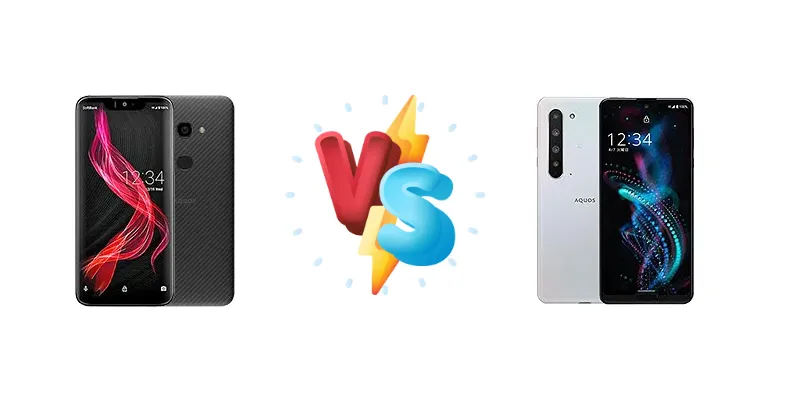
The Sharp Aquos Zero and R5G represent distinct points in Qualcomm's Snapdragon evolution. The Zero, released with the Snapdragon 845, aimed for a balance of performance and efficiency. The R5G, leveraging the Snapdragon 865, pushed into the 5G era with a focus on raw power. This comparison dissects the key differences between these two devices, helping you understand where each excels.
🏆 Quick Verdict
For most users, the Sharp Aquos R5G is the superior choice. The Snapdragon 865 offers a significant performance uplift over the 845, translating to faster app loading, smoother multitasking, and improved gaming. While the Zero remains a capable device, the R5G’s 5G connectivity and newer architecture provide a more future-proof experience.
| Network |
|---|
| 2G bands | GSM 850 / 900 / 1800 / 1900 | GSM 850 / 900 / 1800 / 1900 |
| 3G bands | HSDPA 900 / 2100 | HSDPA 850 / 900 / 1900 / 2100 |
| 4G bands | 1, 3, 7, 8, 28, 38 | 1, 3, 7, 8, 20, 28, 38, 41 |
| 5G bands | - | 1, 3, 28, 78 SA/NSA |
| Speed | HSPA 42.2/5.76 Mbps, LTE (3CA) Cat15 1024/50 Mbps | HSPA, LTE, 5G |
| Technology | GSM / HSPA / LTE | GSM / HSPA / LTE / 5G |
| Launch |
|---|
| Announced | 2019, January. Released 2019, January | 2020, February. Released 2020, February |
| Status | Discontinued | Discontinued |
| Body |
|---|
| Build | Glass front (Gorilla Glass 5), aluminum frame | - |
| Dimensions | 154 x 73 x 8.8 mm (6.06 x 2.87 x 0.35 in) | 162 x 75 x 8.9 mm (6.38 x 2.95 x 0.35 in) |
| SIM | Nano-SIM | Nano-SIM |
| Weight | 146 g (5.15 oz) | 189 g (6.67 oz) |
| | IP68 dust/water resistant (up to 1.5m for 30 mins) | IPX5/IP6X/IPX8 water/dust resistant (up to 1.5m for 30 min) |
| Display |
|---|
| Protection | Corning Gorilla Glass 5 | - |
| Resolution | 1440 x 2992 pixels, 18.7:9 ratio (~536 ppi density) | 1440 x 3168 pixels (~544 ppi density) |
| Size | 6.2 inches, 96.9 cm2 (~86.2% screen-to-body ratio) | 6.4 inches, 99.5 cm2 (~81.9% screen-to-body ratio) |
| Type | OLED, HDR10, Dolby Vision | IGZO IPS LCD, 1B colors, 120Hz, Dolby Vision |
| Platform |
|---|
| CPU | Octa-core (4x2.6 GHz Kryo 385 Gold & 4x1.7 GHz Kryo 385 Silver) | Octa-core (1x2.84 GHz Cortex-A77 & 3x2.42 GHz Cortex-A77 & 4x1.80 GHz Cortex-A55) |
| Chipset | Qualcomm SDM845 Snapdragon 845 (10 nm) | Qualcomm SM8250 Snapdragon 865 5G (7 nm+) |
| GPU | Adreno 630 | Adreno 650 |
| OS | Android 9.0 (Pie) | Android 10 |
| Memory |
|---|
| Card slot | No | No |
| Internal | 128GB 6GB RAM | 256GB 12GB RAM |
| | - | UFS 3.0 |
| Main Camera |
|---|
| Features | LED flash, HDR, panorama | LED flash, panorama |
| Single | 22.6 MP, f/1.9, 22 mm, PDAF, OIS | - |
| Triple | - | 12 MP, f/1.7, 26mm (wide), 1.4µm, dual pixel PDAF, OIS
12 MP, f/2.7, 52mm (telephoto), 1.0µm, PDAF, 2x optical zoom, OIS
48 MP, f/2.9, 19mm (ultrawide), 0.8µm
TOF 3D (depth) |
| Video | 4K@30fps, 1080p@30fps (gyro-EIS) | 8K@30fps, 1080p@30fps |
| Selfie camera |
|---|
| Features | HDR | - |
| Single | 8 MP, f/2.2, 23 mm | 16 MP, f/2.0, 26mm (wide), 0.7µm |
| Video | 1080p@30fps | 1080p@30fps |
| Sound |
|---|
| 3.5mm jack | No | No |
| 35mm jack | No | No |
| Loudspeaker | Yes, with stereo speakers | Yes, with stereo speakers |
| |
24-bit/192kHz audio | 24-bit/192kHz audio |
| Comms |
|---|
| Bluetooth | 5.0, A2DP, LE | 5.1, A2DP, LE, aptX HD, aptX Adaptive |
| NFC | Yes | Yes |
| Positioning | GPS, GLONASS, GALILEO, QZSS | GPS (L1+L5), GLONASS, BDS, GALILEO, QZSS |
| Radio | No | No |
| USB | USB Type-C 2.0 | USB Type-C 3.1 |
| WLAN | Wi-Fi 802.11 a/b/g/n/ac, dual-band, Wi-Fi Direct | Wi-Fi 802.11 a/b/g/n/ac/ax/6, dual-band, Wi-Fi Direct |
| Features |
|---|
| Sensors | Fingerprint (rear-mounted), accelerometer, gyro, proximity, compass | Fingerprint (front-mounted), accelerometer, gyro, proximity, compass |
| Battery |
|---|
| Charging | 18W wired, PD2.0 | - |
| Type | Li-Ion 3130 mAh, non-removable | Li-Ion 3730 mAh |
| Misc |
|---|
| Colors | Meteorite Black | Glare Black, Aurora White |
| Models | SH-Z10 | SH-51A, SHG01, SH-R50 |
| Price | About 600 EUR | About 700 EUR |
Sharp Aquos Zero
- More affordable price point
- Still capable for everyday tasks
- Reliable Snapdragon 845 performance
- Older chipset with lower performance
- Lacks 5G connectivity
- Less efficient power consumption
Sharp Aquos R5G
- Significantly faster Snapdragon 865 performance
- 5G connectivity for faster data speeds
- More efficient power consumption
- Higher price tag
- May run slightly warmer under heavy load
- Potentially larger file sizes for 8K video
Display Comparison
While specific display specs aren't provided, both Aquos devices likely feature Sharp's high-quality LCD panels. However, the R5G benefits from the more advanced Snapdragon 865 ISP, potentially leading to better image processing for display output. The 845 in the Zero, while capable, lacks the same level of image signal processing power. Bezels are likely comparable given Sharp’s design language, but the R5G’s newer chipset allows for potentially more efficient display power management.
Camera Comparison
Without detailed camera specs, it’s difficult to make a definitive judgment. However, the Snapdragon 865 in the R5G includes a significantly more advanced Image Signal Processor (ISP). This ISP supports features like 8K video recording and improved low-light performance. The 845’s ISP is capable, but it lacks the same level of sophistication. The R5G’s ISP also enables faster image processing and better dynamic range. While both phones likely feature similar lens configurations, the R5G’s superior image processing pipeline will result in noticeably better image quality, particularly in challenging lighting conditions.
Performance
The core difference lies in the chipsets. The Aquos Zero’s Snapdragon 845 (10nm) features an octa-core CPU with Kryo 385 cores, while the R5G boasts the Snapdragon 865 5G (7nm+). This process node shrink is crucial; 7nm+ offers significantly improved transistor density and power efficiency. The R5G’s CPU configuration – a 1x2.84 GHz Cortex-A77 prime core, 3x2.42 GHz Cortex-A77 cores, and 4x1.80 GHz Cortex-A55 cores – represents a substantial architectural upgrade over the 845’s Kryo cores. This translates to approximately a 25-30% performance increase in CPU-intensive tasks and a more noticeable jump in GPU performance, benefiting gamers and users running demanding applications. The R5G also benefits from faster RAM speeds (likely LPDDR4X or LPDDR5) compared to the Zero’s LPDDR4, further enhancing responsiveness.
Battery Life
Battery capacity isn’t specified, but the Snapdragon 865’s 7nm+ process offers better power efficiency than the 845’s 10nm process. This means the R5G will likely achieve comparable or better battery life despite potentially having a similar battery size. The R5G also supports faster charging, though the Zero’s 18W PD2.0 charging is respectable. The R5G’s more efficient chipset and potentially faster charging capabilities give it an edge in real-world battery performance.
Buying Guide
Buy the Sharp Aquos Zero if you prioritize a more affordable entry point into the Aquos line and value a device that still handles everyday tasks competently. It’s ideal for users who don’t heavily game or require 5G connectivity. Buy the Sharp Aquos R5G if you demand the best possible performance, want access to 5G networks, and are willing to pay a premium for the latest Snapdragon technology. This is the phone for power users and mobile gamers.
Frequently Asked Questions
❓ Will the Aquos R5G's 5G connectivity actually make a difference in my daily use?
The benefit of 5G depends heavily on your location and carrier coverage. If you live in an area with robust 5G infrastructure, you'll experience significantly faster download and upload speeds, especially for large files and streaming. However, if 5G coverage is limited, the difference may be minimal.
❓ Does the Snapdragon 865 in the R5G get noticeably hotter than the 845 in the Zero during extended gaming sessions?
The Snapdragon 865 is a more powerful chip and will generate more heat under sustained load. However, Sharp likely implemented thermal management solutions in the R5G to mitigate this. While it may get warmer, it shouldn't reach throttling temperatures under normal gaming conditions. The 845 will remain cooler, but at the cost of performance.
❓ Is the performance difference between the two phones noticeable for everyday tasks like browsing and social media?
For basic tasks, the difference won't be dramatic. Both phones are capable of handling everyday use smoothly. However, the R5G will feel snappier and more responsive when switching between apps or loading complex web pages due to its faster processor and RAM.