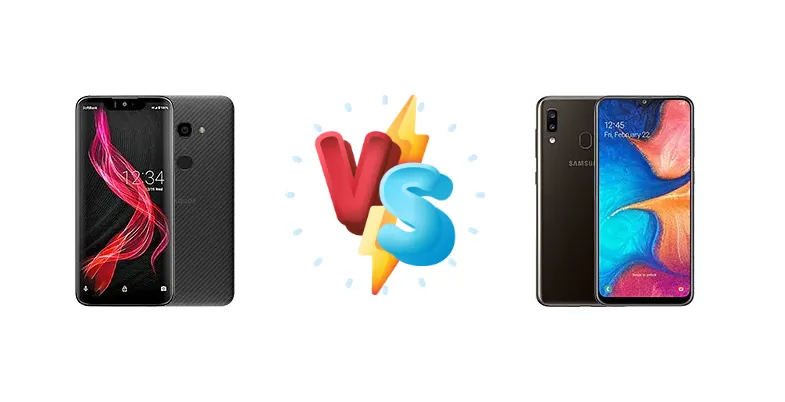
The Sharp Aquos Zero, originally a premium device, now finds itself competing in a price bracket occupied by phones like the Samsung Galaxy A20. This comparison examines whether the Aquos Zero’s older, but significantly more powerful, Snapdragon 845 chipset justifies its potential price premium over the Galaxy A20’s Exynos 7884, or if Samsung’s offering provides a more balanced experience for everyday users.
🏆 Quick Verdict
For users prioritizing performance and future-proofing, the Sharp Aquos Zero is the clear winner. Its Snapdragon 845 delivers a substantially faster experience, particularly in demanding tasks. However, the Samsung Galaxy A20 offers a more modern software experience and potentially better battery optimization for light users.
| Network |
|---|
| 2G bands | GSM 850 / 900 / 1800 / 1900 | GSM 850 / 900 / 1800 / 1900 |
| 3G bands | HSDPA 900 / 2100 | HSDPA 850 / 900 / 1900 / 2100 |
| 4G bands | 1, 3, 7, 8, 28, 38 | 1, 3, 5, 7, 8, 20, 38, 40, 41 |
| Speed | HSPA 42.2/5.76 Mbps, LTE (3CA) Cat15 1024/50 Mbps | HSPA 42.2/5.76 Mbps, LTE Cat4 150/50 Mbps |
| Technology | GSM / HSPA / LTE | GSM / HSPA / LTE |
| | - | 1, 2, 3, 4, 5, 7, 8, 12, 13, 20, 25, 26, 28, 38, 39, 40, 41, 66, 71 - SM-A205U |
| Launch |
|---|
| Announced | 2019, January. Released 2019, January | 2019, March 19. Released 2019, April 05 |
| Status | Discontinued | Discontinued |
| Body |
|---|
| Build | Glass front (Gorilla Glass 5), aluminum frame | Glass front (Gorilla Glass 3), plastic back, plastic frame |
| Dimensions | 154 x 73 x 8.8 mm (6.06 x 2.87 x 0.35 in) | 158.4 x 74.7 x 7.8 mm (6.24 x 2.94 x 0.31 in) |
| SIM | Nano-SIM | · Nano-SIM· Nano-SIM + Nano-SIM |
| Weight | 146 g (5.15 oz) | 169 g (5.96 oz) |
| | IP68 dust/water resistant (up to 1.5m for 30 mins) | - |
| Display |
|---|
| Protection | Corning Gorilla Glass 5 | Corning Gorilla Glass 3 |
| Resolution | 1440 x 2992 pixels, 18.7:9 ratio (~536 ppi density) | 720 x 1560 pixels, 19.5:9 ratio (~268 ppi density) |
| Size | 6.2 inches, 96.9 cm2 (~86.2% screen-to-body ratio) | 6.4 inches, 100.5 cm2 (~85.0% screen-to-body ratio) |
| Type | OLED, HDR10, Dolby Vision | Super AMOLED |
| Platform |
|---|
| CPU | Octa-core (4x2.6 GHz Kryo 385 Gold & 4x1.7 GHz Kryo 385 Silver) | Octa-core (2x1.6 GHz Cortex-A73 & 6x1.35 GHz Cortex-A53) |
| Chipset | Qualcomm SDM845 Snapdragon 845 (10 nm) | Exynos 7884 (14 nm) |
| GPU | Adreno 630 | Mali-G71 MP2 |
| OS | Android 9.0 (Pie) | Android 9.0 (Pie), upgradable to Android 11, One UI 3.1 |
| Memory |
|---|
| Card slot | No | microSDXC (dedicated slot) |
| Internal | 128GB 6GB RAM | 32GB 3GB RAM |
| | - | eMMC 5.1 |
| Main Camera |
|---|
| Dual | - | 13 MP, f/1.9, 28mm (wide), AF
5 MP, f/2.2, 12mm (ultrawide) |
| Features | LED flash, HDR, panorama | LED flash, panorama, HDR |
| Single | 22.6 MP, f/1.9, 22 mm, PDAF, OIS | - |
| Video | 4K@30fps, 1080p@30fps (gyro-EIS) | 1080p@30fps |
| Selfie camera |
|---|
| Features | HDR | - |
| Single | 8 MP, f/2.2, 23 mm | 8 MP, f/2.0 |
| Video | 1080p@30fps | 1080p@30fps |
| Sound |
|---|
| 3.5mm jack | No | Yes |
| 35mm jack | No | Yes |
| Loudspeaker | Yes, with stereo speakers | Yes |
| |
24-bit/192kHz audio | - |
| Comms |
|---|
| Bluetooth | 5.0, A2DP, LE | 5.0, A2DP, LE |
| NFC | Yes | Yes (market/region dependent) |
| Positioning | GPS, GLONASS, GALILEO, QZSS | GPS, GLONASS, BDS |
| Radio | No | FM radio |
| USB | USB Type-C 2.0 | USB Type-C 2.0, OTG |
| WLAN | Wi-Fi 802.11 a/b/g/n/ac, dual-band, Wi-Fi Direct | Wi-Fi 802.11 b/g/n, Wi-Fi Direct |
| Features |
|---|
| Sensors | Fingerprint (rear-mounted), accelerometer, gyro, proximity, compass | Fingerprint (rear-mounted), accelerometer, gyro, proximity, compass |
| Battery |
|---|
| Charging | 18W wired, PD2.0 | 15W wired |
| Type | Li-Ion 3130 mAh, non-removable | Li-Po 4000 mAh, non-removable |
| Misc |
|---|
| Colors | Meteorite Black | Black, Deep Blue, Red, Coral Orange, Gold |
| Models | SH-Z10 | SM-A205F, SM-A205FN, SM-A205GN, SM-A205YN, SM-A205G, SM-A205W, SM-A205U, SM-A205S, SM-S205DL, SM-A205U1 |
| Price | About 600 EUR | About 100 EUR |
| SAR | - | 1.09 W/kg (head) 0.60 W/kg (body) |
| SAR EU | - | 0.23 W/kg (head) 1.38 W/kg (body) |
Sharp Aquos Zero
- Significantly faster processor (Snapdragon 845)
- Better thermal management
- Potentially superior camera image quality
- Potentially older software support
- Smaller battery capacity
Samsung Galaxy A20
- Larger battery capacity
- More modern software experience
- Lower price point
- Slower processor (Exynos 7884)
- Potential for thermal throttling
- Lower image quality in challenging conditions
Display Comparison
While specific display specs for the Aquos Zero are unavailable, Sharp historically focused on high-quality panels. The Galaxy A20 features a 6.3-inch HD+ TFT LCD. The Aquos Zero, being a former flagship, likely boasts a higher peak brightness and potentially better color accuracy. The Exynos 7884’s GPU will be taxed more heavily driving the A20’s larger display, potentially impacting performance. The A20’s lower resolution (HD+) will reduce strain on the GPU, but at the cost of sharpness.
Camera Comparison
Detailed camera specs for the Aquos Zero are limited. However, flagship devices typically prioritize image quality. The Galaxy A20 features a 13MP main camera and a 5MP ultrawide, alongside a 2MP depth sensor and a 2MP macro lens. The 2MP sensors on the A20 are largely marketing features and offer minimal practical benefit. The Aquos Zero’s likely larger sensor and more powerful ISP (Image Signal Processor) within the Snapdragon 845 will result in better low-light performance and more detailed images. The Snapdragon 845’s image processing capabilities will also provide more dynamic range and accurate color reproduction.
Performance
The core difference lies in the chipsets. The Aquos Zero’s Snapdragon 845, built on a 10nm process, features an octa-core CPU with Kryo 385 cores clocked up to 2.6 GHz. This is a significant leap over the Galaxy A20’s Exynos 7884 (14nm), which combines two Cortex-A73 cores at 1.6 GHz with six Cortex-A53 cores at 1.35 GHz. The Snapdragon 845’s superior architecture and higher clock speeds translate to faster app loading, smoother multitasking, and a more responsive user experience. The 10nm process also contributes to better thermal efficiency, reducing the likelihood of throttling during sustained workloads. The A20’s Exynos 7884 will struggle with graphically intensive games and demanding applications.
Battery Life
The Galaxy A20 packs a 4000mAh battery and supports 15W wired charging. The Aquos Zero has a smaller battery and supports 18W wired charging with PD2.0. While the A20’s larger capacity provides a theoretical advantage, the Snapdragon 845’s superior power efficiency could offset this difference in real-world usage. The Aquos Zero’s PD2.0 support allows for potentially faster charging with compatible chargers, though the 3W difference in wattage isn’t massive. The Exynos 7884’s less efficient architecture will likely result in faster battery drain during demanding tasks.
Buying Guide
Buy the Sharp Aquos Zero if you need a phone capable of handling demanding games, multitasking, and future software updates without significant slowdown. It’s ideal for users who value raw processing power. Buy the Samsung Galaxy A20 if you prioritize a larger screen, a more modern software experience, and a lower upfront cost, and your usage primarily consists of social media, browsing, and light tasks.
Frequently Asked Questions
❓ Does the Exynos 7884 in the Galaxy A20 overheat during prolonged gaming sessions?
The Exynos 7884 is prone to thermal throttling under sustained load. While it can handle casual gaming, demanding titles will likely experience frame drops and reduced performance as the chip heats up. The 14nm process is less efficient than the Snapdragon 845’s 10nm process, contributing to this issue.
❓ Is the 18W charging on the Aquos Zero significantly faster than the 15W charging on the Galaxy A20?
The difference is noticeable, but not dramatic. The Aquos Zero’s PD2.0 support allows for potentially faster charging with a compatible charger, but the 3W difference won’t result in a massive time saving. Both phones will take approximately 2-3 hours to fully charge from 0%.
❓ How does the Snapdragon 845 handle multitasking compared to the Exynos 7884?
The Snapdragon 845 excels at multitasking due to its more powerful CPU and larger memory bandwidth. Switching between apps is significantly faster and smoother on the Aquos Zero, while the Galaxy A20 may exhibit noticeable lag when running multiple applications simultaneously.
❓ Will the Aquos Zero receive future Android updates?
Given its age, software support for the Aquos Zero is likely limited. While it may have launched with a recent Android version at the time, it may not receive major OS updates beyond that. The Galaxy A20, being a more recent device, is more likely to receive at least one major Android update.