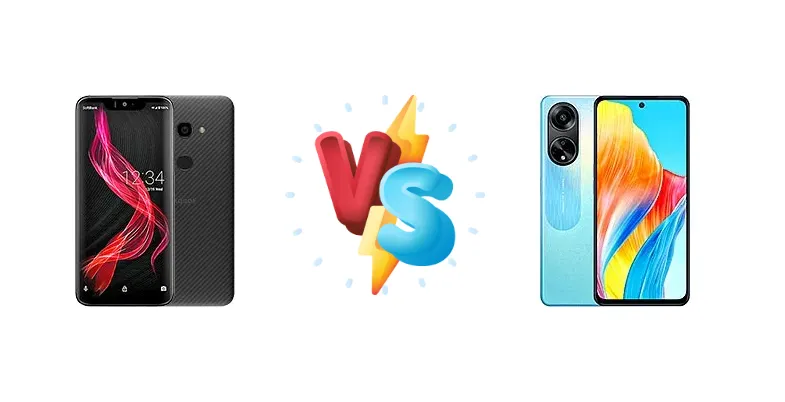
The Sharp Aquos Zero, while representing a former flagship experience with the Snapdragon 845, now faces competition from newer, more affordable devices like the Oppo A98. This comparison dissects the trade-offs between a chip from 2018 and a more recent, efficiency-focused Snapdragon 695, focusing on real-world impact for today’s user.
🏆 Quick Verdict
For most users, the Oppo A98 represents the smarter buy. While the Aquos Zero’s Snapdragon 845 offers theoretical performance advantages, the A98’s 6nm Snapdragon 695 provides a solid experience with significantly faster 67W charging, making it more practical for daily use. The A98’s modern features and price point outweigh the Zero’s aging hardware.
| Network |
|---|
| 2G bands | GSM 850 / 900 / 1800 / 1900 | GSM 850 / 900 / 1800 / 1900 |
| 3G bands | HSDPA 900 / 2100 | HSDPA 800 / 850 / 900 / 1700(AWS) / 1900 / 2100 |
| 4G bands | 1, 3, 7, 8, 28, 38 | 1, 2, 3, 4, 5, 7, 8, 12, 13, 17, 18, 19, 20, 26, 28, 32, 38, 39, 40, 41, 66 |
| 5G bands | - | 1, 3, 5, 7, 8, 20, 28, 38, 40, 41, 66, 77, 78 SA/NSA |
| Speed | HSPA 42.2/5.76 Mbps, LTE (3CA) Cat15 1024/50 Mbps | HSPA, LTE, 5G |
| Technology | GSM / HSPA / LTE | GSM / HSPA / LTE / 5G |
| Launch |
|---|
| Announced | 2019, January. Released 2019, January | 2023, May 09 |
| Status | Discontinued | Available. Released 2023, May 19 |
| Body |
|---|
| Build | Glass front (Gorilla Glass 5), aluminum frame | - |
| Dimensions | 154 x 73 x 8.8 mm (6.06 x 2.87 x 0.35 in) | 165.6 x 76.1 x 8.2 mm (6.52 x 3.00 x 0.32 in) |
| SIM | Nano-SIM | Nano-SIM + Nano-SIM |
| Weight | 146 g (5.15 oz) | 192 g (6.77 oz) |
| | IP68 dust/water resistant (up to 1.5m for 30 mins) | - |
| Display |
|---|
| Protection | Corning Gorilla Glass 5 | - |
| Resolution | 1440 x 2992 pixels, 18.7:9 ratio (~536 ppi density) | 1080 x 2400 pixels, 20:9 ratio (~392 ppi density) |
| Size | 6.2 inches, 96.9 cm2 (~86.2% screen-to-body ratio) | 6.72 inches, 109.0 cm2 (~86.5% screen-to-body ratio) |
| Type | OLED, HDR10, Dolby Vision | IPS LCD, 120Hz, 550 nits (typ), 680 nits (HBM) |
| Platform |
|---|
| CPU | Octa-core (4x2.6 GHz Kryo 385 Gold & 4x1.7 GHz Kryo 385 Silver) | Octa-core (2x2.2 GHz Kryo 660 Gold & 6x1.7 GHz Kryo 660 Silver) |
| Chipset | Qualcomm SDM845 Snapdragon 845 (10 nm) | Qualcomm SM6375 Snapdragon 695 5G (6 nm) |
| GPU | Adreno 630 | Adreno 619 |
| OS | Android 9.0 (Pie) | Android 13, upgradable to Android 14, ColorOS 14 |
| Memory |
|---|
| Card slot | No | microSDXC |
| Internal | 128GB 6GB RAM | 256GB 8GB RAM |
| | - | UFS 2.2 |
| Main Camera |
|---|
| Dual | - | 64 MP, f/1.7, 26mm (wide), PDAF
2 MP, f/3.3, 34mm (microscope)
Auxiliary lens |
| Features | LED flash, HDR, panorama | LED flash, HDR, panorama |
| Single | 22.6 MP, f/1.9, 22 mm, PDAF, OIS | - |
| Video | 4K@30fps, 1080p@30fps (gyro-EIS) | 1080p@30fps |
| Selfie camera |
|---|
| Features | HDR | Panorama |
| Single | 8 MP, f/2.2, 23 mm | 32 MP, f/2.4, 22mm (wide) |
| Video | 1080p@30fps | 1080p@30fps |
| Sound |
|---|
| 3.5mm jack | No | Yes |
| 35mm jack | No | Yes |
| Loudspeaker | Yes, with stereo speakers | Yes, with stereo speakers |
| |
24-bit/192kHz audio | - |
| Comms |
|---|
| Bluetooth | 5.0, A2DP, LE | 5.1, A2DP, LE, aptX HD |
| Infrared port | - | Yes |
| NFC | Yes | Yes |
| Positioning | GPS, GLONASS, GALILEO, QZSS | GPS (L1), GLONASS (G1), BDS (B1I), GALILEO (E1), QZSS (L1) |
| Radio | No | No |
| USB | USB Type-C 2.0 | USB Type-C 2.0, OTG |
| WLAN | Wi-Fi 802.11 a/b/g/n/ac, dual-band, Wi-Fi Direct | Wi-Fi 802.11 a/b/g/n/ac, dual-band |
| Features |
|---|
| Sensors | Fingerprint (rear-mounted), accelerometer, gyro, proximity, compass | Fingerprint (side-mounted), accelerometer, gyro, proximity, compass |
| Battery |
|---|
| Charging | 18W wired, PD2.0 | 67W wired, PD, 50% in 18 min |
| Type | Li-Ion 3130 mAh, non-removable | Li-Po 5000 mAh |
| Misc |
|---|
| Colors | Meteorite Black | Cool Black, Dreamy Blue |
| Models | SH-Z10 | CPH2529 |
| Price | About 600 EUR | About 290 EUR |
Sharp Aquos Zero
- Potentially higher peak performance with Snapdragon 845
- Likely superior display quality (based on flagship status)
- Possible OIS for better image stabilization
- Significantly slower 18W charging
- Older chipset with potential software support issues
- Less power efficient Snapdragon 845
Oppo A98
- Ultra-fast 67W charging (50% in 18 minutes)
- More power-efficient Snapdragon 695 5G
- Modern 5G connectivity
- Potentially lower peak performance compared to the 845
- Likely a less premium display panel
- Camera performance may rely heavily on software processing
Display Comparison
Context data lacks display specifics for both devices. However, given the Aquos Zero’s flagship origins, it likely features a higher-quality panel with potentially better color accuracy and peak brightness compared to the A98. The A98, being a more budget-oriented device, likely prioritizes cost-effectiveness over display fidelity. Bezels are likely slimmer on the Aquos Zero due to its original higher price point.
Camera Comparison
Without detailed camera specs, a direct comparison is difficult. However, the Aquos Zero, as a former flagship, likely features a larger sensor and more sophisticated image processing. The A98 will likely rely more on software algorithms to compensate for a potentially smaller sensor. The presence of OIS on the Aquos Zero is probable, offering better low-light performance and video stabilization. We can assume the A98 will include a standard suite of camera features, but image quality will likely be a step below the Aquos Zero in ideal conditions.
Performance
The core difference lies in the chipsets. The Aquos Zero’s Snapdragon 845 (10nm) boasts a higher clock speed (up to 2.6GHz) and a more powerful GPU than the Oppo A98’s Snapdragon 695 5G (6nm). However, the 6nm process of the 695 offers superior power efficiency. While the 845 will likely win in benchmark tests, the 695’s architecture and efficiency mean it will likely sustain performance for longer periods without thermal throttling. The A98’s Kryo 660 cores, while clocked slightly lower, benefit from architectural improvements. The Aquos Zero, being older, may also suffer from software optimization issues.
Battery Life
The Aquos Zero’s battery capacity is unknown, but its older chipset is less efficient. The Oppo A98’s 67W charging is a game-changer, delivering a 50% charge in just 18 minutes. The Aquos Zero’s 18W charging is comparatively slow. Even if the Aquos Zero has a larger battery capacity, the A98’s faster charging mitigates the difference, providing a more convenient user experience. The 6nm process of the Snapdragon 695 also contributes to better battery life during typical usage.
Buying Guide
Buy the Sharp Aquos Zero if you prioritize raw, albeit dated, processing power for specific, demanding tasks and are comfortable with slower charging speeds. This phone is for the enthusiast who values a potentially higher peak performance ceiling. Buy the Oppo A98 if you prefer a balanced experience with excellent battery charging speeds, 5G connectivity, and a more modern feature set at a significantly lower price point. This is the phone for the everyday user.
Frequently Asked Questions
❓ Will the Snapdragon 695 in the Oppo A98 struggle with demanding games like Genshin Impact?
While the Snapdragon 695 isn't a gaming powerhouse, it can handle many popular titles at medium settings. Genshin Impact may require lower graphics settings and frame rate caps to maintain a smooth experience. The 695’s efficiency will prevent excessive throttling during extended gaming sessions, unlike the potentially overheating Snapdragon 845 in the Aquos Zero.
❓ Is the older Snapdragon 845 in the Aquos Zero still relevant for everyday tasks like browsing and social media?
Absolutely. The Snapdragon 845 remains a capable processor for everyday tasks. You won't experience lag or slowdowns with typical usage. However, the A98’s 695 offers a more future-proof experience with 5G connectivity and better power efficiency for all-day use.
❓ How much does software optimization play a role in the performance difference between these two phones?
Software optimization is crucial. The Aquos Zero, being an older device, may not receive the same level of software support and optimization as the Oppo A98. Oppo’s ColorOS is generally well-optimized for the Snapdragon 695, potentially maximizing its performance. Lack of updates on the Aquos Zero could lead to performance degradation over time.