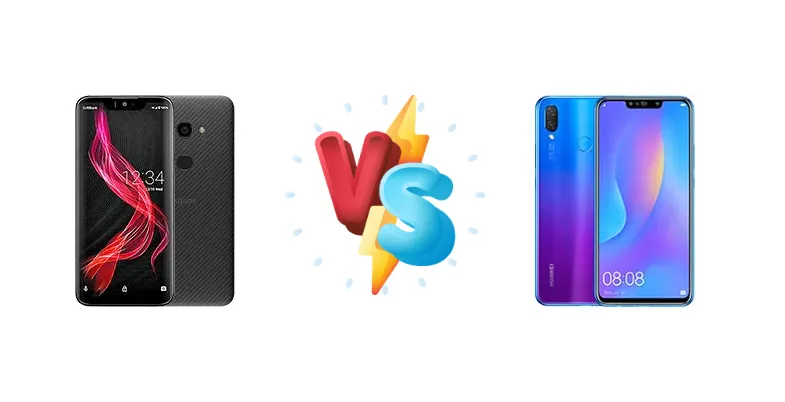
The Sharp Aquos Zero and Huawei nova 3i represent distinct approaches to the smartphone market. The Aquos Zero, equipped with a flagship Snapdragon 845, aimed for a premium experience, while the nova 3i targeted the mid-range with Huawei’s Kirin 710. This comparison dissects their key differences, helping you determine which device best suits your needs, especially considering the Aquos Zero's current availability as a discounted, older model.
🏆 Quick Verdict
For users prioritizing performance and future-proofing, the Sharp Aquos Zero is the clear winner thanks to its Snapdragon 845. However, the Huawei nova 3i provides a solid, functional experience at a significantly lower price point, making it ideal for budget-conscious consumers who don't demand top-tier processing power.
| Network |
|---|
| 2G bands | GSM 850 / 900 / 1800 / 1900 | GSM 850 / 900 / 1800 / 1900 |
| 3G bands | HSDPA 900 / 2100 | HSDPA 850 / 900 / 2100 |
| 4G bands | 1, 3, 7, 8, 28, 38 | 1, 3, 5, 7, 8, 28, 38, 40, 41 |
| Speed | HSPA 42.2/5.76 Mbps, LTE (3CA) Cat15 1024/50 Mbps | HSPA 42.2/5.76 Mbps, LTE (3CA) Cat12 600/150 Mbps |
| Technology | GSM / HSPA / LTE | GSM / HSPA / LTE |
| Launch |
|---|
| Announced | 2019, January. Released 2019, January | 2018, July 18. Released 2018, July 27 |
| Status | Discontinued | Discontinued |
| Body |
|---|
| Build | Glass front (Gorilla Glass 5), aluminum frame | Glass front, plastic back, plastic frame |
| Dimensions | 154 x 73 x 8.8 mm (6.06 x 2.87 x 0.35 in) | 157.6 x 75.2 x 7.6 mm (6.20 x 2.96 x 0.30 in) |
| SIM | Nano-SIM | Nano-SIM + Nano-SIM |
| Weight | 146 g (5.15 oz) | 169 g (5.96 oz) |
| | IP68 dust/water resistant (up to 1.5m for 30 mins) | - |
| Display |
|---|
| Protection | Corning Gorilla Glass 5 | - |
| Resolution | 1440 x 2992 pixels, 18.7:9 ratio (~536 ppi density) | 1080 x 2340 pixels, 19.5:9 ratio (~409 ppi density) |
| Size | 6.2 inches, 96.9 cm2 (~86.2% screen-to-body ratio) | 6.3 inches, 97.4 cm2 (~82.2% screen-to-body ratio) |
| Type | OLED, HDR10, Dolby Vision | IPS LCD |
| Platform |
|---|
| CPU | Octa-core (4x2.6 GHz Kryo 385 Gold & 4x1.7 GHz Kryo 385 Silver) | Octa-core (4x2.2 GHz Cortex-A73 & 4x1.7 GHz Cortex-A53) |
| Chipset | Qualcomm SDM845 Snapdragon 845 (10 nm) | Kirin 710 (12 nm) |
| GPU | Adreno 630 | Mali-G51 MP4 |
| OS | Android 9.0 (Pie) | Android 8.1 (Oreo), upgradable to Android 9.0 (Pie), EMUI 9.0 |
| Memory |
|---|
| Card slot | No | microSDXC (uses shared SIM slot) |
| Internal | 128GB 6GB RAM | 64GB 4GB RAM, 128GB 4GB RAM, 128GB 6GB RAM |
| | - | eMMC 5.1 |
| Main Camera |
|---|
| Dual | - | 16 MP, f/2.2, PDAF
Auxiliary lens |
| Features | LED flash, HDR, panorama | LED flash, HDR, panorama |
| Single | 22.6 MP, f/1.9, 22 mm, PDAF, OIS | - |
| Video | 4K@30fps, 1080p@30fps (gyro-EIS) | 1080p@30fps |
| Selfie camera |
|---|
| Dual | - | 24 MP, f/2.0, 26mm (wide), 1/2.8", 0.9µm
2 MP, depth sensor |
| Features | HDR | HDR |
| Single | 8 MP, f/2.2, 23 mm | - |
| Video | 1080p@30fps | 1080p@30fps |
| Sound |
|---|
| 3.5mm jack | No | Yes |
| 35mm jack | No | Yes |
| Loudspeaker | Yes, with stereo speakers | Yes |
| |
24-bit/192kHz audio | - |
| Comms |
|---|
| Bluetooth | 5.0, A2DP, LE | 4.2, A2DP, LE, EDR, aptX HD |
| NFC | Yes | No |
| Positioning | GPS, GLONASS, GALILEO, QZSS | GPS, GLONASS, BDS |
| Radio | No | FM radio |
| USB | USB Type-C 2.0 | microUSB 2.0, OTG |
| WLAN | Wi-Fi 802.11 a/b/g/n/ac, dual-band, Wi-Fi Direct | Wi-Fi 802.11 b/g/n, Wi-Fi Direct |
| Features |
|---|
| Sensors | Fingerprint (rear-mounted), accelerometer, gyro, proximity, compass | Fingerprint (rear-mounted), accelerometer, gyro, proximity, compass |
| Battery |
|---|
| Charging | 18W wired, PD2.0 | 10W wired |
| Type | Li-Ion 3130 mAh, non-removable | Li-Ion 3340 mAh, non-removable |
| Misc |
|---|
| Colors | Meteorite Black | Black, Pearl White, Iris Purple |
| Models | SH-Z10 | INE-LX1, INE-LX1r, INE-LX1, Sydney 6353, INE-LX2r, INE-AL00, INE-TL00 |
| Price | About 600 EUR | About 220 EUR |
Sharp Aquos Zero
- Significantly faster processor (Snapdragon 845)
- Faster charging with PD2.0 (18W)
- Likely superior camera system
- Potentially higher price (even now)
- May be harder to find new
Huawei nova 3i
- More affordable price
- Decent performance for everyday tasks
- Widely available
- Slower processor (Kirin 710)
- Slower charging (10W)
- Likely inferior camera performance
Display Comparison
While display specifications aren't provided, the Aquos Zero, being a higher-tier device, likely featured a superior panel in terms of color accuracy and brightness. The nova 3i, typical of its price range, likely utilized an IPS LCD. The Aquos Zero’s potential for higher peak brightness would translate to better outdoor visibility. The absence of detailed display specs highlights the Aquos Zero’s overall focus on premium components.
Camera Comparison
Without detailed camera specs, it’s difficult to make a precise comparison. However, given the Aquos Zero’s flagship positioning, it likely featured a more sophisticated camera system with a larger sensor and potentially optical image stabilization (OIS). The nova 3i likely relied on software processing to enhance image quality. The Aquos Zero’s superior processing power from the Snapdragon 845 would also contribute to faster image processing and better low-light performance. The presence of a 2MP macro camera on the nova 3i is a common feature in this price bracket, but its utility is limited compared to a well-tuned primary sensor.
Performance
The core difference lies in the chipsets. The Sharp Aquos Zero’s Qualcomm Snapdragon 845 (10nm) significantly outperforms the Huawei nova 3i’s Kirin 710 (12nm). The Snapdragon 845’s Kryo 385 cores, with their 2.6 GHz clock speed, offer a substantial advantage over the Kirin 710’s Cortex-A73 cores at 2.2 GHz. The 10nm process node of the Snapdragon 845 also contributes to better thermal efficiency, reducing the likelihood of throttling during sustained workloads. This means the Aquos Zero will handle graphically intensive games and demanding applications with greater ease and consistency. The Kirin 710, while capable, is designed for everyday tasks and lighter gaming.
Battery Life
Battery capacity isn't specified, but the Aquos Zero’s 18W wired charging with PD2.0 support provides a significant advantage over the nova 3i’s 10W charging. PD2.0 allows for faster and more efficient charging, meaning the Aquos Zero can replenish its battery more quickly. While a larger battery capacity on the nova 3i could offset the slower charging, the Aquos Zero’s faster charging speeds would be more convenient for users who frequently need to top up their battery.
Buying Guide
Buy the Sharp Aquos Zero if you need a phone capable of handling demanding games, intensive multitasking, and benefit from faster charging speeds. It’s a good choice for those who want a near-flagship experience at a potentially reduced price. Buy the Huawei nova 3i if you prioritize affordability, a decent camera for social media, and a reliable daily driver for basic tasks like browsing, calling, and messaging. It’s a practical option for users who don’t require the latest and greatest in mobile processing.
Frequently Asked Questions
❓ Will the Kirin 710 in the nova 3i struggle with modern mobile games?
The Kirin 710 can handle many mobile games, but you'll likely need to lower graphics settings for demanding titles like PUBG or Genshin Impact to maintain a smooth frame rate. The Snapdragon 845 in the Aquos Zero will provide a much more consistent and higher-fidelity gaming experience.
❓ Is the 10W charging on the nova 3i noticeably slow compared to the Aquos Zero's 18W PD2.0?
Yes, the difference is significant. 10W charging will take considerably longer to fully charge the nova 3i, potentially taking over two hours. The Aquos Zero’s 18W PD2.0 charging can reduce that time by a substantial margin, making it more convenient for users on the go.
❓ Given the Aquos Zero is an older model, are replacement parts and software updates still readily available?
This is a valid concern. While the Aquos Zero was a premium device, its age means software updates may be limited or non-existent. Finding replacement parts could also be more challenging than for newer, more popular models. This is a trade-off for the potentially lower price.