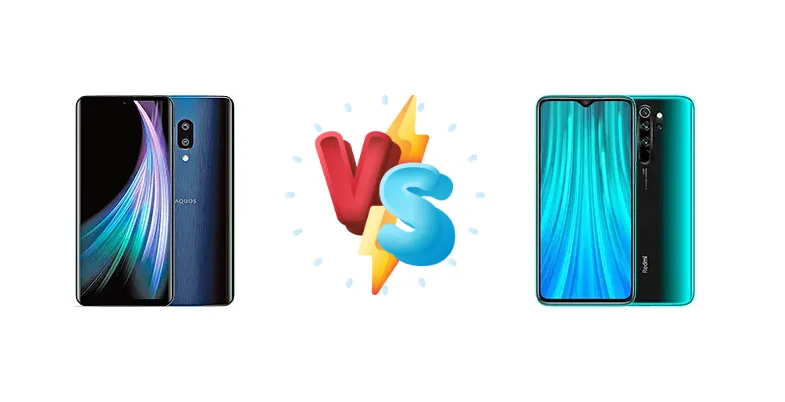
The Sharp Aquos Zero 2 and Xiaomi Redmi Note 8 Pro represent distinct approaches to the smartphone market. The Aquos Zero 2, equipped with a flagship Snapdragon 855, aimed for a premium, compact experience. Conversely, the Redmi Note 8 Pro targeted the mid-range with a focus on value, highlighted by its Helio G90T chipset and versatile camera system. This comparison dissects their strengths and weaknesses to determine which device best suits your needs.
🏆 Quick Verdict
For users prioritizing raw performance and a more refined experience, the Sharp Aquos Zero 2 is the superior choice, thanks to its Snapdragon 855. However, the Xiaomi Redmi Note 8 Pro delivers excellent value, offering a compelling feature set and solid performance for everyday tasks and casual gaming at a significantly lower price point.
| Network |
|---|
| 2G bands | GSM 850 / 900 / 1800 / 1900 | GSM 850 / 900 / 1800 / 1900 |
| 3G bands | HSDPA 850 / 900 / 1700(AWS) / 1900 / 2100 | HSDPA 850 / 900 / 1900 / 2100 |
| 4G bands | 1, 2, 3, 4, 5, 6, 7, 8, 11, 12, 13, 17, 18, 19, 20, 28, 38, 39, 41 - Taiwan | 1, 3, 5, 7, 8, 40, 41 |
| Speed | HSPA, LTE | HSPA, LTE |
| Technology | GSM / HSPA / LTE | GSM / HSPA / LTE |
| Launch |
|---|
| Announced | 2020, May 22. Released 2020, May 22 | 2019, August 29. Released 2019, September 24 |
| Status | Discontinued | Discontinued |
| Body |
|---|
| Build | - | Glass front (Gorilla Glass 5), glass back (Gorilla Glass 5), plastic frame |
| Dimensions | 158 x 74 x 8.8 mm (6.22 x 2.91 x 0.35 in) | 161.4 x 76.4 x 8.8 mm (6.35 x 3.01 x 0.35 in) |
| SIM | Nano-SIM | Nano-SIM + Nano-SIM |
| Weight | 141 g (4.97 oz) | 200 g (7.05 oz) |
| | IP68 dust/water resistant (up to 1.5m for 30 mins) | - |
| Display |
|---|
| Protection | Corning Gorilla Glass 6 | Corning Gorilla Glass 5 |
| Resolution | 1080 x 2340 pixels, 19.5:9 ratio (~403 ppi density) | 1080 x 2340 pixels, 19.5:9 ratio (~395 ppi density) |
| Size | 6.4 inches, 100.5 cm2 (~86.0% screen-to-body ratio) | 6.53 inches, 104.7 cm2 (~84.9% screen-to-body ratio) |
| Type | OLED, 1B colors, 240Hz, HDR10, Dolby Vision | IPS LCD, HDR, 500 nits (typ) |
| Platform |
|---|
| CPU | Octa-core (1x2.84 GHz Kryo 485 & 3x2.42 GHz Kryo 485 & 4x1.78 GHz Kryo 485) | Octa-core (2x2.05 GHz Cortex-A76 & 6x2.0 GHz Cortex-A55) |
| Chipset | Qualcomm SM8150 Snapdragon 855 (7 nm) | Mediatek MT6785V/CC Helio G90T (12 nm) |
| GPU | Adreno 640 | Mali-G76 MC4 |
| OS | Android 10 | Android 9.0 (Pie), upgradable to Android 11, MIUI 12.5 |
| Memory |
|---|
| Card slot | No | microSDXC (uses shared SIM slot) |
| Internal | 256GB 8GB RAM | 64GB 4GB RAM, 64GB 6GB RAM, 128GB 4GB RAM, 128GB 6GB RAM, 128GB 8GB RAM, 256GB 8GB RAM |
| | UFS 3.0 | UFS 2.1 |
| Main Camera |
|---|
| Dual | 12.2 MP, f/1.7, (wide), 1/2.55", 1.4µm, dual pixel PDAF, OIS
20 MP, f/2.4, 125˚ (ultrawide), AF | - |
| Features | LED flash, HDR, panorama | LED flash, HDR, panorama |
| Quad | - | 64 MP, f/1.9, 26mm (wide), 1/1.72", 0.8µm, PDAF
8 MP, f/2.2, 13mm (ultrawide), 1/4.0", 1.12µm
2 MP (macro)
Auxiliary lens |
| Video | 4K@30fps, 1080p@30fps, gyro-EIS | 4K@30fps, 1080p@30/60/120fps, 720p@960fps, gyro-EIS |
| Selfie camera |
|---|
| Features | HDR | HDR, panorama |
| Single | 8 MP, f/2.2, 23mm (wide) | 20 MP, f/2.0, (wide), 1/3", 0.9µm |
| Video | 1080p@30fps, gyro-EIS | 1080p@30fps |
| Sound |
|---|
| 3.5mm jack | No | Yes |
| 35mm jack | No | Yes |
| Loudspeaker | Yes, with stereo speakers | Yes |
| | 24-bit/192kHz audio | - |
| Comms |
|---|
| Bluetooth | 5.0, A2DP, LE, aptX HD, aptX Adaptive | 5.0, A2DP, LE |
| Infrared port | - | Yes |
| NFC | Yes | Yes |
| Positioning | GPS (L1+L5), GLONASS, BDS, GALILEO, QZSS | GPS, GLONASS, GALILEO, BDS |
| Radio | No | FM radio, recording |
| USB | USB Type-C 2.0 | USB Type-C 2.0 |
| WLAN | Wi-Fi 802.11 a/b/g/n/ac, dual-band, Wi-Fi Direct | Wi-Fi 802.11 a/b/g/n/ac, dual-band, Wi-Fi Direct |
| Features |
|---|
| Sensors | Fingerprint (under display, optical), accelerometer, gyro, proximity, compass | Fingerprint (rear-mounted), accelerometer, gyro, proximity, compass |
| Battery |
|---|
| Charging | Wired, PD2.0 | 18W wired |
| Type | Li-Ion 3130 mAh | Li-Po 4500 mAh, non-removable |
| Misc |
|---|
| Colors | Blue | Black, Red, Blue, White, Deep Sea Blue, Midnight Blue, Electric Blue, Twilight Orange |
| Models | SH-Z20, SHV47, 906SH | 2015105, M1906G7I, M1906G7G |
| Price | About 670 EUR | About 220 EUR |
| SAR | - | 1.15 W/kg (head) 1.18 W/kg (body) |
| SAR EU | - | 1.00 W/kg (head) 1.47 W/kg (body) |
| Tests |
|---|
| Audio quality | - |
Noise -93.6dB / Crosstalk -91.9dB |
| Battery life | - | Endurance rating 114h |
| Camera | - |
Photo / Video |
| Display | - |
Contrast ratio: 1326:1 (nominal) |
| Loudspeaker | - |
Voice 64dB / Noise 71dB / Ring 82dB |
| Performance | - |
AnTuTu: 224759 (v7), 279355 (v8)
GeekBench: 6999 (v4.4), 1622 (v5.1)
GFXBench: 14fps (ES 3.1 onscreen) |
Sharp Aquos Zero 2
- Flagship Snapdragon 855 processor delivers superior performance.
- PD2.0 charging offers faster and more versatile charging.
- Likely higher quality display and build materials.
- Limited information on battery capacity.
- Potentially higher price point.
Xiaomi Redmi Note 8 Pro
- Excellent value for money.
- Versatile camera system with a 64MP main sensor.
- Long battery life (114h endurance rating).
- Less powerful Helio G90T processor.
- 12nm process node leads to lower efficiency.
- 2MP macro camera offers limited utility.
Display Comparison
The Redmi Note 8 Pro boasts a 6.53-inch display with a measured peak brightness of 640 nits and a 1326:1 contrast ratio. While respectable, the Aquos Zero 2, though display specs are not provided, likely benefits from a higher-quality panel befitting its flagship status. The Redmi Note 8 Pro’s contrast ratio, while nominal, suggests a standard IPS LCD experience. The absence of details on the Aquos Zero 2’s panel technology (LTPO, OLED) leaves room for speculation, but its positioning suggests a superior visual experience. Bezels are likely slimmer on the Aquos Zero 2, contributing to its compact form factor.
Camera Comparison
Both phones offer photo and video capabilities, but details are limited. The Redmi Note 8 Pro gained notoriety for its 64MP main sensor, a significant feature for its price point. However, sensor size and lens aperture are crucial factors not provided. The Aquos Zero 2, being a flagship, likely features a more sophisticated camera system with a larger sensor and better image processing. The Redmi Note 8 Pro’s inclusion of a 2MP macro camera is largely a marketing gimmick, offering limited practical benefit. The Aquos Zero 2’s image processing algorithms are likely more refined, resulting in better dynamic range and low-light performance.
Performance
The core difference lies in the chipsets. The Sharp Aquos Zero 2’s Qualcomm Snapdragon 855 (7nm) is a significant step up from the Xiaomi Redmi Note 8 Pro’s MediaTek Helio G90T (12nm). The Snapdragon 855’s Kryo 485 cores, with their varying clock speeds (2.84 GHz, 2.42 GHz, 1.78 GHz), offer superior single-core and multi-core performance. The Helio G90T’s Cortex-A76 and A55 cores, while capable, are less efficient and powerful. The 7nm process node of the Snapdragon 855 also translates to better thermal efficiency, reducing the likelihood of throttling during sustained workloads. While the Redmi Note 8 Pro is adequate for most tasks, the Aquos Zero 2 provides a smoother, more responsive experience, especially in demanding games and applications.
Battery Life
Both devices share an endurance rating of 114 hours, suggesting comparable battery life despite the Aquos Zero 2 lacking specific battery capacity information. However, the Redmi Note 8 Pro features 18W wired charging, while the Aquos Zero 2 supports PD2.0, a faster and more versatile charging standard. PD2.0 allows for potentially faster charging speeds with compatible chargers, and can also be used to charge other devices. The efficiency of the Snapdragon 855 may offset any potential battery capacity difference, contributing to similar real-world usage times.
Buying Guide
Buy the Sharp Aquos Zero 2 if you need a compact phone with flagship-level processing power for demanding applications, gaming, or future-proofing. Its PD2.0 charging and potentially higher build quality justify the investment for power users. Buy the Xiaomi Redmi Note 8 Pro if you prefer a larger display, a versatile camera system, and long battery life without breaking the bank. It’s ideal for everyday users, social media enthusiasts, and those seeking a capable gaming experience on a budget.
Frequently Asked Questions
❓ Does the Helio G90T in the Redmi Note 8 Pro struggle with demanding games like PUBG or Genshin Impact?
While the Helio G90T can run PUBG, you'll likely need to lower graphics settings for a smooth experience. Genshin Impact may be less playable, even on lower settings, due to the chipset's limitations. The Snapdragon 855 in the Aquos Zero 2 handles these games with ease at higher settings.
❓ Is the 64MP camera on the Redmi Note 8 Pro a significant advantage over what the Aquos Zero 2 offers?
Megapixel count isn't everything. While the 64MP sensor captures more detail, the Aquos Zero 2 likely benefits from a larger sensor, better optics, and more sophisticated image processing, resulting in superior image quality, especially in challenging lighting conditions.
❓ How much faster is PD2.0 charging on the Aquos Zero 2 compared to the 18W charging on the Redmi Note 8 Pro?
PD2.0 can deliver up to 45W with compatible chargers, significantly faster than the Redmi Note 8 Pro's 18W. Even with a standard PD charger, the Aquos Zero 2 will likely charge faster, and the protocol offers more flexibility for charging other devices.