
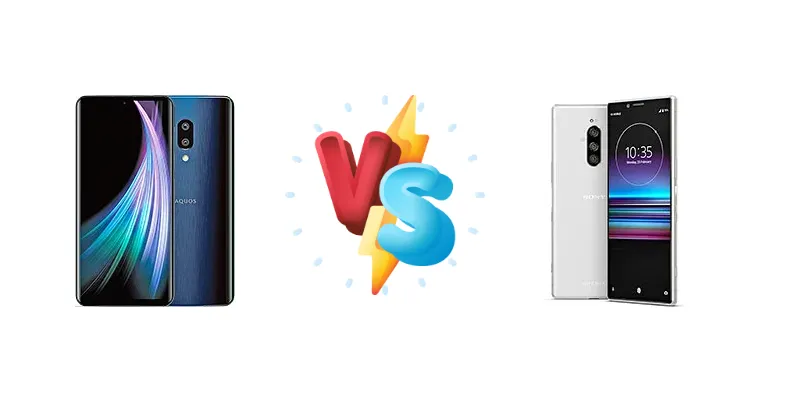
Sharp Aquos Zero 2 vs Sony Xperia 1: A Detailed Comparison of 2019 Flagships
| Phones Images | |||||
|---|---|---|---|---|---|
|
🏆 Quick Verdict
For the average user prioritizing long-term battery life and a more streamlined experience, the Sony Xperia 1 emerges as the better choice. While the Aquos Zero 2 is a capable device, the Xperia 1’s 79-hour endurance rating and refined software provide a more consistent and reliable performance.
| PHONES | ||
|---|---|---|
| Phone Names | Sharp Aquos Zero 2 | Sony Xperia 1 |
| Network | ||
|---|---|---|
| 2G bands | GSM 850 / 900 / 1800 / 1900 | GSM 850 / 900 / 1800 / 1900 |
| 3G bands | HSDPA 850 / 900 / 1700(AWS) / 1900 / 2100 | HSDPA 800 / 850 / 900 / 1700(AWS) / 1900 / 2100 |
| 4G bands | 1, 2, 3, 4, 5, 6, 7, 8, 11, 12, 13, 17, 18, 19, 20, 28, 38, 39, 41 - Taiwan | 1, 2, 3, 4, 5, 7, 8, 12, 13, 17, 19, 20, 26, 28, 29, 32, 38, 39, 40, 41, 46, 66 |
| Speed | HSPA, LTE | HSPA 42.2/5.76 Mbps, LTE Cat19 1600/150 Mbps |
| Technology | GSM / HSPA / LTE | GSM / HSPA / LTE |
| Launch | ||
|---|---|---|
| Announced | 2020, May 22. Released 2020, May 22 | 2019, February 25. Released 2019, May 30 |
| Status | Discontinued | Discontinued |
| Body | ||
|---|---|---|
| Build | - | Glass front (Gorilla Glass 6), glass back (Gorilla Glass 6), aluminum frame |
| Dimensions | 158 x 74 x 8.8 mm (6.22 x 2.91 x 0.35 in) | 167 x 72 x 8.2 mm (6.57 x 2.83 x 0.32 in) |
| SIM | Nano-SIM | · Nano-SIM· Nano-SIM + Nano-SIM |
| Weight | 141 g (4.97 oz) | 178 g (6.28 oz) |
| IP68 dust/water resistant (up to 1.5m for 30 mins) | IP65/IP68 dust/water resistant (up to 1.5m for 30 mins) | |
| Display | ||
|---|---|---|
| Protection | Corning Gorilla Glass 6 | Corning Gorilla Glass 6 |
| Resolution | 1080 x 2340 pixels, 19.5:9 ratio (~403 ppi density) | 1644 x 3840 pixels, 21:9 ratio (~643 ppi density) |
| Size | 6.4 inches, 100.5 cm2 (~86.0% screen-to-body ratio) | 6.5 inches, 98.6 cm2 (~82.0% screen-to-body ratio) |
| Type | OLED, 1B colors, 240Hz, HDR10, Dolby Vision | OLED, HDR BT.2020 |
| - | Runs at 1096 x 2560 pixels except for select use cases Triluminos display X-Reality Engine | |
| Platform | ||
|---|---|---|
| CPU | Octa-core (1x2.84 GHz Kryo 485 & 3x2.42 GHz Kryo 485 & 4x1.78 GHz Kryo 485) | Octa-core (1x2.84 GHz Kryo 485 & 3x2.42 GHz Kryo 485 & 4x1.78 GHz Kryo 485) |
| Chipset | Qualcomm SM8150 Snapdragon 855 (7 nm) | Qualcomm SM8150 Snapdragon 855 (7 nm) |
| GPU | Adreno 640 | Adreno 640 |
| OS | Android 10 | Android 9.0 (Pie), upgradable to Android 11 |
| Memory | ||
|---|---|---|
| Card slot | No | microSDXC (uses shared SIM slot) - dual SIM model only |
| Internal | 256GB 8GB RAM | 64GB 6GB RAM, 128GB 6GB RAM |
| UFS 3.0 | UFS 2.1 | |
| Main Camera | ||
|---|---|---|
| Dual | 12.2 MP, f/1.7, (wide), 1/2.55", 1.4µm, dual pixel PDAF, OIS 20 MP, f/2.4, 125˚ (ultrawide), AF | - |
| Features | LED flash, HDR, panorama | Color spectrum sensor, LED flash, panorama, HDR, eye tracking |
| Triple | - | 12 MP, f/1.6, 26mm (wide), 1/2.55", 1.4µm, predictive dual pixel PDAF, 5-axis OIS 12 MP, f/2.4, 52mm (telephoto), 1/3.4", 1.0µm, predictive PDAF, 2x optical zoom, 5-axis OIS 12 MP, f/2.4, 16mm (ultrawide), 1/3.4", 1.0µm |
| Video | 4K@30fps, 1080p@30fps, gyro-EIS | 4K@24/25/30fps HDR, 1080p@60fps, 1080p@30fps (5-axis gyro-EIS), 1080p@960fps |
| Selfie camera | ||
|---|---|---|
| Features | HDR | HDR |
| Single | 8 MP, f/2.2, 23mm (wide) | 8 MP, f/2.0, 24mm (wide), 1/4.0", 1.12µm |
| Video | 1080p@30fps, gyro-EIS | 1080p@30fps (5-axis gyro-EIS) |
| Sound | ||
|---|---|---|
| 3.5mm jack | No | No |
| 35mm jack | No | No |
| Loudspeaker | Yes, with stereo speakers | Yes, with stereo speakers |
| 24-bit/192kHz audio | 24-bit/192kHz audio Dynamic vibration system | |
| Comms | ||
|---|---|---|
| Bluetooth | 5.0, A2DP, LE, aptX HD, aptX Adaptive | 5.0, A2DP, aptX HD, LE |
| NFC | Yes | Yes |
| Positioning | GPS (L1+L5), GLONASS, BDS, GALILEO, QZSS | GPS, GLONASS, BDS, GALILEO |
| Radio | No | No |
| USB | USB Type-C 2.0 | USB Type-C 3.1, OTG |
| WLAN | Wi-Fi 802.11 a/b/g/n/ac, dual-band, Wi-Fi Direct | Wi-Fi 802.11 a/b/g/n/ac, dual-band, Wi-Fi Direct, DLNA |
| Features | ||
|---|---|---|
| Sensors | Fingerprint (under display, optical), accelerometer, gyro, proximity, compass | Fingerprint (side-mounted), accelerometer, gyro, proximity, barometer, compass |
| Battery | ||
|---|---|---|
| Charging | Wired, PD2.0 | 18W wired, PD2.0 |
| Type | Li-Ion 3130 mAh | Li-Ion 3330 mAh, non-removable |
| Misc | ||
|---|---|---|
| Colors | Blue | Black, Gray, Purple, White |
| Models | SH-Z20, SHV47, 906SH | J8110, J8170, J9110, J9150, SOV40, SO-03L |
| Price | About 670 EUR | About 500 EUR |
| Tests | ||
|---|---|---|
| Audio quality | - | Noise -93.6dB / Crosstalk -85.2dB |
| Battery life | - | Endurance rating 79h |
| Camera | - | Photo / Video |
| Display | - | Contrast ratio: Infinite (nominal) |
| Loudspeaker | - | -26.7 LUFS (Good) |
| Performance | - | AnTuTu: 356734 (v7), 418206 (v8) GeekBench: 10985 (v4.4), 2753 (v5.1) GFXBench: 33fps (ES 3.1 onscreen) |
Sharp Aquos Zero 2
- Potentially lighter design (speculation)
- Snapdragon 855 performance
- PD2.0 charging support
- Limited information available
- Unknown battery capacity and charging speed
Sony Xperia 1
- Exceptional 79-hour battery endurance
- Bright 665 nit display with infinite contrast
- 18W PD2.0 fast charging
- Polarizing 21:9 aspect ratio
- Snapdragon 855 is now several generations old
Display Comparison
The Sony Xperia 1 boasts a 665 nit peak brightness, a figure not provided for the Aquos Zero 2, suggesting a potentially superior viewing experience in direct sunlight. The Xperia 1’s ‘infinite’ contrast ratio, while a nominal specification, indicates a high-quality panel capable of deep blacks. Without panel technology details for the Aquos Zero 2, it’s difficult to assess its color accuracy or viewing angles relative to the Xperia 1. The Xperia 1’s 21:9 aspect ratio, while polarizing, caters to multimedia consumption and multitasking, a feature absent from the Aquos Zero 2’s likely more conventional display.
Camera Comparison
Both devices feature photo and video capabilities, but detailed camera specifications are lacking for the Aquos Zero 2. The Xperia 1’s camera system, while not detailed in the provided data, benefits from Sony’s expertise in image sensor technology and image processing. Without sensor size, aperture, or OIS information for the Aquos Zero 2, it’s impossible to assess its low-light performance or image stabilization capabilities relative to the Xperia 1. The absence of any mention of multiple cameras on the Aquos Zero 2 suggests a simpler camera setup compared to the Xperia 1.
Performance
Both the Sharp Aquos Zero 2 and Sony Xperia 1 are powered by the Qualcomm SM8150 Snapdragon 855 (7 nm) chipset, featuring an identical octa-core CPU configuration. This means raw processing power will be comparable for most tasks. However, thermal management – a critical factor for sustained performance – is unknown for the Aquos Zero 2. The Xperia 1’s larger chassis may offer better heat dissipation, potentially mitigating throttling during extended gaming sessions. Both devices support PD2.0 charging, but the Xperia 1’s 18W charging speed is explicitly stated, while the Aquos Zero 2’s charging speed is not.
Battery Life
The Sony Xperia 1’s standout feature is its impressive 79-hour endurance rating, indicating exceptional battery life. While the Aquos Zero 2’s battery capacity is unknown, the Xperia 1’s endurance suggests superior power efficiency or a larger battery. Both devices support PD2.0 charging, and the Xperia 1’s 18W charging speed provides a defined charging timeframe. Without charging speed data for the Aquos Zero 2, it’s difficult to estimate its 0-100% charge time.
Buying Guide
Buy the Sharp Aquos Zero 2 if you prioritize a potentially lighter design (though weight data is unavailable) and are comfortable with a less mainstream brand experience. Buy the Sony Xperia 1 if you prefer a more polished software experience, a brighter display with infinite contrast, and exceptional battery endurance for demanding users who need all-day power.