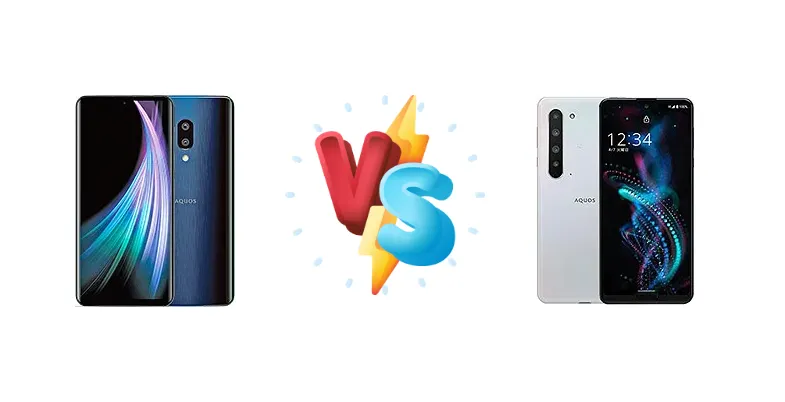
The Sharp Aquos Zero 2 and R5G represent a fascinating period for the brand, offering high-end specs in relatively compact form factors. While both devices aimed for the flagship space, they arrived with different chipsets – the Snapdragon 855 and 865 respectively – and at different points in the 5G rollout. This comparison dissects the core differences to help you determine which, if either, remains a viable option today.
🏆 Quick Verdict
For the average user in 2024, the Sharp Aquos R5G is the better choice. The Snapdragon 865 offers a noticeable performance uplift over the 855, particularly in sustained workloads and 5G connectivity, justifying the price difference at launch and likely still holding an edge in longevity.
| Network |
|---|
| 2G bands | GSM 850 / 900 / 1800 / 1900 | GSM 850 / 900 / 1800 / 1900 |
| 3G bands | HSDPA 850 / 900 / 1700(AWS) / 1900 / 2100 | HSDPA 850 / 900 / 1900 / 2100 |
| 4G bands | 1, 2, 3, 4, 5, 6, 7, 8, 11, 12, 13, 17, 18, 19, 20, 28, 38, 39, 41 - Taiwan | 1, 3, 7, 8, 20, 28, 38, 41 |
| 5G bands | - | 1, 3, 28, 78 SA/NSA |
| Speed | HSPA, LTE | HSPA, LTE, 5G |
| Technology | GSM / HSPA / LTE | GSM / HSPA / LTE / 5G |
| Launch |
|---|
| Announced | 2020, May 22. Released 2020, May 22 | 2020, February. Released 2020, February |
| Status | Discontinued | Discontinued |
| Body |
|---|
| Dimensions | 158 x 74 x 8.8 mm (6.22 x 2.91 x 0.35 in) | 162 x 75 x 8.9 mm (6.38 x 2.95 x 0.35 in) |
| SIM | Nano-SIM | Nano-SIM |
| Weight | 141 g (4.97 oz) | 189 g (6.67 oz) |
| | IP68 dust/water resistant (up to 1.5m for 30 mins) | IPX5/IP6X/IPX8 water/dust resistant (up to 1.5m for 30 min) |
| Display |
|---|
| Protection | Corning Gorilla Glass 6 | - |
| Resolution | 1080 x 2340 pixels, 19.5:9 ratio (~403 ppi density) | 1440 x 3168 pixels (~544 ppi density) |
| Size | 6.4 inches, 100.5 cm2 (~86.0% screen-to-body ratio) | 6.4 inches, 99.5 cm2 (~81.9% screen-to-body ratio) |
| Type | OLED, 1B colors, 240Hz, HDR10, Dolby Vision | IGZO IPS LCD, 1B colors, 120Hz, Dolby Vision |
| Platform |
|---|
| CPU | Octa-core (1x2.84 GHz Kryo 485 & 3x2.42 GHz Kryo 485 & 4x1.78 GHz Kryo 485) | Octa-core (1x2.84 GHz Cortex-A77 & 3x2.42 GHz Cortex-A77 & 4x1.80 GHz Cortex-A55) |
| Chipset | Qualcomm SM8150 Snapdragon 855 (7 nm) | Qualcomm SM8250 Snapdragon 865 5G (7 nm+) |
| GPU | Adreno 640 | Adreno 650 |
| OS | Android 10 | Android 10 |
| Memory |
|---|
| Card slot | No | No |
| Internal | 256GB 8GB RAM | 256GB 12GB RAM |
| | UFS 3.0 | UFS 3.0 |
| Main Camera |
|---|
| Dual | 12.2 MP, f/1.7, (wide), 1/2.55", 1.4µm, dual pixel PDAF, OIS
20 MP, f/2.4, 125˚ (ultrawide), AF | - |
| Features | LED flash, HDR, panorama | LED flash, panorama |
| Triple | - | 12 MP, f/1.7, 26mm (wide), 1.4µm, dual pixel PDAF, OIS
12 MP, f/2.7, 52mm (telephoto), 1.0µm, PDAF, 2x optical zoom, OIS
48 MP, f/2.9, 19mm (ultrawide), 0.8µm
TOF 3D (depth) |
| Video | 4K@30fps, 1080p@30fps, gyro-EIS | 8K@30fps, 1080p@30fps |
| Selfie camera |
|---|
| Features | HDR | - |
| Single | 8 MP, f/2.2, 23mm (wide) | 16 MP, f/2.0, 26mm (wide), 0.7µm |
| Video | 1080p@30fps, gyro-EIS | 1080p@30fps |
| Sound |
|---|
| 3.5mm jack | No | No |
| 35mm jack | No | No |
| Loudspeaker | Yes, with stereo speakers | Yes, with stereo speakers |
| | 24-bit/192kHz audio | 24-bit/192kHz audio |
| Comms |
|---|
| Bluetooth | 5.0, A2DP, LE, aptX HD, aptX Adaptive | 5.1, A2DP, LE, aptX HD, aptX Adaptive |
| NFC | Yes | Yes |
| Positioning | GPS (L1+L5), GLONASS, BDS, GALILEO, QZSS | GPS (L1+L5), GLONASS, BDS, GALILEO, QZSS |
| Radio | No | No |
| USB | USB Type-C 2.0 | USB Type-C 3.1 |
| WLAN | Wi-Fi 802.11 a/b/g/n/ac, dual-band, Wi-Fi Direct | Wi-Fi 802.11 a/b/g/n/ac/ax/6, dual-band, Wi-Fi Direct |
| Features |
|---|
| Sensors | Fingerprint (under display, optical), accelerometer, gyro, proximity, compass | Fingerprint (front-mounted), accelerometer, gyro, proximity, compass |
| Battery |
|---|
| Charging | Wired, PD2.0 | - |
| Type | Li-Ion 3130 mAh | Li-Ion 3730 mAh |
| Misc |
|---|
| Colors | Blue | Glare Black, Aurora White |
| Models | SH-Z20, SHV47, 906SH | SH-51A, SHG01, SH-R50 |
| Price | About 670 EUR | About 700 EUR |
Sharp Aquos Zero 2
- Potentially lower price point in 2024
- Compact and lightweight design
- Capable Snapdragon 855 processor for everyday tasks
- Older chipset with less processing power
- Lacks 5G connectivity
- May exhibit more throttling under sustained load
Sharp Aquos R5G
- More powerful Snapdragon 865 processor
- Integrated 5G modem for faster connectivity
- Improved efficiency and thermal management
- Likely higher price point
- May be slightly larger and heavier
- Potential for software support to be limited
Display Comparison
Unfortunately, detailed display specs are unavailable. However, both Aquos phones were known for their high-quality IGZO LCD panels. The R5G, being a later model, likely benefited from refinements in color accuracy and potentially higher peak brightness. The Zero 2’s focus on minimizing bezels suggests a strong emphasis on screen-to-body ratio, a feature likely carried over to the R5G. Without specific nit ratings, it’s difficult to definitively declare a winner, but the R5G’s later release date suggests potential improvements in display technology.
Camera Comparison
Detailed camera specs are lacking, but both phones likely featured multi-camera systems. The R5G, as the higher-end model, likely benefited from a larger main sensor and more advanced image processing algorithms. The Snapdragon 865’s improved image signal processor (ISP) would also contribute to better image quality, particularly in low-light conditions. Without specific sensor sizes and aperture information, it’s difficult to make a precise comparison, but the R5G’s chipset and positioning suggest a superior camera experience.
Performance
The core difference lies in the chipsets. The Aquos Zero 2 utilizes the Qualcomm Snapdragon 855 (7nm), featuring an octa-core CPU with a 2.84 GHz Kryo 485 prime core. The R5G steps up to the Snapdragon 865 5G (7nm+). While both share the same core count, the 865 employs newer Cortex-A77 cores in its performance cluster, offering a significant architectural improvement over the Kryo 485. This translates to faster single-core and multi-core performance, especially noticeable in demanding applications. The '7nm+' process node of the 865 also contributes to improved efficiency and potentially better thermal management. The R5G’s integrated 5G modem is a key advantage, enabling faster download and upload speeds where 5G networks are available.
Battery Life
Battery capacity details are unavailable. However, both devices support wired charging with PD2.0. The R5G’s more efficient Snapdragon 865 could potentially offer longer battery life despite a similar or even smaller battery capacity. The 865’s improved power management features contribute to reduced power consumption during both active use and standby. While charging wattage isn’t specified, the R5G likely benefited from faster charging speeds due to advancements in charging technology at the time of its release.
Buying Guide
Buy the Sharp Aquos Zero 2 if you prioritize a potentially lower price point and are primarily focused on everyday tasks like browsing, social media, and light gaming. Its Snapdragon 855 is still capable, and the device's compact size is a major draw. Buy the Sharp Aquos R5G if you demand smoother performance in demanding games, benefit from 5G connectivity, and want a phone that feels more future-proof, even if it comes at a premium.
Frequently Asked Questions
❓ Will the Aquos R5G's 5G modem actually be useful in 2024?
While 5G coverage has expanded, its usefulness depends heavily on your location and carrier. If you live in an area with robust 5G infrastructure and have a compatible plan, the R5G's 5G modem will provide significantly faster download and upload speeds. However, if 5G is limited or unavailable, the benefit will be minimal.
❓ Is the performance difference between the Snapdragon 855 and 865 noticeable for everyday tasks?
For basic tasks like browsing, social media, and email, the performance difference will be subtle. However, when multitasking, playing demanding games, or editing photos/videos, the Snapdragon 865 in the R5G will provide a smoother and more responsive experience.
❓ How does the lack of detailed specs impact the comparison?
The absence of specific details like battery capacity, screen brightness, and camera sensor sizes forces us to rely on inferences based on the devices' positioning and the advancements in technology between their release dates. This makes the comparison less precise, but we've focused on the core chipset differences as the most significant factor.