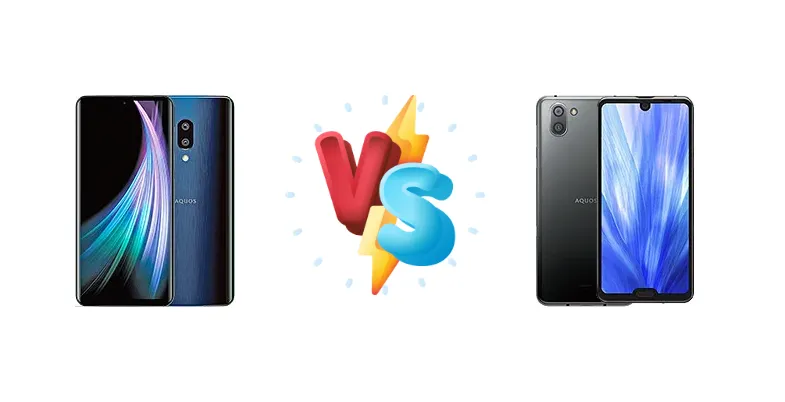
The Sharp Aquos Zero 2 and R3 represent a fascinating period for the Japanese manufacturer, both leveraging the powerful Snapdragon 855 chipset. While sharing core components, they diverge in key areas like charging capabilities and potentially, display technology. This comparison dissects these differences to determine which device best suits your priorities.
🏆 Quick Verdict
For most users, the Sharp Aquos R3 emerges as the better choice. While both phones offer identical processing power thanks to the Snapdragon 855, the R3’s inclusion of wireless charging adds significant convenience. The price difference, if any, is likely to be offset by this feature for many.
| Network |
|---|
| 2G bands | GSM 850 / 900 / 1800 / 1900 | GSM 850 / 900 / 1800 / 1900 |
| 3G bands | HSDPA 850 / 900 / 1700(AWS) / 1900 / 2100 | HSDPA 900 / 2100 |
| 4G bands | 1, 2, 3, 4, 5, 6, 7, 8, 11, 12, 13, 17, 18, 19, 20, 28, 38, 39, 41 - Taiwan | 1, 3, 7, 8, 28, 38 |
| Speed | HSPA, LTE | HSPA 42.2/5.76 Mbps, LTE (3CA) Cat15 1024/50 Mbps |
| Technology | GSM / HSPA / LTE | GSM / HSPA / LTE |
| Launch |
|---|
| Announced | 2020, May 22. Released 2020, May 22 | 2019, August. Released 2019, August |
| Status | Discontinued | Discontinued |
| Body |
|---|
| Dimensions | 158 x 74 x 8.8 mm (6.22 x 2.91 x 0.35 in) | 156 x 74 x 8.9 mm (6.14 x 2.91 x 0.35 in) |
| SIM | Nano-SIM | Nano-SIM + Nano-SIM |
| Weight | 141 g (4.97 oz) | 185 g (6.53 oz) |
| | IP68 dust/water resistant (up to 1.5m for 30 mins) | IPX5/IP6X/IPX8 water/dust resistant (up to 1.5m for 30 min) |
| Display |
|---|
| Protection | Corning Gorilla Glass 6 | Corning Gorilla Glass 5 |
| Resolution | 1080 x 2340 pixels, 19.5:9 ratio (~403 ppi density) | 1440 x 3120 pixels, 19.5:9 ratio (~554 ppi density) |
| Size | 6.4 inches, 100.5 cm2 (~86.0% screen-to-body ratio) | 6.2 inches, 94.4 cm2 (~81.7% screen-to-body ratio) |
| Type | OLED, 1B colors, 240Hz, HDR10, Dolby Vision | IGZO IPS LCD, 1B colors, 120Hz, HDR10, Dolby Vision |
| Platform |
|---|
| CPU | Octa-core (1x2.84 GHz Kryo 485 & 3x2.42 GHz Kryo 485 & 4x1.78 GHz Kryo 485) | Octa-core (1x2.84 GHz Kryo 485 & 3x2.42 GHz Kryo 485 & 4x1.78 GHz Kryo 485) |
| Chipset | Qualcomm SM8150 Snapdragon 855 (7 nm) | Qualcomm SM8150 Snapdragon 855 (7 nm) |
| GPU | Adreno 640 | Adreno 640 |
| OS | Android 10 | Android 9.0 (Pie), upgradable to Android 10 |
| Memory |
|---|
| Card slot | No | microSDXC (uses shared SIM slot) |
| Internal | 256GB 8GB RAM | 128GB 6GB RAM |
| | UFS 3.0 | UFS |
| Main Camera |
|---|
| Dual | 12.2 MP, f/1.7, (wide), 1/2.55", 1.4µm, dual pixel PDAF, OIS
20 MP, f/2.4, 125˚ (ultrawide), AF | 12.2 MP, f/1.7, (wide), 1/2.55", 1.4µm, dual pixel PDAF, OIS
20 MP, f/2.4, 125˚ (ultrawide), AF, OIS |
| Features | LED flash, HDR, panorama | Dual-LED flash, HDR, panorama |
| Video | 4K@30fps, 1080p@30fps, gyro-EIS | 1080p@30fps |
| Selfie camera |
|---|
| Features | HDR | - |
| Single | 8 MP, f/2.2, 23mm (wide) | 16 MP, f/2.0 |
| Video | 1080p@30fps, gyro-EIS | 1080p@30fps |
| Sound |
|---|
| 3.5mm jack | No | Yes |
| 35mm jack | No | Yes |
| Loudspeaker | Yes, with stereo speakers | Yes, with stereo speakers |
| | 24-bit/192kHz audio | 24-bit/192kHz audio |
| Comms |
|---|
| Bluetooth | 5.0, A2DP, LE, aptX HD, aptX Adaptive | 5.0, A2DP, LE |
| NFC | Yes | Yes |
| Positioning | GPS (L1+L5), GLONASS, BDS, GALILEO, QZSS | GPS, GLONASS |
| Radio | No | No |
| USB | USB Type-C 2.0 | USB Type-C 3.0 |
| WLAN | Wi-Fi 802.11 a/b/g/n/ac, dual-band, Wi-Fi Direct | Wi-Fi 802.11 a/b/g/n/ac, dual-band, Wi-Fi Direct |
| Features |
|---|
| Sensors | Fingerprint (under display, optical), accelerometer, gyro, proximity, compass | Fingerprint (front-mounted), accelerometer, gyro, proximity, compass |
| Battery |
|---|
| Charging | Wired, PD2.0 | Wired, PD
Wireless |
| Type | Li-Ion 3130 mAh | Li-Po 3200 mAh |
| Misc |
|---|
| Colors | Blue | Classic Black |
| Models | SH-Z20, SHV47, 906SH | - |
| Price | About 670 EUR | About 750 EUR |
Sharp Aquos Zero 2
- Potentially lighter design (speculation based on feature set)
- Fast wired PD2.0 charging
- Snapdragon 855 performance
- Lacks wireless charging
- Limited charging versatility
Sharp Aquos R3
- Wireless charging support
- Wired PD charging
- Snapdragon 855 performance
- Potentially heavier design (speculation)
- May be slightly more expensive
Display Comparison
Both the Aquos Zero 2 and R3 utilize displays designed for immersive viewing, though specific details like panel type (LCD vs OLED) and resolution aren't provided. The absence of LTPO information suggests neither phone features the variable refresh rate technology common in later flagships. Bezels were a key focus for Sharp during this era, and both devices likely feature minimal bezels. Without specific nit brightness data, it's difficult to definitively state which display is superior, but Sharp's reputation suggests both offer vibrant and color-accurate visuals.
Camera Comparison
Camera specifications are not detailed enough to draw firm conclusions. The absence of sensor size or aperture information makes a direct comparison impossible. While both phones likely feature a multi-camera setup, the quality will depend heavily on image processing algorithms and lens quality. The presence of OIS (Optical Image Stabilization) would be a significant advantage, but this is unconfirmed. Any 2MP macro or depth sensors are likely to offer limited benefit, serving primarily as marketing features.
Performance
At the heart of both devices lies the Qualcomm SM8150 Snapdragon 855 (7 nm) chipset, featuring an octa-core CPU configuration (1x2.84 GHz Kryo 485, 3x2.42 GHz Kryo 485, and 4x1.78 GHz Kryo 485). This means identical CPU and GPU performance. The lack of information regarding RAM speed (LPDDR4X is likely) prevents a deeper dive into memory bandwidth. Thermal management will be crucial; the Snapdragon 855 is known to throttle under sustained load, and Sharp’s cooling solution will determine how well each phone maintains peak performance during extended gaming sessions. The identical chipsets mean the performance difference will be negligible in real-world use.
Battery Life
Battery capacity isn't specified, but the Aquos R3’s support for both wired (PD) and wireless charging provides a clear advantage. The Zero 2 is limited to wired PD2.0 charging. Wireless charging adds convenience, allowing for topping up without cables. While wired charging is faster, the R3’s wireless capability offers flexibility. Without knowing the mAh ratings, it’s impossible to determine which phone offers superior battery life, but the R3’s charging versatility is a significant benefit.
Buying Guide
Buy the Sharp Aquos Zero 2 if you prioritize a potentially lighter design and are comfortable solely with wired PD2.0 charging. It’s a solid option for those seeking raw performance without extra frills. Buy the Sharp Aquos R3 if you value the convenience of wireless charging and appreciate a more complete feature set, even if it means a slightly heavier device. The R3 caters to users who want a modern flagship experience.
Frequently Asked Questions
❓ Does the Snapdragon 855 in either phone struggle with demanding games like PUBG or Genshin Impact?
The Snapdragon 855 is a capable chipset, but it's known to throttle under sustained load. Both the Zero 2 and R3 will likely experience some performance degradation during extended gaming sessions. The effectiveness of Sharp’s thermal management will be the deciding factor in how well each phone mitigates throttling.
❓ Is the wireless charging on the Aquos R3 particularly fast compared to other phones with wireless charging?
The context data doesn't specify the wireless charging wattage of the Aquos R3. However, given it's a flagship device from 2019, it likely supports Qi wireless charging at around 10-15W. This is typical for the time, and while not the fastest wireless charging available today, it's still a convenient feature.
❓ Are there any known issues with the software or long-term reliability of either the Zero 2 or R3?
Information regarding long-term software support and reliability is limited. Sharp’s software update track record isn’t as consistent as some other major manufacturers. Users should research potential software issues specific to these models before purchasing.