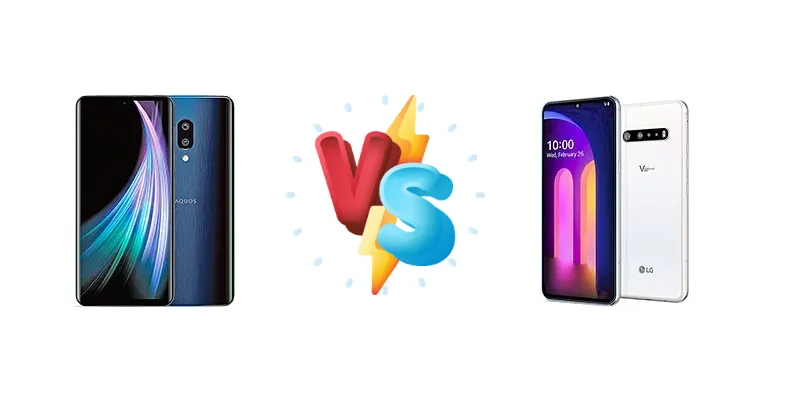
The Sharp Aquos Zero 2 and LG V60 ThinQ 5G represent interesting points in Qualcomm's Snapdragon evolution. The Zero 2, with the Snapdragon 855, aimed for a refined experience, while the V60, leveraging the Snapdragon 865, pushed into the emerging 5G landscape. This comparison dissects their strengths and weaknesses, focusing on how their core hardware impacts real-world usage.
🏆 Quick Verdict
For the average user in 2024, the LG V60 ThinQ 5G is the better choice. While both phones offer similar battery endurance ratings (103h), the V60’s Snapdragon 865 provides a performance uplift and crucially, 5G connectivity, making it more future-proof and versatile.
| Network |
|---|
| 2G bands | GSM 850 / 900 / 1800 / 1900 | GSM 850 / 900 / 1800 / 1900 |
| 3G bands | HSDPA 850 / 900 / 1700(AWS) / 1900 / 2100 | HSDPA 850 / 900 / 1700(AWS) / 1900 / 2100 |
| 4G bands | 1, 2, 3, 4, 5, 6, 7, 8, 11, 12, 13, 17, 18, 19, 20, 28, 38, 39, 41 - Taiwan | 2, 4, 5, 12, 25, 26, 41, 46, 48, 66, 71 - USA |
| 5G bands | - | 2, 25, 41, 66, 71 SA/NSA/Sub6 |
| Speed | HSPA, LTE | HSPA 42.2/5.76 Mbps, LTE (7CA) Cat22, 5G |
| Technology | GSM / HSPA / LTE | GSM / CDMA / HSPA / EVDO / LTE / 5G |
| | - | CDMA2000 1xEV-DO |
| Launch |
|---|
| Announced | 2020, May 22. Released 2020, May 22 | 2020, February 26. Released 2020, March 20 |
| Status | Discontinued | Discontinued |
| Body |
|---|
| Build | - | Glass front (Gorilla Glass 5), glass back (Gorilla Glass 6), aluminum frame |
| Dimensions | 158 x 74 x 8.8 mm (6.22 x 2.91 x 0.35 in) | 169.3 x 77.6 x 8.9 mm (6.67 x 3.06 x 0.35 in) |
| SIM | Nano-SIM | · Nano-SIM· Nano-SIM + Nano-SIM |
| Weight | 141 g (4.97 oz) | 213 g (Global)/ 218 g (Verizon) (7.51 oz) |
| | IP68 dust/water resistant (up to 1.5m for 30 mins) | IP68 dust/water resistant (up to 1.5m for 30 min)
MIL-STD-810G compliant*
Method 516.6, Procedure IV "Transit Drop"
*does not guarantee ruggedness or use in extreme conditions |
| Display |
|---|
| Protection | Corning Gorilla Glass 6 | Corning Gorilla Glass 5 |
| Resolution | 1080 x 2340 pixels, 19.5:9 ratio (~403 ppi density) | 1080 x 2460 pixels (~395 ppi density) |
| Size | 6.4 inches, 100.5 cm2 (~86.0% screen-to-body ratio) | 6.8 inches, 109.8 cm2 (~83.6% screen-to-body ratio) |
| Type | OLED, 1B colors, 240Hz, HDR10, Dolby Vision | P-OLED, HDR10+ |
| | - | Always-on display |
| Platform |
|---|
| CPU | Octa-core (1x2.84 GHz Kryo 485 & 3x2.42 GHz Kryo 485 & 4x1.78 GHz Kryo 485) | Octa-core (1x2.84 GHz Cortex-A77 & 3x2.42 GHz Cortex-A77 & 4x1.80 GHz Cortex-A55) |
| Chipset | Qualcomm SM8150 Snapdragon 855 (7 nm) | Qualcomm SM8250 Snapdragon 865 5G (7 nm+) |
| GPU | Adreno 640 | Adreno 650 |
| OS | Android 10 | Android 10, upgradable to Android 13 |
| Memory |
|---|
| Card slot | No | microSDXC (uses shared SIM slot) - dual-SIM model |
| Internal | 256GB 8GB RAM | 128GB 8GB RAM, 256GB 8GB RAM |
| | UFS 3.0 | UFS 2.1 |
| Main Camera |
|---|
| Dual | 12.2 MP, f/1.7, (wide), 1/2.55", 1.4µm, dual pixel PDAF, OIS
20 MP, f/2.4, 125˚ (ultrawide), AF | 64 MP, f/1.8, 27mm (standard), 1/1.72", 0.8µm, dual pixel PDAF, OIS
13 MP, f/1.9, 12mm (ultrawide), 1/3.4", 1.0µm
0.3 MP, TOF 3D, f/1.4, (depth) |
| Features | LED flash, HDR, panorama | Dual-LED dual-tone flash, HDR, panorama |
| Video | 4K@30fps, 1080p@30fps, gyro-EIS | 8K@30fps, 4K@30/60fps, 1080p, HDR10+, 24-bit/192kHz stereo sound rec., gyro-EIS |
| Selfie camera |
|---|
| Features | HDR | HDR |
| Single | 8 MP, f/2.2, 23mm (wide) | 10 MP, f/1.9, 30mm (standard), 1/3.1", 1.22µm |
| Video | 1080p@30fps, gyro-EIS | 4K@30fps, gyro-EIS |
| Sound |
|---|
| 3.5mm jack | No | Yes |
| 35mm jack | No | Yes |
| Loudspeaker | Yes, with stereo speakers | Yes, with stereo speakers |
| | 24-bit/192kHz audio | 32-bit/192kHz audio
24-bit/192kHz audio recording |
| Comms |
|---|
| Bluetooth | 5.0, A2DP, LE, aptX HD, aptX Adaptive | 5.1, A2DP, LE, aptX HD |
| NFC | Yes | Yes |
| Positioning | GPS (L1+L5), GLONASS, BDS, GALILEO, QZSS | GPS, GLONASS, GALILEO, BDS |
| Radio | No | FM radio (USA model only) |
| USB | USB Type-C 2.0 | USB Type-C 3.1, OTG |
| WLAN | Wi-Fi 802.11 a/b/g/n/ac, dual-band, Wi-Fi Direct | Wi-Fi 802.11 a/b/g/n/ac/6, dual-band, Wi-Fi Direct, DLNA |
| Features |
|---|
| Sensors | Fingerprint (under display, optical), accelerometer, gyro, proximity, compass | Fingerprint (under display, optical), accelerometer, gyro, proximity, compass, barometer |
| Battery |
|---|
| Charging | Wired, PD2.0 | Wired, PD2.0, QC4
Wireless |
| Type | Li-Ion 3130 mAh | Li-Po 5000 mAh |
| Misc |
|---|
| Colors | Blue | Classy Blue, Classy White |
| Models | SH-Z20, SHV47, 906SH | LM-V600, A001LG |
| Price | About 670 EUR | About 700 EUR |
| Tests |
|---|
| Battery life | - |
Endurance rating 103h
|
Sharp Aquos Zero 2
- Potentially more compact design (based on brand history)
- Efficient Snapdragon 855 processor
- PD2.0 fast charging
- Lacks 5G connectivity
- Older processor architecture
- No wireless charging
LG V60 ThinQ 5G
- Faster Snapdragon 865 processor
- Integrated 5G modem
- Wireless charging support
- Potentially larger form factor
- May experience more thermal throttling under sustained load
- More expensive at launch
Display Comparison
Unfortunately, display specifications beyond the chipsets are absent. However, given LG’s history with OLED panels, the V60 likely boasts superior color accuracy and contrast compared to the Zero 2. Both support PD2.0 charging, suggesting a focus on fast wired charging, but the V60 adds wireless charging, a convenience the Zero 2 lacks. The V60’s larger market presence likely means more readily available display calibration profiles.
Camera Comparison
Without detailed camera specs, a direct comparison is difficult. However, the V60’s position as a flagship suggests a more sophisticated camera system. The Snapdragon 865’s image signal processor (ISP) is more advanced, offering better noise reduction and dynamic range. While both phones likely support 4K video recording, the V60’s ISP would handle the processing more efficiently. The absence of information on sensor sizes and lens apertures makes a definitive statement impossible, but the V60 likely has a more versatile camera setup.
Performance
The LG V60’s Snapdragon 865 represents a significant architectural leap over the Aquos Zero 2’s Snapdragon 855. The 865 utilizes the newer Cortex-A77 cores (vs A76 in the 855) and a more efficient 7nm+ process. This translates to roughly 10-15% better CPU performance and a more substantial GPU improvement. While both chips feature an octa-core configuration with a 2.84 GHz prime core, the V60’s supporting cores (3x2.42 GHz Cortex-A77 & 4x1.80 GHz Cortex-A55) are more efficient. The V60 also benefits from integrated 5G modem, a feature absent in the Zero 2.
Battery Life
Both devices share an endurance rating of 103 hours, indicating similar real-world battery life despite the V60’s more powerful processor. This suggests efficient power management on both sides. However, the V60 gains an advantage with support for both PD2.0 *and* Quick Charge 4.0, allowing for potentially faster wired charging speeds than the Zero 2’s PD2.0 only support. The addition of wireless charging on the V60 further enhances its convenience.
Buying Guide
Buy the Sharp Aquos Zero 2 if you prioritize a potentially more compact form factor (though dimensions aren't provided, Sharp historically focuses on ergonomics) and are content with 4G connectivity. Buy the LG V60 ThinQ 5G if you want a more powerful processor for demanding tasks, the benefits of 5G, and faster charging speeds thanks to Quick Charge 4.0 support.
Frequently Asked Questions
❓ Does the Snapdragon 865 in the LG V60 get noticeably warmer than the 855 in the Aquos Zero 2 during extended gaming sessions?
The Snapdragon 865 is more powerful, and therefore generates more heat. While both phones likely have thermal management systems, the V60 is more prone to thermal throttling under sustained heavy load. However, the performance gains generally outweigh the potential for minor throttling.
❓ Is the 5G connectivity on the LG V60 actually useful in 2024, or is it just a marketing feature?
5G coverage has expanded significantly since the V60’s release. In areas with 5G availability, you’ll experience substantially faster download and upload speeds compared to 4G. Even if 5G isn’t ubiquitous in your area, the V60 is better positioned for future network upgrades.
❓ Given the similar battery endurance ratings, will I notice a real-world difference in how long these phones last on a single charge?
The 103-hour endurance rating is a standardized test. Real-world usage varies. The V60’s more efficient processor and potentially larger battery capacity (not specified) might translate to slightly longer battery life with moderate use, but the difference will likely be minimal.