
Sharp Aquos Zero 2 vs LG V50S ThinQ 5G: A Detailed Comparison of Snapdragon 855 Flagships
| Phones Images | |||||
|---|---|---|---|---|---|
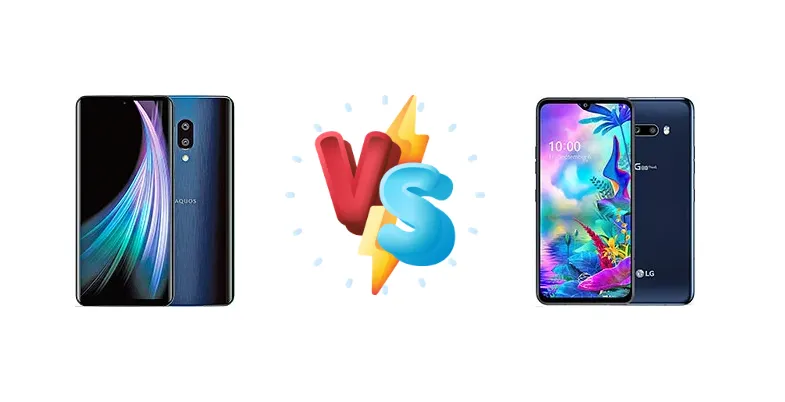
|
🏆 Quick Verdict
For the average user prioritizing convenience and future-proofing, the LG V50S ThinQ 5G emerges as the slightly better choice. Its inclusion of 9W wireless charging and broader charging protocol support (QC3) adds versatility, while the Aquos Zero 2 focuses on streamlined wired charging with PD2.0.
| PHONES | ||
|---|---|---|
| Phone Names | Sharp Aquos Zero 2 | LG V50S ThinQ 5G |
| Network | ||
|---|---|---|
| 2G bands | GSM 850 / 900 / 1800 / 1900 | GSM 850 / 900 / 1800 / 1900 |
| 3G bands | HSDPA 850 / 900 / 1700(AWS) / 1900 / 2100 | HSDPA 850 / 900 / 1700(AWS) / 1900 / 2100 |
| 4G bands | 1, 2, 3, 4, 5, 6, 7, 8, 11, 12, 13, 17, 18, 19, 20, 28, 38, 39, 41 - Taiwan | 1, 2, 3, 4, 5, 7, 8, 12, 13, 17, 20, 25, 26, 28, 40, 41 |
| 5G bands | - | 41 NSA |
| Speed | HSPA, LTE | HSPA 42.2/5.76 Mbps, LTE Cat19 1600/75 Mbps, 5G (2+ Gbps DL) |
| Technology | GSM / HSPA / LTE | GSM / CDMA / HSPA / EVDO / LTE / 5G |
| - | CDMA2000 1xEV-DO | |
| Launch | ||
|---|---|---|
| Announced | 2020, May 22. Released 2020, May 22 | 2019, October. Released 2019, October |
| Status | Discontinued | Discontinued |
| Body | ||
|---|---|---|
| Build | - | Glass front (Gorilla Glass 5), glass back (Gorilla Glass 6), aluminum frame |
| Dimensions | 158 x 74 x 8.8 mm (6.22 x 2.91 x 0.35 in) | 159.3 x 75.8 x 8.4 mm (6.27 x 2.98 x 0.33 in) |
| SIM | Nano-SIM | · Nano-SIM· Nano-SIM + Nano-SIM |
| Weight | 141 g (4.97 oz) | 192 g (6.77 oz) |
| IP68 dust/water resistant (up to 1.5m for 30 mins) | IP68 dust/water resistant (up to 1.5m for 30 min) MIL-STD-810G compliant* *does not guarantee ruggedness or use in extreme conditions | |
| Display | ||
|---|---|---|
| Protection | Corning Gorilla Glass 6 | Corning Gorilla Glass 5 |
| Resolution | 1080 x 2340 pixels, 19.5:9 ratio (~403 ppi density) | 1080 x 2340 pixels, 19.5:9 ratio (~403 ppi density) |
| Size | 6.4 inches, 100.5 cm2 (~86.0% screen-to-body ratio) | 6.4 inches, 100.5 cm2 (~83.3% screen-to-body ratio) |
| Type | OLED, 1B colors, 240Hz, HDR10, Dolby Vision | OLED, HDR10 |
| - | Always-on display | |
| Platform | ||
|---|---|---|
| CPU | Octa-core (1x2.84 GHz Kryo 485 & 3x2.42 GHz Kryo 485 & 4x1.78 GHz Kryo 485) | Octa-core (1x2.84 GHz Kryo 485 & 3x2.42 GHz Kryo 485 & 4x1.78 GHz Kryo 485) |
| Chipset | Qualcomm SM8150 Snapdragon 855 (7 nm) | Qualcomm SM8150 Snapdragon 855 (7 nm) |
| GPU | Adreno 640 | Adreno 640 |
| OS | Android 10 | Android 9.0 (Pie), upgradable to Android 12 |
| Memory | ||
|---|---|---|
| Card slot | No | microSDXC (uses shared SIM slot) - dual-SIM model |
| Internal | 256GB 8GB RAM | 256GB 8GB RAM |
| UFS 3.0 | UFS 2.1 | |
| Main Camera | ||
|---|---|---|
| Dual | 12.2 MP, f/1.7, (wide), 1/2.55", 1.4µm, dual pixel PDAF, OIS 20 MP, f/2.4, 125˚ (ultrawide), AF | 12 MP, f/1.8, 27mm (standard), 1/2.55", 1.4µm, dual pixel PDAF, OIS 13 MP, f/2.4, 9mm (ultrawide), 1/3.4", 1.0µm |
| Features | LED flash, HDR, panorama | Dual-LED dual-tone flash, HDR, panorama |
| Video | 4K@30fps, 1080p@30fps, gyro-EIS | 4K@30/60fps, 1080p@30/60/240fps, 24-bit/192kHz stereo sound rec., gyro-EIS |
| Selfie camera | ||
|---|---|---|
| Features | HDR | HDR |
| Single | 8 MP, f/2.2, 23mm (wide) | 32 MP, f/1.9, 26mm (wide), 1/2.8", 0.8µm |
| Video | 1080p@30fps, gyro-EIS | 4K@30fps, gyro-EIS |
| Sound | ||
|---|---|---|
| 3.5mm jack | No | Yes |
| 35mm jack | No | Yes |
| Loudspeaker | Yes, with stereo speakers | Yes, with stereo speakers |
| 24-bit/192kHz audio | 32-bit/192kHz audio 24-bit/192kHz audio recording Tuned by Meridian Audio | |
| Comms | ||
|---|---|---|
| Bluetooth | 5.0, A2DP, LE, aptX HD, aptX Adaptive | 5.0, A2DP, LE, aptX HD |
| NFC | Yes | Yes |
| Positioning | GPS (L1+L5), GLONASS, BDS, GALILEO, QZSS | GPS, GLONASS, GALILEO, BDS |
| Radio | No | FM radio |
| USB | USB Type-C 2.0 | USB Type-C 3.1, OTG |
| WLAN | Wi-Fi 802.11 a/b/g/n/ac, dual-band, Wi-Fi Direct | Wi-Fi 802.11 a/b/g/n/ac, dual-band, Wi-Fi Direct, DLNA |
| Features | ||
|---|---|---|
| Sensors | Fingerprint (under display, optical), accelerometer, gyro, proximity, compass | Fingerprint (under display, optical), accelerometer, gyro, proximity, compass, barometer |
| Battery | ||
|---|---|---|
| Charging | Wired, PD2.0 | 21W wired, PD, QC3 9W wireless |
| Type | Li-Ion 3130 mAh | Li-Po 4000 mAh, non-removable |
| Misc | ||
|---|---|---|
| Colors | Blue | Aurora Black |
| Models | SH-Z20, SHV47, 906SH | LM-V510N |
| Price | About 670 EUR | About 1100 EUR |
Sharp Aquos Zero 2
- Streamlined design aesthetic
- Fast wired charging with PD2.0
- Potentially optimized thermal management (unconfirmed)
- Lacks wireless charging
- Limited charging protocol support (PD2.0 only)
LG V50S ThinQ 5G
- Wireless charging support (9W)
- Broad charging compatibility (PD, QC3)
- Likely more versatile camera system
- Potential for thermal throttling under heavy load
- Larger and potentially heavier design
Display Comparison
Both devices lack detailed display specifications in the provided data, but considering their release timelines, it’s reasonable to assume both utilize OLED panels. The LG V50S, being a flagship from a major brand, likely boasts a higher peak brightness and potentially wider color gamut coverage. Sharp, known for its display technology, may have focused on color accuracy in the Aquos Zero 2. The absence of refresh rate data suggests neither device features a high refresh rate display, a common omission in 2019 flagships.
Camera Comparison
Without sensor details, a direct camera comparison is difficult. However, LG’s V-series traditionally emphasizes versatile camera systems. The V50S ThinQ 5G likely features a more sophisticated multi-camera setup with a larger primary sensor and optical image stabilization (OIS). The Aquos Zero 2, while potentially capable, likely prioritizes simplicity. The inclusion of a 2MP macro lens on either device is largely a marketing gimmick and won’t significantly impact image quality.
Performance
Both the Sharp Aquos Zero 2 and the LG V50S ThinQ 5G are powered by the Qualcomm SM8150 Snapdragon 855 (7 nm) with an identical CPU configuration: Octa-core (1x2.84 GHz Kryo 485 & 3x2.42 GHz Kryo 485 & 4x1.78 GHz Kryo 485). This means raw processing power will be virtually identical. Performance differences will likely stem from thermal management and software optimization. LG’s V-series historically features aggressive thermal throttling under sustained load, while Sharp’s implementation remains less documented. RAM speed (LPDDR4X is likely on both) isn’t specified, but won’t be a major differentiator.
Battery Life
Battery capacity isn’t specified for either device. However, the LG V50S ThinQ 5G gains a significant advantage with its support for both 21W wired charging, Power Delivery (PD), and Quick Charge 3.0 (QC3), alongside 9W wireless charging. The Aquos Zero 2 relies solely on wired PD2.0 charging. This means the V50S offers more flexibility in charging options and the convenience of wireless top-ups. While a larger battery capacity on the Aquos Zero 2 could offset the slower charging, the V50S’s charging versatility is a clear win for most users.
Buying Guide
Buy the Sharp Aquos Zero 2 if you prioritize a minimalist design and fast, efficient wired charging via the PD2.0 standard. It’s ideal for users who consistently have access to Power Delivery chargers and prefer a cleaner aesthetic. Buy the LG V50S ThinQ 5G if you value the convenience of wireless charging, broader compatibility with charging standards (Quick Charge 3.0), and a more feature-rich software experience, even if it means slightly less streamlined charging.