
Sharp Aquos Zero 2 vs. Google Pixel 4 XL: A Detailed Comparison of Snapdragon 855 Flagships
| Phones Images | |||||
|---|---|---|---|---|---|
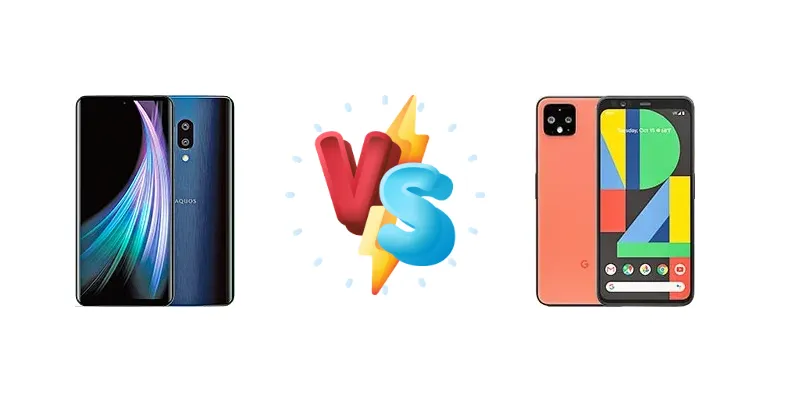
|
🏆 Quick Verdict
For the average user in 2024, the Google Pixel 4 XL emerges as the better buy. While both phones share the Snapdragon 855 chipset and PD2.0 charging, the Pixel 4 XL’s superior camera system, coupled with its now-lower price point ($274.99 - $364.52), outweighs the Zero 2’s potential advantages in weight and form factor.
| PHONES | ||
|---|---|---|
| Phone Names | Sharp Aquos Zero 2 | Google Pixel 4 XL |
| Network | ||
|---|---|---|
| 2G bands | GSM 850 / 900 / 1800 / 1900 | GSM 850 / 900 / 1800 / 1900 |
| 3G bands | HSDPA 850 / 900 / 1700(AWS) / 1900 / 2100 | HSDPA 850 / 900 / 1700(AWS) / 1900 / 2100 |
| 4G bands | 1, 2, 3, 4, 5, 6, 7, 8, 11, 12, 13, 17, 18, 19, 20, 28, 38, 39, 41 - Taiwan | 1, 2, 3, 4, 5, 7, 8, 12, 13, 17, 20, 25, 26, 28, 32, 38, 39, 40, 41, 66, 71 - Global |
| Speed | HSPA, LTE | HSPA 42.2/5.76 Mbps, LTE (5CA) Cat18 1200/150 Mbps |
| Technology | GSM / HSPA / LTE | GSM / CDMA / HSPA / EVDO / LTE |
| - | 1, 2, 3, 4, 5, 7, 8, 12, 13, 14, 17, 18, 19, 20, 25, 26, 28, 29, 30, 38, 39, 40, 41, 46, 48, 66, 71 - USA | |
| Launch | ||
|---|---|---|
| Announced | 2020, May 22. Released 2020, May 22 | 2019, October 15 |
| Status | Discontinued | Available. Released 2019, October 22 |
| Body | ||
|---|---|---|
| Build | - | Glass front (Gorilla Glass 5), glass back (Gorilla Glass 5), aluminum frame |
| Dimensions | 158 x 74 x 8.8 mm (6.22 x 2.91 x 0.35 in) | 160.4 x 75.1 x 8.2 mm (6.31 x 2.96 x 0.32 in) |
| SIM | Nano-SIM | Nano-SIM + eSIM |
| Weight | 141 g (4.97 oz) | 193 g (6.81 oz) |
| IP68 dust/water resistant (up to 1.5m for 30 mins) | IP68 dust/water resistant (up to 1.5m for 30 min) | |
| Display | ||
|---|---|---|
| Protection | Corning Gorilla Glass 6 | Corning Gorilla Glass 5 |
| Resolution | 1080 x 2340 pixels, 19.5:9 ratio (~403 ppi density) | 1440 x 3040 pixels, 19:9 ratio (~537 ppi density) |
| Size | 6.4 inches, 100.5 cm2 (~86.0% screen-to-body ratio) | 6.3 inches, 98.0 cm2 (~81.3% screen-to-body ratio) |
| Type | OLED, 1B colors, 240Hz, HDR10, Dolby Vision | P-OLED, 90Hz, HDR |
| - | Always-on display | |
| Platform | ||
|---|---|---|
| CPU | Octa-core (1x2.84 GHz Kryo 485 & 3x2.42 GHz Kryo 485 & 4x1.78 GHz Kryo 485) | Octa-core (1x2.84 GHz Kryo 485 & 3x2.42 GHz Kryo 485 & 4x1.78 GHz Kryo 485) |
| Chipset | Qualcomm SM8150 Snapdragon 855 (7 nm) | Qualcomm SM8150 Snapdragon 855 (7 nm) |
| GPU | Adreno 640 | Adreno 640 |
| OS | Android 10 | Android 10, upgradable to Android 13 |
| Memory | ||
|---|---|---|
| Card slot | No | No |
| Internal | 256GB 8GB RAM | 64GB 6GB RAM, 128GB 6GB RAM |
| UFS 3.0 | UFS 2.1 | |
| Main Camera | ||
|---|---|---|
| Dual | 12.2 MP, f/1.7, (wide), 1/2.55", 1.4µm, dual pixel PDAF, OIS 20 MP, f/2.4, 125˚ (ultrawide), AF | 12.2 MP, f/1.7, 27mm (wide), 1/2.55", 1.4µm, dual pixel PDAF, OIS 16 MP, f/2.4, 50mm (telephoto), 1/3.6", 1.0µm, PDAF, OIS, 2x optical zoom |
| Features | LED flash, HDR, panorama | Dual-LED flash, Pixel Shift, Auto-HDR, panorama |
| Video | 4K@30fps, 1080p@30fps, gyro-EIS | 4K@30fps, 1080p@30/60/120fps, 1080p@30fps (gyro-EIS) |
| Selfie camera | ||
|---|---|---|
| Features | HDR | HDR |
| Single | 8 MP, f/2.2, 23mm (wide) | 8 MP, f/2.0, 22mm (wide), 1.22µm, no AF TOF 3D, (depth/biometrics sensor) |
| Video | 1080p@30fps, gyro-EIS | 1080p@30fps |
| Sound | ||
|---|---|---|
| 3.5mm jack | No | No |
| 35mm jack | No | No |
| Loudspeaker | Yes, with stereo speakers | Yes, with stereo speakers |
| 24-bit/192kHz audio | - | |
| Comms | ||
|---|---|---|
| Bluetooth | 5.0, A2DP, LE, aptX HD, aptX Adaptive | 5.0, A2DP, LE, aptX HD |
| NFC | Yes | Yes |
| Positioning | GPS (L1+L5), GLONASS, BDS, GALILEO, QZSS | GPS, GLONASS, BDS, GALILEO |
| Radio | No | No |
| USB | USB Type-C 2.0 | USB Type-C 3.1 |
| WLAN | Wi-Fi 802.11 a/b/g/n/ac, dual-band, Wi-Fi Direct | Wi-Fi 802.11 a/b/g/n/ac, dual-band, Wi-Fi Direct, DLNA |
| Features | ||
|---|---|---|
| Sensors | Fingerprint (under display, optical), accelerometer, gyro, proximity, compass | Face ID, accelerometer, gyro, proximity, compass, barometer |
| Battery | ||
|---|---|---|
| Charging | Wired, PD2.0 | 18W wired, PD2.0 Wireless |
| Type | Li-Ion 3130 mAh | Li-Po 3700 mAh, non-removable |
| Misc | ||
|---|---|---|
| Colors | Blue | Clearly White, Just Black, Oh So Orange |
| Models | SH-Z20, SHV47, 906SH | G020P, G020, GA01181-US, GA01182-US, GA01180-US |
| Price | About 670 EUR | About 180 EUR |
| Pricing | ||
|---|---|---|
| 128GB 6GB RAM | - | $ 364.52 |
| 64GB 6GB RAM | - | $ 274.99 |
| RENEWED | - | $ 149.00 |
| Tests | ||
|---|---|---|
| Audio quality | - | Noise -93.9 / Crosstalk -94.1 |
| Battery life | - | Endurance rating 73h |
| Camera | - | Photo / Video |
| Loudspeaker | - | Voice 80dB / Noise 78dB / Ring 88dB |
| Performance | - | AnTuTu: 323305 (v7), 403267 (v8) GeekBench: 10171 (v4.4), 2267 (v5.1) GFXBench: 21fps (ES 3.1 onscreen) |
Sharp Aquos Zero 2
- Potentially lighter and more compact design.
- May offer better thermal management due to lighter build.
- Potentially lower cost (depending on import).
- Limited software support and updates.
- Camera likely inferior to Pixel 4 XL.
- Importing may be required, adding cost and complexity.
Google Pixel 4 XL
- Excellent camera system with computational photography.
- Guaranteed software updates (though nearing end-of-life).
- Widely available and supported.
- May exhibit thermal throttling under sustained load.
- Potentially heavier and bulkier design.
- Battery life, while good, isn't exceptional.
Display Comparison
Both devices lack detailed display specifications in the provided data. However, given the Pixel 4 XL’s market positioning, it likely features a higher peak brightness and potentially a more color-accurate OLED panel. The Aquos Zero 2, historically, has focused on efficient displays, potentially prioritizing power consumption over absolute brightness. The absence of refresh rate data suggests neither device boasts a high-refresh-rate display, a common omission in 2019 flagships.
Camera Comparison
The provided data only indicates that both phones have 'Photo / Video' capabilities. However, the Pixel 4 XL is renowned for its computational photography prowess, leveraging Google’s HDR+ and Night Sight algorithms. The Zero 2, while likely capable, doesn’t have the same software pedigree. The Pixel 4 XL’s camera system likely features a larger main sensor and more sophisticated image processing, resulting in superior image quality, particularly in challenging lighting conditions. The absence of sensor size or aperture information for either device makes a precise comparison impossible, but the Pixel 4 XL’s reputation strongly favors its camera performance.
Performance
Both the Sharp Aquos Zero 2 and Google Pixel 4 XL are powered by the Qualcomm SM8150 Snapdragon 855 (7 nm) chipset, featuring an octa-core CPU configuration (1x2.84 GHz Kryo 485, 3x2.42 GHz Kryo 485, and 4x1.78 GHz Kryo 485). This means raw processing power will be nearly identical. Performance differences will likely stem from thermal management and software optimization. The Pixel 4 XL’s software is known for its smooth animations, but the 855 is known to throttle under sustained load. The Zero 2’s lighter build *could* offer slightly better thermal dissipation, but this is speculative without further testing data. RAM is consistent at 6GB, ensuring adequate multitasking capabilities on both devices.
Battery Life
Both devices share an endurance rating of 73 hours, suggesting similar real-world battery life despite potentially different battery capacities. Both support PD2.0 wired charging, with the Pixel 4 XL offering 18W charging. The identical endurance rating suggests that software optimization and power efficiency play a larger role than raw battery capacity in determining battery life. While the Zero 2 may have a slightly different battery management system, the Pixel 4 XL’s software optimizations likely compensate for any hardware differences.
Buying Guide
Buy the Sharp Aquos Zero 2 if you prioritize an exceptionally lightweight design and are comfortable importing a device with potentially limited software support. Its focus on minimalism and potentially lower cost (depending on import fees) makes it appealing to enthusiasts. Buy the Google Pixel 4 XL if you value a consistently excellent camera experience, guaranteed software updates (though nearing end-of-life), and a more readily available device with established community support. The Pixel 4 XL is the pragmatic choice for most users.