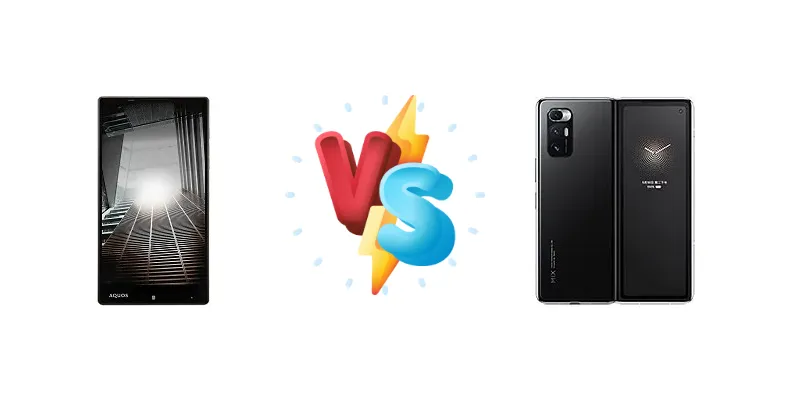
The smartphone landscape is constantly evolving, and choosing the right device can be overwhelming. Today, we pit the Sharp Aquos Xx, a phone known for its unique design and display, against the Xiaomi Mi Mix Fold, a groundbreaking foldable device. Let's dive into a comprehensive comparison to see which phone emerges victorious.
🏆 Quick Verdict
The Xiaomi Mi Mix Fold is the clear winner. Its Snapdragon 888 chipset, foldable display, and significantly faster charging offer a superior experience compared to the Aquos Xx's older Snapdragon 810. While the Aquos Xx might appeal to those seeking a more compact design, the Mi Mix Fold's innovation and performance are unmatched.
| Network |
|---|
| 2G bands | GSM 900 / 1800 / 1900 | GSM 850 / 900 / 1800 / 1900 |
| 3G bands | HSDPA 900 / 2100 | HSDPA 850 / 900 / 1700(AWS) / 1900 / 2100 |
| 4G bands | LTE 900 / 1700 / 2100 / 2500 | 1, 2, 3, 4, 5, 7, 8, 12, 17, 18, 19, 20, 26, 28, 34, 38, 39, 40, 41, 42 |
| 5G bands | - | 1, 3, 28, 41, 77, 78, 79 SA/NSA |
| Speed | HSPA 42.2/5.76 Mbps, LTE (2CA) Cat6 300/50 Mbps | HSPA, LTE, 5G |
| Technology | GSM / HSPA / LTE | GSM / CDMA / HSPA / EVDO / LTE / 5G |
| | - | CDMA2000 1xEV-DO |
| Launch |
|---|
| Announced | 2015, May. Released 2015, July | 2021, March |
| Status | Discontinued | Available. Released 2021, April 16 |
| Body |
|---|
| Build | - | Glass front (folded), plastic front (unfolded), glass back (Gorilla Glass 5) or ceramic back, aluminum frame |
| Dimensions | 146 x 79 x 8.7 mm (5.75 x 3.11 x 0.34 in) | Unfolded: 173.3 x 133.4 x 7.6 mm Folded: 173.3 x 69.8 x 17.2 mm |
| SIM | Nano-SIM | Nano-SIM + Nano-SIM |
| Weight | 168 g (5.93 oz) | 317 g (Glass)332 g (Ceramic) (11.18 oz) |
| | Splash resistant | - |
| Display |
|---|
| Resolution | 1080 x 1920 pixels, 16:9 ratio (~386 ppi density) | 1860 x 2480 pixels, 4:3 ratio (~387 ppi density) |
| Size | 5.7 inches, 89.6 cm2 (~77.7% screen-to-body ratio) | 8.01 inches, 198.7 cm2 (~85.9% screen-to-body ratio) |
| Type | S-PureLED | Foldable AMOLED, 1B colors, HDR10+, Dolby Vision, 600 nits (typ), 900 nits (peak) |
| | - | Cover display:
AMOLED, 90Hz, HDR10+, Dolby Vision, 650 nits (typ), 900 nits (peak)
6.52 inches, 840 x 2520 pixels, 27:9 ratio |
| Platform |
|---|
| CPU | Octa-core (4x1.5 GHz Cortex-A53 & 4x2.0 GHz Cortex-A57) | Octa-core (1x2.84 GHz Cortex-X1 & 3x2.42 GHz Cortex-A78 & 4x1.80 GHz Cortex-A55) |
| Chipset | Qualcomm MSM8994 Snapdragon 810 (20 nm) | Qualcomm SM8350 Snapdragon 888 5G (5 nm) |
| GPU | Adreno 430 | Adreno 660 |
| OS | Android 5.0 (Lollipop) | Android 10, MIUI 12 |
| Memory |
|---|
| Card slot | microSDXC (dedicated slot) | No |
| Internal | 32GB 3GB RAM | 256GB 12GB RAM, 512GB 12GB RAM, 512GB 16GB RAM |
| | eMMC 5.0 | UFS 3.1 |
| Main Camera |
|---|
| Features | LED flash, panorama, HDR | Color spectrum sensor, Dual-LED flash, HDR, panorama |
| Single | 13 MP, AF | 20 MP, 27mm (wide), 1/3.4", 0.8µm |
| Triple | - | 108 MP, f/1.8, (wide), 1/1.52", 0.7µm, PDAF
8 MP, 80mm (telephoto/macro), liquid lens, PDAF, 3x optical zoom
13 MP, f/2.4, 123˚ (ultrawide), 1.12µm |
| Video | 4K@30fps, 1080p@120fps, 480p@210fps | 8K@24/30fps, 4K@30/60fps, 1080p@30/60fps, gyro-EIS |
| Selfie camera |
|---|
| Features | - | HDR, panorama |
| Single | 2.1 MP | 20 MP, (wide) |
| Video | 1080p@30fps | 1080p@30/60fps, 720p@120fps |
| Sound |
|---|
| 3.5mm jack | Yes | No |
| 35mm jack | Yes | No |
| Loudspeaker | Yes | Yes, with stereo speakers (4 speakers) |
| | Direct Wave Receiver
| 24-bit/192kHz audio
Tuned by Harman Kardon |
| Comms |
|---|
| Bluetooth | 4.1, A2DP | 5.2, A2DP, LE, aptX HD, aptX Adaptive |
| Infrared port | - | Yes |
| NFC | Yes | Yes |
| Positioning | GPS | GPS (L1+L5), GLONASS (L1), BDS (B1I+B1c+B2a), GALILEO (E1+E5a), QZSS (L1+L5), NavIC (L5) |
| Radio | No | No |
| USB | microUSB 2.0 | USB Type-C |
| WLAN | Wi-Fi 802.11 a/b/g/n/ac, dual-band, hotspot | Wi-Fi 802.11 a/b/g/n/ac/6e, dual-band, Wi-Fi Direct |
| Features |
|---|
| Sensors | Accelerometer, gyro, proximity, compass | Fingerprint (side-mounted), accelerometer, gyro, proximity, compass, barometer |
| Battery |
|---|
| Charging | - | 67W wired, PD3.0, QC4, 100% in 37 min |
| Stand-by | Up to 410 h (2G) / Up to 450 h (3G) | - |
| Talk time | Up to 11 h 30 min (2G) / Up to 22 h 30 min (3G) | - |
| Type | Li-Ion 3000 mAh, non-removable | Li-Po 5020 mAh |
| Misc |
|---|
| Colors | Black, White, Red | Black, Ceramic |
| Models | 304SH, 404SH | M2011J18C |
| Price | About 340 EUR | About 1300 EUR |
Sharp Aquos Xx
- Potentially compact design
- Sharp's display technology (color accuracy)
- May be more durable (unconfirmed)
- Outdated Snapdragon 810 chipset
- Slow charging
- Limited camera capabilities
- Scarce information available
Xiaomi Mi Mix Fold
- Foldable display for enhanced versatility
- Powerful Snapdragon 888 chipset
- Fast 67W charging
- Advanced camera system
- Modern design
- Foldable design may be less durable than traditional phones
- Potentially higher price point
- Larger size and weight
Display Comparison
The Xiaomi Mi Mix Fold boasts a massive 7.6-inch foldable AMOLED display with a high refresh rate, offering an immersive viewing experience. The Aquos Xx likely features a smaller, traditional LCD display, potentially with Sharp's renowned color accuracy, but lacks the foldable versatility and higher resolution of the Mi Mix Fold. The Fold's external display is also a significant advantage for quick tasks.
Camera Comparison
While specific camera specs for the Aquos Xx are scarce, the Mi Mix Fold generally features a more advanced camera system with higher resolution sensors and improved image processing capabilities. Expect better low-light performance and more detailed photos from the Mi Mix Fold.
Performance
The Snapdragon 888 in the Mi Mix Fold is a generational leap over the Aquos Xx's Snapdragon 810. Expect significantly faster app loading, smoother multitasking, and better gaming performance on the Mi Mix Fold. The 5nm process of the 888 also contributes to improved power efficiency.
Battery Life
The Mi Mix Fold's 67W fast charging is a game-changer, allowing for incredibly quick top-ups. While the Aquos Xx likely has a decent battery capacity, its older chipset and lack of fast charging technology put it at a disadvantage.
Buying Guide
Who should buy the Sharp Aquos Xx? Users prioritizing a smaller, potentially more durable (though unconfirmed) device and are comfortable with older hardware. Who should buy the Xiaomi Mi Mix Fold? Tech enthusiasts, early adopters, and those seeking a versatile foldable phone with top-tier performance and fast charging.
Frequently Asked Questions
❓ Is the Sharp Aquos Xx still worth buying?
The Aquos Xx is a very old device. Unless you find it at a drastically reduced price and prioritize a compact size above all else, it's not recommended due to its outdated hardware.
❓ How durable is the Xiaomi Mi Mix Fold's foldable screen?
Foldable screens have improved significantly, but they are still inherently more susceptible to damage than traditional screens. Xiaomi has implemented protective layers, but careful handling is still recommended.