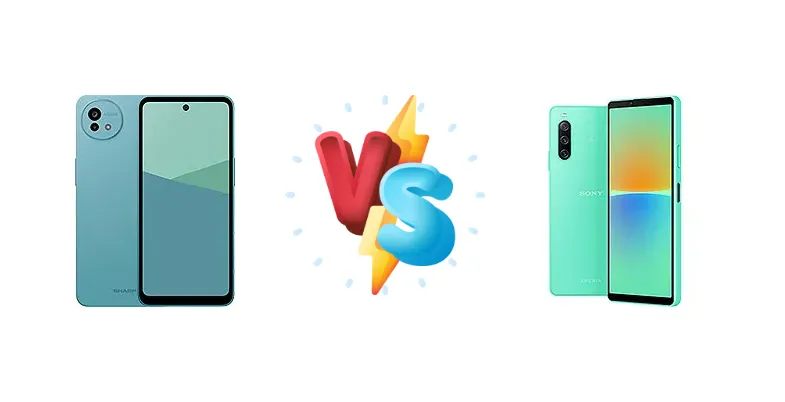
The mid-range smartphone market is fiercely competitive, and the Sharp Aquos wish5 and Sony Xperia 10 IV represent distinct approaches. The Aquos wish5, powered by the Mediatek Dimensity 6300, aims for strong value, while the Xperia 10 IV leverages Sony’s imaging expertise and a focus on endurance with its Snapdragon 695. This comparison dissects their key differences to determine which device best suits your needs.
🏆 Quick Verdict
For the average user prioritizing battery life and a brighter display, the Sony Xperia 10 IV emerges as the better choice. Its proven 163-hour endurance rating and 683 nits peak brightness offer a more reliable experience, despite the Aquos wish5’s newer chipset.
| Network |
|---|
| 2G bands | GSM 850 / 900 / 1800 / 1900 | GSM 850 / 900 / 1800 / 1900 |
| 3G bands | HSDPA 900 / 2100 | HSDPA 850 / 900 / 1700(AWS) / 2100 |
| 4G bands | LTE | 1, 3, 4, 5, 7, 8, 20, 28, 38, 39, 40, 41 |
| 5G bands | SA/NSA | 1, 3, 7, 8, 28, 38, 41, 77, 78, 79 SA/NSA |
| Speed | HSPA, LTE, 5G | HSPA, LTE, 5G |
| Technology | GSM / HSPA / LTE / 5G | GSM / HSPA / LTE / 5G |
| Launch |
|---|
| Announced | 2025, May 29 | 2022, May 11 |
| Status | Available. Released 2025, June 26 | Available. Released 2022, June 30 |
| Body |
|---|
| Build | Glass front, plastic back, plastic frame | Glass front (Gorilla Glass Victus), plastic frame, plastic back |
| Dimensions | 166 x 76 x 8.8 mm (6.54 x 2.99 x 0.35 in) | 153 x 67 x 8.3 mm (6.02 x 2.64 x 0.33 in) |
| SIM | Nano-SIM + eSIM | · Nano-SIM + eSIM· Nano-SIM + Nano-SIM |
| Weight | 187 g (6.60 oz) | 161 g (5.68 oz) |
| | - | IP65/IP68 dust/water resistant (up to 1.5m for 30 min) |
| Display |
|---|
| Protection | - | Corning Gorilla Glass Victus |
| Resolution | 720 x 1612 pixels, 20:9 ratio (~267 ppi density) | 1080 x 2520 pixels, 21:9 ratio (~457 ppi density) |
| Size | 6.6 inches, 104.6 cm2 (~82.9% screen-to-body ratio) | 6.0 inches, 84.1 cm2 (~82.0% screen-to-body ratio) |
| Type | IPS LCD, 120Hz | OLED, 1B colors, HDR |
| | - | Triluminos display |
| Platform |
|---|
| CPU | Octa-core (2x2.4 GHz Cortex-A76 & 6x2.0 GHz Cortex-A55) | Octa-core (2x2.2 GHz Kryo 660 Gold & 6x1.7 GHz Kryo 660 Silver) |
| Chipset | Mediatek Dimensity 6300 (6 nm) | Qualcomm SM6375 Snapdragon 695 5G (6 nm) |
| GPU | Mali-G57 MC2 | Adreno 619 |
| OS | Android 15, up to 2 major Android upgrades | Android 12, upgradable to Android 14 |
| Memory |
|---|
| Card slot | microSDXC | microSDXC (uses shared SIM slot) |
| Internal | 64GB 4GB RAM, 128GB 4GB RAM, 128GB 6GB RAM, 256GB 8GB RAM | 128GB 6GB RAM |
| | - | UFS |
| Main Camera |
|---|
| Dual | 50 MP, f/1.8, 25mm (wide), PDAF
Auxiliary lens | - |
| Features | LED flash, HDR, panorama | LED flash, HDR, panorama |
| Single | - | 8 MP, f/2.0, 27mm (wide), 1/4.0" |
| Triple | - | 12 MP, f/1.8, 27mm (wide), 1/2.8", PDAF, OIS
8 MP, f/2.2, 54mm (telephoto), 1/4.4", PDAF, 2x optical zoom
8 MP, f/2.2, 120˚, 16mm (ultrawide), 1/4.0" |
| Video | Yes, gyro-EIS | 1080p@30fps |
| Selfie camera |
|---|
| Features | - | HDR |
| Single | 8 MP, f/2.0, 26mm (wide) | 8 MP, f/2.0, 27mm (wide), 1/4.0" |
| Video | 1080p@30fps | 1080p@30fps |
| Sound |
|---|
| 3.5mm jack | - | Yes |
| 35mm jack | Yes | Yes |
| Loudspeaker | Yes | Yes |
| | - | 24-bit/192kHz audio
|
| Comms |
|---|
| Bluetooth | 5.3, A2DP, LE | 5.1, A2DP, LE, aptX HD, aptX Adaptive |
| NFC | Yes | Yes |
| Positioning | GPS | GPS, GLONASS, GALILEO, BDS, QZSS |
| Radio | Unspecified | No |
| USB | USB Type-C 2.0 | USB Type-C 2.0, OTG |
| WLAN | Wi-Fi 802.11 a/b/g/n/ac, dual-band | Wi-Fi 802.11 a/b/g/n/ac, dual-band, Wi-Fi Direct |
| Features |
|---|
| Sensors | Fingerprint (side-mounted), accelerometer, gyro, proximity, compass | Fingerprint (side-mounted), accelerometer, proximity, compass |
| Battery |
|---|
| Charging | 27W wired | 21W wired (unofficial rating), PD, QC |
| Type | 5000 mAh | Li-Po 5000 mAh |
| Misc |
|---|
| Colors | Black, Blue, White, Green, Pink | Black, White, Mint, Lavender |
| Models | SH-AC05, SH-M32 | XQ-CC54, XQ-CC72, SOG07 |
| Price | About 200 EUR | £ 99.99 / € 112.89 |
| Tests |
|---|
| Battery life | - |
Endurance rating 163h
|
| Camera | - |
Photo / Video |
| Display | - |
Contrast ratio: Infinite (nominal) |
| Loudspeaker | - |
-30.6 LUFS (Below average)
|
| Performance | - |
AnTuTu: 396008 (v9)
GeekBench: 1908 (v5.1)
GFXBench: 16fps (ES 3.1 onscreen) |
Sharp Aquos wish5
- More recent chipset (Dimensity 6300)
- Faster wired charging (27W)
- Potentially better value for money
- Unknown display quality
- Unproven battery life
- Camera performance is a question mark
Sony Xperia 10 IV
- Exceptional battery life (163h endurance)
- Brighter display (683 nits)
- Sony’s established camera processing
- Slightly older chipset (Snapdragon 695)
- Slower charging (21W)
- Potentially higher price
Display Comparison
The Sony Xperia 10 IV boasts a significantly brighter display, reaching a measured 683 nits, making it far more usable outdoors compared to the Aquos wish5 (brightness data unavailable). While both utilize 6nm chipsets, the Xperia 10 IV’s display benefits from Sony’s image processing, offering potentially more accurate colors. The Xperia 10 IV’s ‘infinite’ contrast ratio (nominal) suggests a standard OLED-like experience, though specifics on panel technology are missing. The Aquos wish5’s display specs are currently unknown, making a direct comparison difficult, but it’s likely positioned as a cost-saving measure.
Camera Comparison
Both devices offer photo and video capabilities, but details are sparse. The Xperia 10 IV benefits from Sony’s renowned camera expertise, likely employing sophisticated image processing algorithms. Without sensor size or aperture information for either device, it’s difficult to assess image quality. The Aquos wish5’s camera system is largely unknown, while the Xperia 10 IV’s camera performance is well-documented in reviews, showcasing its strengths in daylight photography. We can assume the Xperia 10 IV will offer a more refined and consistent camera experience.
Performance
The Sharp Aquos wish5’s Mediatek Dimensity 6300 (6nm) features a 2x2.4 GHz Cortex-A76 and 6x2.0 GHz Cortex-A55 core configuration. This contrasts with the Sony Xperia 10 IV’s Qualcomm Snapdragon 695 5G (6nm) with its 2x2.2 GHz Kryo 660 Gold and 6x1.7 GHz Kryo 660 Silver cores. While clock speeds are slightly higher on the Aquos wish5, the architectural efficiency of Qualcomm’s Kryo cores and potential software optimizations could give the Xperia 10 IV an edge in sustained performance. Both devices likely pair their chipsets with similar RAM configurations, but LPDDR5x support is unconfirmed for either.
Battery Life
The Sony Xperia 10 IV stands out with a remarkable 163-hour endurance rating, indicating exceptional battery life. While the Aquos wish5’s battery capacity is unknown, its 27W wired charging is slightly faster than the Xperia 10 IV’s 21W (unofficial rating) with PD and QC support. However, faster charging doesn’t necessarily translate to a better experience if the battery capacity is significantly smaller. The Xperia 10 IV’s proven endurance suggests it can comfortably last a full day, even with heavy usage, a key advantage over the Aquos wish5.
Buying Guide
Buy the Sharp Aquos wish5 if you need a phone with a more modern chipset for potentially better future software support and are comfortable with a potentially less refined software experience. Buy the Sony Xperia 10 IV if you prefer a phone with a proven track record of excellent battery life, a brighter and more usable display in sunlight, and Sony’s established camera processing style.
Frequently Asked Questions
❓ Does the Mediatek Dimensity 6300 in the Aquos wish5 offer a noticeable performance improvement over the Snapdragon 695 in the Xperia 10 IV for gaming?
While the Dimensity 6300 has slightly higher clock speeds, the Snapdragon 695 benefits from Qualcomm’s optimized architecture and software. Real-world gaming performance will likely be similar, with the Xperia 10 IV potentially offering more consistent frame rates due to better thermal management and driver support.
❓ How does the 21W charging on the Xperia 10 IV compare to the 27W charging on the Aquos wish5 in terms of actual charging time?
The difference in charging wattage is relatively small. The actual charging time will depend heavily on the battery capacity of each device, which is currently unknown for the Aquos wish5. Even with 27W, a larger battery will take longer to charge than a smaller battery with 21W.
❓ Is the camera on the Sony Xperia 10 IV significantly better than what we can expect from the Sharp Aquos wish5, given the lack of detailed specs for the Aquos wish5?
Yes, based on Sony’s reputation and established camera processing algorithms, the Xperia 10 IV is likely to offer a more refined and consistent camera experience. Without knowing the sensor size or aperture of the Aquos wish5’s camera, it’s difficult to make a direct comparison, but Sony’s expertise gives it a clear advantage.