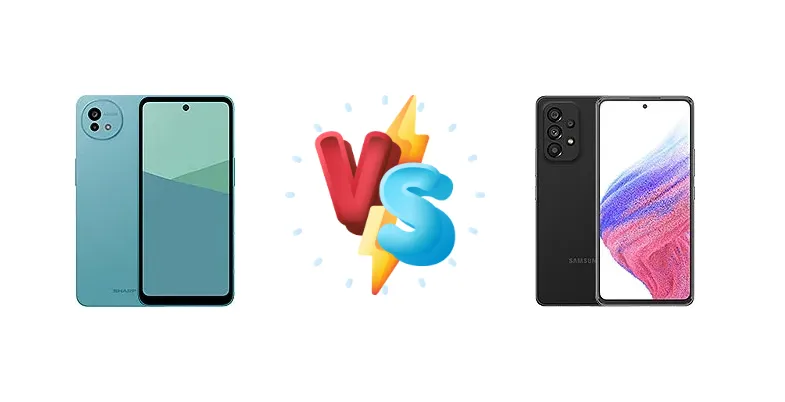
The mid-range smartphone market is fiercely competitive, and the Sharp Aquos wish5 and Samsung Galaxy A53 5G represent compelling options for budget-conscious buyers. While both aim to deliver a well-rounded experience, they take different approaches to achieving it. The Aquos wish5 leverages a newer Mediatek Dimensity 6300 chipset, while the A53 relies on Samsung’s older, but still capable, Exynos 1280. This comparison will dissect their key differences to determine which device offers the best value.
🏆 Quick Verdict
For the average user prioritizing a balance of performance and battery life, the Samsung Galaxy A53 5G emerges as the slightly better choice. Its proven endurance rating and brighter display offset the Aquos wish5’s newer chipset, offering a more refined and reliable experience. However, the Aquos wish5 presents a strong value proposition for those seeking a newer processor at a potentially lower price point.
| Network |
|---|
| 2G bands | GSM 850 / 900 / 1800 / 1900 | GSM 850 / 900 / 1800 / 1900 |
| 3G bands | HSDPA 900 / 2100 | HSDPA 850 / 900 / 1700(AWS) / 1900 / 2100 |
| 4G bands | LTE | 1, 2, 3, 4, 5, 7, 12, 14, 20, 29, 30, 38, 39, 40, 41, 46, 48, 66 - SM-A536U |
| 5G bands | SA/NSA | 2, 5, 41, 66, 77, 78 SA/NSA/Sub6/mmWave - SM-A536U |
| Speed | HSPA, LTE, 5G | HSPA, LTE, 5G |
| Technology | GSM / HSPA / LTE / 5G | GSM / HSPA / LTE / 5G |
| | - | 2, 5, 48, 66, 77, 78, 260, 261 SA/NSA/Sub6/mmWave - SM-A536V |
| Launch |
|---|
| Announced | 2025, May 29 | 2022, March 17 |
| Status | Available. Released 2025, June 26 | Available. Released 2022, March 24 |
| Body |
|---|
| Build | Glass front, plastic back, plastic frame | Glass front (Gorilla Glass 5), plastic frame, plastic back |
| Dimensions | 166 x 76 x 8.8 mm (6.54 x 2.99 x 0.35 in) | 159.6 x 74.8 x 8.1 mm (6.28 x 2.94 x 0.32 in) |
| SIM | Nano-SIM + eSIM | · Nano-SIM· Nano-SIM + Nano-SIM |
| Weight | 187 g (6.60 oz) | 189 g (6.67 oz) |
| | - | IP67 dust/water resistant (up to 1m for 30 min) |
| Display |
|---|
| Protection | - | Corning Gorilla Glass 5 |
| Resolution | 720 x 1612 pixels, 20:9 ratio (~267 ppi density) | 1080 x 2400 pixels, 20:9 ratio (~405 ppi density) |
| Size | 6.6 inches, 104.6 cm2 (~82.9% screen-to-body ratio) | 6.5 inches, 102.0 cm2 (~85.4% screen-to-body ratio) |
| Type | IPS LCD, 120Hz | Super AMOLED, 120Hz, 800 nits (HBM) |
| Platform |
|---|
| CPU | Octa-core (2x2.4 GHz Cortex-A76 & 6x2.0 GHz Cortex-A55) | Octa-core (2x2.4 GHz Cortex-A78 & 6x2.0 GHz Cortex-A55) |
| Chipset | Mediatek Dimensity 6300 (6 nm) | Exynos 1280 (5 nm) |
| GPU | Mali-G57 MC2 | Mali-G68 |
| OS | Android 15, up to 2 major Android upgrades | Android 12, up to 4 major Android upgrades, One UI 8 |
| Memory |
|---|
| Card slot | microSDXC | microSDXC (uses shared SIM slot) |
| Internal | 64GB 4GB RAM, 128GB 4GB RAM, 128GB 6GB RAM, 256GB 8GB RAM | 128GB 4GB RAM, 128GB 6GB RAM, 128GB 8GB RAM, 256GB 6GB RAM, 256GB 8GB RAM |
| Main Camera |
|---|
| Dual | 50 MP, f/1.8, 25mm (wide), PDAF
Auxiliary lens | - |
| Features | LED flash, HDR, panorama | LED flash, panorama, HDR |
| Quad | - | 64 MP, f/1.8, 26mm (wide), 1/1.7X", 0.8µm, PDAF, OIS
12 MP, f/2.2, 123˚ (ultrawide), 1.12µm
5 MP (macro)
Auxiliary lens |
| Single | - | 32 MP, f/2.2, 26mm (wide), 1/2.8", 0.8µm |
| Video | Yes, gyro-EIS | 4K@30fps, 1080p@30/60fps; gyro-EIS |
| Selfie camera |
|---|
| Features | - | HDR |
| Single | 8 MP, f/2.0, 26mm (wide) | 32 MP, f/2.2, 26mm (wide), 1/2.8", 0.8µm |
| Video | 1080p@30fps | 4K@30fps, 1080p@30fps |
| Sound |
|---|
| 3.5mm jack | - | No |
| 35mm jack | Yes | No |
| Loudspeaker | Yes | Yes, with stereo speakers |
| Comms |
|---|
| Bluetooth | 5.3, A2DP, LE | 5.1, A2DP, LE |
| NFC | Yes | Yes (market/region dependent) |
| Positioning | GPS | GPS, GLONASS, GALILEO, BDS |
| Radio | Unspecified | No |
| USB | USB Type-C 2.0 | USB Type-C 2.0, OTG |
| WLAN | Wi-Fi 802.11 a/b/g/n/ac, dual-band | Wi-Fi 802.11 a/b/g/n/ac, dual-band, Wi-Fi Direct |
| Features |
|---|
| Sensors | Fingerprint (side-mounted), accelerometer, gyro, proximity, compass | Fingerprint (under display, optical), accelerometer, gyro, compass, barometer (market/region dependent) |
| | - | Virtual proximity sensing |
| Battery |
|---|
| Charging | 27W wired | 25W wired |
| Type | 5000 mAh | Li-Po 5000 mAh |
| Misc |
|---|
| Colors | Black, Blue, White, Green, Pink | Black, White, Blue, Peach |
| Models | SH-AC05, SH-M32 | SM-A536B, SM-A536B/DS, SM-A536U, SM-A536U1, SM-A5360, SM-A536E, SM-A536E/DS, SM-A536V, SM-A536W, SM-A536N, SM-S536DL |
| Price | About 200 EUR | $ 151.42 / £ 185.00 / € 169.14 |
| SAR | - | 0.75 W/kg (head) 1.58 W/kg (body) |
| SAR EU | - | 0.89 W/kg (head) 1.60 W/kg (body) |
| Tests |
|---|
| Battery life | - |
Endurance rating 113h
|
| Camera | - |
Photo / Video |
| Display | - |
Contrast ratio: Infinite (nominal) |
| Loudspeaker | - |
-26.5 LUFS (Good)
|
| Performance | - |
AnTuTu: 329802 (v8), 379313 (v9)
GeekBench: 1891 (v5.1)
GFXBench: 19fps (ES 3.1 onscreen) |
Sharp Aquos wish5
- Newer Mediatek Dimensity 6300 chipset
- Potentially faster 27W charging
- Likely more affordable price point
- Limited display specifications
- Unknown battery capacity
- Less established brand reputation
Samsung Galaxy A53 5G
- Brighter 830 nit display
- Proven 113-hour endurance rating
- Samsung’s One UI software ecosystem
- Older Exynos 1280 chipset
- Slower 25W charging
- Potentially higher price
Display Comparison
The Samsung Galaxy A53 5G boasts a significantly brighter display, reaching a measured peak of 830 nits, compared to an unstated value for the Aquos wish5. This brightness advantage translates to better outdoor visibility. While the A53’s contrast ratio is listed as ‘Infinite’ (nominal), this is typical marketing language; the real-world benefit is a punchy, vibrant image. The Aquos wish5’s display specifications are currently limited, making a direct comparison difficult, but it’s likely to be less vibrant. The A53’s larger user base also means more readily available screen calibration data and user feedback regarding color accuracy.
Camera Comparison
Both devices offer photo and video capabilities, but detailed camera specifications are limited for the Aquos wish5. The Galaxy A53 5G likely benefits from Samsung’s well-regarded image processing algorithms and potentially a larger main sensor (specifications unavailable for either device). The inclusion of Optical Image Stabilization (OIS) on the A53, if present, would provide a significant advantage in low-light photography and video recording. It’s crucial to note that the presence of a 2MP macro camera on either device is largely a marketing gimmick; image quality from such sensors is typically poor. Focus should be on the main sensor and its capabilities.
Performance
Both phones utilize octa-core CPUs with a similar core configuration (2x high-performance Cortex-A76/A78 and 6x efficiency Cortex-A55 cores). However, the Exynos 1280 in the A53 is fabricated on a 5nm process, while the Dimensity 6300 in the Aquos wish5 uses a 6nm process. The smaller node generally translates to improved power efficiency and thermal performance, potentially allowing the Exynos 1280 to sustain peak performance for longer periods. While the Cortex-A78 cores in the A53 are slightly older architecture than the A76 cores in the wish5, the 5nm process and Samsung’s optimization could mitigate this difference. The Aquos wish5’s newer chipset *could* offer better software support in the long run, but this remains to be seen.
Battery Life
The Samsung Galaxy A53 5G has an endurance rating of 113 hours, indicating excellent battery life. While the Aquos wish5’s battery capacity is unknown, its 27W wired charging is slightly faster than the A53’s 25W charging. However, charging speed isn’t the sole determinant of battery experience; the A53’s larger battery (implied by its endurance rating) and the Exynos 1280’s potentially better power efficiency likely result in longer real-world usage. A full charge from 0-100% on the A53 is estimated to take around 1 hour and 30 minutes, while the Aquos wish5 may be slightly faster.
Buying Guide
Buy the Sharp Aquos wish5 if you need a phone with a more modern chipset for potentially better long-term software support and are comfortable with a potentially less polished software experience. Buy the Samsung Galaxy A53 5G if you prefer a phone with a proven track record of battery life, a brighter and more vibrant display, and Samsung’s established One UI software ecosystem.
Frequently Asked Questions
❓ Does the Exynos 1280 in the Galaxy A53 5G tend to overheat during prolonged gaming sessions?
While the Exynos 1280 isn't known for extreme overheating, it can experience thermal throttling during extended, graphically demanding games. Samsung’s software optimizations and the phone’s cooling system mitigate this to some extent, but users may notice a slight performance dip after prolonged use. The 5nm process helps, but it's not a flagship-level chip.
❓ Is the 27W charging on the Aquos wish5 significantly faster in real-world use compared to the A53’s 25W?
The difference between 27W and 25W charging is relatively small. While the Aquos wish5 *may* charge slightly faster, the overall charging time difference will likely be minimal – perhaps 10-15 minutes for a full charge. Battery capacity and charging curve optimization play a larger role than the wattage difference.
❓ How does the software update policy differ between Sharp and Samsung for these devices?
Samsung generally provides more consistent and longer-term software support for its devices, typically offering 3-4 years of OS updates and 5 years of security patches. Sharp’s software update policy is less predictable, and the Aquos wish5 may receive fewer updates over its lifespan. This is a key consideration for users who prioritize long-term software support.