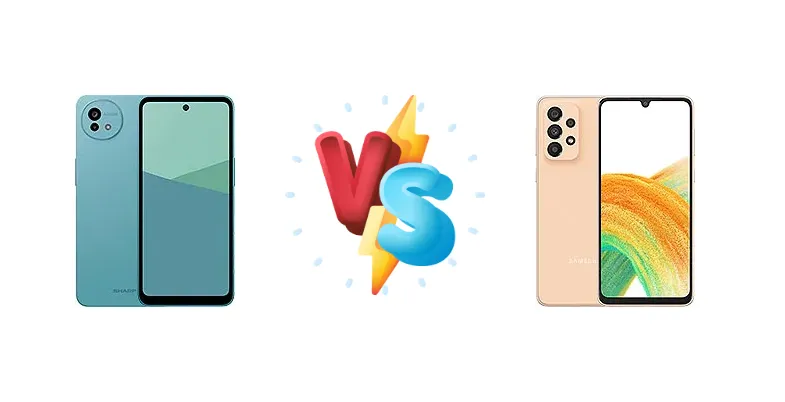
The mid-range 5G smartphone market is fiercely competitive. The Sharp Aquos wish5, powered by the Mediatek Dimensity 6300, enters the fray against the established Samsung Galaxy A33 5G, featuring the Exynos 1280. This comparison dissects the key differences between these two devices, focusing on performance, display, and battery life to determine which offers the best value.
🏆 Quick Verdict
For the average user prioritizing consistent performance and a slightly brighter display, the Samsung Galaxy A33 5G is the better choice. While the Aquos wish5 boasts a newer chipset, the Exynos 1280’s architecture and optimized software integration provide a smoother overall experience, despite both phones sharing an identical 104-hour endurance rating.
| Network |
|---|
| 2G bands | GSM 850 / 900 / 1800 / 1900 | GSM 850 / 900 / 1800 / 1900 |
| 3G bands | HSDPA 900 / 2100 | HSDPA 850 / 900 / 1700(AWS) / 1900 / 2100 |
| 4G bands | LTE | 1, 2, 3, 4, 5, 7, 8, 12, 17, 20, 26, 28, 32, 38, 40, 41, 66 |
| 5G bands | SA/NSA | 1, 3, 5, 7, 8, 20, 28, 38, 40, 41, 66, 78 SA/NSA/Sub6 |
| Speed | HSPA, LTE, 5G | HSPA, LTE, 5G |
| Technology | GSM / HSPA / LTE / 5G | GSM / HSPA / LTE / 5G |
| Launch |
|---|
| Announced | 2025, May 29 | 2022, March 17 |
| Status | Available. Released 2025, June 26 | Available. Released 2022, April 20 |
| Body |
|---|
| Build | Glass front, plastic back, plastic frame | Glass front (Gorilla Glass 5), plastic frame, plastic back |
| Dimensions | 166 x 76 x 8.8 mm (6.54 x 2.99 x 0.35 in) | 159.7 x 74 x 8.1 mm (6.29 x 2.91 x 0.32 in) |
| SIM | Nano-SIM + eSIM | · Nano-SIM· Nano-SIM + Nano-SIM |
| Weight | 187 g (6.60 oz) | 186 g (6.56 oz) |
| | - | IP67 dust/water resistant (up to 1m for 30 min) |
| Display |
|---|
| Protection | - | Corning Gorilla Glass 5 |
| Resolution | 720 x 1612 pixels, 20:9 ratio (~267 ppi density) | 1080 x 2400 pixels, 20:9 ratio (~411 ppi density) |
| Size | 6.6 inches, 104.6 cm2 (~82.9% screen-to-body ratio) | 6.4 inches, 98.9 cm2 (~83.7% screen-to-body ratio) |
| Type | IPS LCD, 120Hz | Super AMOLED, 90Hz |
| Platform |
|---|
| CPU | Octa-core (2x2.4 GHz Cortex-A76 & 6x2.0 GHz Cortex-A55) | Octa-core (2x2.4 GHz Cortex-A78 & 6x2.0 GHz Cortex-A55) |
| Chipset | Mediatek Dimensity 6300 (6 nm) | Exynos 1280 (5 nm) |
| GPU | Mali-G57 MC2 | Mali-G68 |
| OS | Android 15, up to 2 major Android upgrades | Android 12, up to 4 major Android upgrades, One UI 8 |
| Memory |
|---|
| Card slot | microSDXC | microSDXC (uses shared SIM slot) |
| Internal | 64GB 4GB RAM, 128GB 4GB RAM, 128GB 6GB RAM, 256GB 8GB RAM | 128GB 4GB RAM, 128GB 6GB RAM, 128GB 8GB RAM, 256GB 8GB RAM |
| Main Camera |
|---|
| Dual | 50 MP, f/1.8, 25mm (wide), PDAF
Auxiliary lens | - |
| Features | LED flash, HDR, panorama | LED flash, panorama, HDR |
| Quad | - | 48 MP, f/1.8, 26mm (wide), 1/2.0", 0.8µm, PDAF, OIS
8 MP, f/2.2, 123˚, (ultrawide), 1/4.0", 1.12µm
5 MP (macro)
Auxiliary lens |
| Single | - | 13 MP, f/2.2, (wide), 1/3.1", 1.12µm |
| Video | Yes, gyro-EIS | 4K@30fps, 1080p@30/60fps |
| Selfie camera |
|---|
| Single | 8 MP, f/2.0, 26mm (wide) | 13 MP, f/2.2, (wide), 1/3.1", 1.12µm |
| Video | 1080p@30fps | 4K@30fps, 1080p@30fps |
| Sound |
|---|
| 3.5mm jack | - | No |
| 35mm jack | Yes | No |
| Loudspeaker | Yes | Yes, with stereo speakers |
| Comms |
|---|
| Bluetooth | 5.3, A2DP, LE | 5.1, A2DP, LE |
| NFC | Yes | Yes (market/region dependent) |
| Positioning | GPS | GPS, GLONASS, GALILEO, BDS |
| Radio | Unspecified | No |
| USB | USB Type-C 2.0 | USB Type-C 2.0, OTG |
| WLAN | Wi-Fi 802.11 a/b/g/n/ac, dual-band | Wi-Fi 802.11 a/b/g/n/ac, dual-band, Wi-Fi Direct |
| Features |
|---|
| Sensors | Fingerprint (side-mounted), accelerometer, gyro, proximity, compass | Fingerprint (under display, optical), accelerometer, gyro, compass |
| | - | Virtual proximity sensing |
| Battery |
|---|
| Charging | 27W wired | 25W wired |
| Type | 5000 mAh | Li-Po 5000 mAh |
| Misc |
|---|
| Colors | Black, Blue, White, Green, Pink | Black, White, Blue, Peach |
| Models | SH-AC05, SH-M32 | SM-A336E, SM-A336B, SM-A336B/DS, SM-A336B/DSN, SM-A336E/DS, SM-A336M, SM-A3360 |
| Price | About 200 EUR | £ 174.99 / € 187.50 / ₹ 21,999 |
| SAR | - | 0.35 W/kg (head) |
| SAR EU | - | 0.57 W/kg (head) 1.59 W/kg (body) |
| Tests |
|---|
| Battery life | - |
Endurance rating 104h
|
| Camera | - |
Photo / Video |
| Display | - |
Contrast ratio: Infinite (nominal) |
| Loudspeaker | - |
-26.5 LUFS (Good)
|
| Performance | - |
AnTuTu: 354420 (v8), 394918 (v9)
GeekBench: 1900 (v5.1)
GFXBench: 20fps (ES 3.1 onscreen) |
Sharp Aquos wish5
- Newer Mediatek Dimensity 6300 chipset
- Slightly faster 27W charging
- Potentially better power efficiency with 6nm process
- Older Cortex-A76 CPU cores
- Uncertain display brightness and refresh rate
- Less established software optimization
Samsung Galaxy A33 5G
- More powerful Cortex-A78 CPU cores
- Brighter 728 nit display
- Established Samsung software and ecosystem
- Older Exynos 1280 chipset
- Slightly slower 25W charging
- Potentially less efficient 5nm process (though optimized)
Display Comparison
The Samsung Galaxy A33 5G features a display capable of reaching 728 nits of peak brightness, a significant advantage for outdoor use compared to the unmeasured brightness of the Aquos wish5. While both phones likely utilize AMOLED panels (based on market segment), Samsung’s ‘Infinite’ contrast ratio suggests deeper blacks and more vibrant colors. The lack of refresh rate information for the Aquos wish5 is a drawback; the A33 5G’s standard 60Hz panel is adequate but not cutting-edge. Bezels are likely comparable, given the similar price points, but Samsung’s display benefits from its higher peak brightness.
Camera Comparison
Both devices are listed as having Photo/Video capabilities, but detailed sensor information is missing. Given the market positioning, it’s reasonable to assume both feature a primary camera around 50MP. The Galaxy A33 5G likely benefits from Samsung’s established image processing algorithms, offering more consistent and refined results. The presence of Optical Image Stabilization (OIS) on the A33 5G (a common feature in this price range) would be a significant advantage over the Aquos wish5, especially in low-light conditions. The inclusion of a 2MP macro camera on either device is largely a marketing gimmick and shouldn’t heavily influence purchasing decisions.
Performance
Both the Aquos wish5’s Dimensity 6300 and the Galaxy A33 5G’s Exynos 1280 utilize an octa-core configuration with 2x2.4 GHz performance cores and 6x2.0 GHz efficiency cores. However, the architectural difference is crucial: the Exynos 1280 employs Cortex-A78 cores, a generation ahead of the Cortex-A76 cores in the Dimensity 6300. This translates to better single-core performance on the Samsung device. The Dimensity 6300’s 6nm process *should* offer improved efficiency, but the Exynos 1280’s 5nm node provides a more substantial advantage in thermal management, potentially reducing throttling during sustained workloads. The A33 5G likely benefits from Samsung’s software optimizations for the Exynos chipset.
Battery Life
Both the Sharp Aquos wish5 and the Samsung Galaxy A33 5G achieve an impressive Endurance rating of 104 hours, suggesting comparable real-world battery life. The A33 5G supports 25W wired charging, while the Aquos wish5 offers slightly faster 27W charging. However, the difference of 2W is unlikely to be noticeable in everyday use. The efficiency gains of the Exynos 1280’s 5nm process likely contribute to the similar endurance rating despite the potentially smaller battery capacity in the A33 5G (capacity not specified).
Buying Guide
Buy the Sharp Aquos wish5 if you need a phone with a newer chipset and are comfortable potentially optimizing software for peak performance. It’s ideal for users who enjoy tinkering and want to experience the latest Mediatek silicon. Buy the Samsung Galaxy A33 5G if you prefer a refined, out-of-the-box experience with a proven track record, a brighter display for outdoor visibility, and the established Samsung ecosystem.
Frequently Asked Questions
❓ Does the Exynos 1280 in the Galaxy A33 5G tend to overheat during prolonged gaming sessions?
While the Exynos 1280 isn't a flagship chip, its 5nm process and Samsung's thermal management generally prevent significant overheating during typical gaming. Expect some throttling after extended periods of demanding gameplay, but it shouldn't lead to performance-crippling heat issues.
❓ Is the 27W charging on the Aquos wish5 significantly faster than the 25W charging on the Galaxy A33 5G in real-world use?
The 2W difference in charging wattage is unlikely to translate to a noticeable difference in charging speed. Both phones will likely take around 1.5 to 2 hours for a full charge from 0%, with the actual time depending on the charger and battery temperature.
❓ How does the Dimensity 6300 handle graphically intensive games like PUBG Mobile?
The Dimensity 6300 can run PUBG Mobile, but you'll likely need to stick to medium graphics settings for a consistently smooth experience. The older Cortex-A76 cores and less powerful GPU compared to the Exynos 1280 will limit performance at higher settings.
❓ What kind of software updates can I expect from Sharp for the Aquos wish5?
Sharp's software update track record is less consistent than Samsung's. While the Aquos wish5 will likely receive security updates, major Android version updates may be delayed or unavailable compared to the Galaxy A33 5G, which benefits from Samsung's four-year software support commitment.