
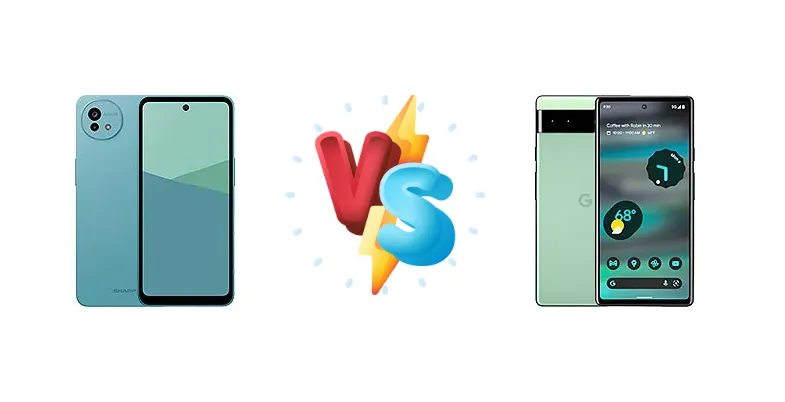
Sharp Aquos wish5 vs Google Pixel 6a: Which Mid-Range Phone Reigns Supreme?
| Phones Images | |||||
|---|---|---|---|---|---|
|
🏆 Quick Verdict
For most users, the Google Pixel 6a remains the superior choice. Its Google Tensor chip provides a more robust and refined experience, particularly in image processing and AI-driven features. However, the Aquos wish5’s faster 27W charging offers a compelling advantage for those prioritizing quick top-ups.
| PHONES | ||
|---|---|---|
| Phone Names | Sharp Aquos wish5 | Google Pixel 6a |
| Network | ||
|---|---|---|
| 2G bands | GSM 850 / 900 / 1800 / 1900 | GSM 850 / 900 / 1800 / 1900 |
| 3G bands | HSDPA 900 / 2100 | HSDPA 800 / 850 / 900 / 1700(AWS) / 1900 / 2100 |
| 4G bands | LTE | 1, 2, 3, 4, 5, 7, 8, 12, 13, 14, 17, 18, 19, 20, 25, 26, 28, 29, 30, 38, 39, 40, 41, 42, 48, 66, 71 - GX7AS, GB62Z (USA/Canada) |
| 5G bands | SA/NSA | 1, 2, 3, 5, 7, 8, 12, 20, 25, 28, 30, 38, 40, 41, 48, 66, 71, 77, 78 SA/NSA/Sub6 - GX7AS (USA/Canada) |
| Speed | HSPA, LTE, 5G | HSPA, LTE, 5G |
| Technology | GSM / HSPA / LTE / 5G | GSM / HSPA / LTE / 5G |
| - | 1, 2, 3, 5, 7, 8, 12, 20, 25, 28, 30, 40, 48, 66, 71, 77, 78 SA/NSA/Sub6 - G1AZG (International) | |
| Launch | ||
|---|---|---|
| Announced | 2025, May 29 | 2022, May 11 |
| Status | Available. Released 2025, June 26 | Available. Released 2022, July 21 |
| Body | ||
|---|---|---|
| Build | Glass front, plastic back, plastic frame | Glass front (Gorilla Glass 3), aluminum frame, plastic back |
| Dimensions | 166 x 76 x 8.8 mm (6.54 x 2.99 x 0.35 in) | 152.2 x 71.8 x 8.9 mm (5.99 x 2.83 x 0.35 in) |
| SIM | Nano-SIM + eSIM | Nano-SIM + eSIM |
| Weight | 187 g (6.60 oz) | 178 g (6.28 oz) |
| - | IP67 dust/water resistant (up to 1m for 30 min) | |
| Display | ||
|---|---|---|
| Protection | - | Corning Gorilla Glass 3 |
| Resolution | 720 x 1612 pixels, 20:9 ratio (~267 ppi density) | 1080 x 2400 pixels, 20:9 ratio (~429 ppi density) |
| Size | 6.6 inches, 104.6 cm2 (~82.9% screen-to-body ratio) | 6.1 inches, 90.7 cm2 (~83.0% screen-to-body ratio) |
| Type | IPS LCD, 120Hz | OLED, HDR |
| - | Always-on display | |
| Platform | ||
|---|---|---|
| CPU | Octa-core (2x2.4 GHz Cortex-A76 & 6x2.0 GHz Cortex-A55) | Octa-core (2x2.80 GHz Cortex-X1 & 2x2.25 GHz Cortex-A76 & 4x1.80 GHz Cortex-A55) |
| Chipset | Mediatek Dimensity 6300 (6 nm) | Google Tensor (5 nm) |
| GPU | Mali-G57 MC2 | Mali-G78 MP20 |
| OS | Android 15, up to 2 major Android upgrades | Android 12, upgradable to Android 15, up to 5 major Android upgrades |
| Memory | ||
|---|---|---|
| Card slot | microSDXC | No |
| Internal | 64GB 4GB RAM, 128GB 4GB RAM, 128GB 6GB RAM, 256GB 8GB RAM | 128GB 6GB RAM |
| - | UFS 3.1 | |
| Main Camera | ||
|---|---|---|
| Dual | 50 MP, f/1.8, 25mm (wide), PDAF Auxiliary lens | 12.2 MP, f/1.7, 27mm, (wide), 1/2.55", 1.4µm, dual pixel PDAF, OIS 12 MP, f/2.2, 17mm, 114˚ (ultrawide), 1.25µm |
| Features | LED flash, HDR, panorama | Dual-LED flash, Pixel Shift, Auto-HDR, panorama |
| Single | - | 8 MP, f/2.0, 24mm (wide), 1.12µm |
| Video | Yes, gyro-EIS | 4K@30/60fps, 1080p@30/60/120/240fps; gyro-EIS, OIS |
| Selfie camera | ||
|---|---|---|
| Features | - | HDR, panorama |
| Single | 8 MP, f/2.0, 26mm (wide) | 8 MP, f/2.0, 24mm (wide), 1.12µm |
| Video | 1080p@30fps | 1080p@30fps |
| Sound | ||
|---|---|---|
| 3.5mm jack | - | No |
| 35mm jack | Yes | No |
| Loudspeaker | Yes | Yes, with stereo speakers |
| Comms | ||
|---|---|---|
| Bluetooth | 5.3, A2DP, LE | 5.2, A2DP, LE |
| NFC | Yes | Yes |
| Positioning | GPS | GPS, GLONASS, GALILEO, QZSS |
| Radio | Unspecified | No |
| USB | USB Type-C 2.0 | USB Type-C 3.1 |
| WLAN | Wi-Fi 802.11 a/b/g/n/ac, dual-band | Wi-Fi 802.11 a/b/g/n/ac/6e, dual-band, Wi-Fi Direct |
| Features | ||
|---|---|---|
| Sensors | Fingerprint (side-mounted), accelerometer, gyro, proximity, compass | Fingerprint (under display, optical), accelerometer, gyro, proximity, compass, barometer |
| Battery | ||
|---|---|---|
| Charging | 27W wired | 18W wired, PD3.0 |
| Type | 5000 mAh | Li-Po 4410 mAh |
| Misc | ||
|---|---|---|
| Colors | Black, Blue, White, Green, Pink | Chalk, Charcoal, Sage |
| Models | SH-AC05, SH-M32 | GX7AS, GB62Z, G1AZG, GB17L |
| Price | About 200 EUR | $ 138.99 / C$ 228.74 / ₹ 23,999 |
| Tests | ||
|---|---|---|
| Battery life | - | Endurance rating 94h |
| Display | - | Contrast ratio: Infinite (nominal) |
Sharp Aquos wish5
- Faster 27W wired charging
- Potentially lower price point
- Mediatek Dimensity 6300 offers decent efficiency
- Less powerful processor than Google Tensor
- Software updates likely less frequent
- Camera performance likely inferior to Pixel 6a
Google Pixel 6a
- Superior processor performance with Google Tensor
- Exceptional camera quality and computational photography
- Guaranteed software updates and Google ecosystem integration
- Slower 18W charging
- Potentially higher price
- May experience some thermal throttling under sustained load
Display Comparison
The Pixel 6a boasts a brighter display, reaching a measured 876 nits, which translates to better visibility outdoors compared to the Aquos wish5 (brightness data unavailable). While the Aquos wish5’s panel specifics are unknown, the Pixel 6a’s ‘infinite’ contrast ratio (nominal) suggests a superior OLED experience. The Pixel 6a’s display is likely to offer richer blacks and more vibrant colors. The lack of high refresh rate information for the Aquos wish5 suggests the Pixel 6a will provide a smoother scrolling experience.
Camera Comparison
The Pixel 6a’s camera prowess is largely attributed to Google’s computational photography, powered by the Tensor chip. While sensor details for the Aquos wish5 are missing, the Pixel 6a’s image processing excels in dynamic range, detail preservation, and low-light performance. The Pixel 6a’s software algorithms compensate for potentially smaller sensor sizes, delivering consistently impressive results. The Aquos wish5 likely relies more on hardware specifications, and without detailed information, it’s difficult to assess its camera capabilities against the Pixel 6a’s software-driven advantage.
Performance
The Google Tensor (5nm) in the Pixel 6a represents a significant architectural leap over the Mediatek Dimensity 6300 (6nm) found in the Aquos wish5. The Tensor utilizes a Cortex-X1 prime core clocked at 2.80 GHz, offering substantially higher peak performance than the Aquos wish5’s Cortex-A76 cores at 2.4 GHz. While both are octa-core CPUs, the Tensor’s more advanced architecture and smaller 5nm process node translate to better efficiency and sustained performance, particularly in demanding tasks like video editing and gaming. The Pixel 6a’s Tensor chip also benefits from Google’s dedicated AI processing unit, enhancing features like voice recognition and image processing.
Battery Life
Both phones achieve an impressive endurance rating of 94 hours, indicating similar overall battery life. However, the Aquos wish5’s 27W wired charging significantly outpaces the Pixel 6a’s 18W charging with PD3.0. This means the Aquos wish5 can replenish its battery much faster, potentially adding hours of use in a short amount of time. While the Pixel 6a’s battery efficiency is commendable, the Aquos wish5 offers a clear advantage for users who prioritize quick charging.
Buying Guide
Buy the Sharp Aquos wish5 if you prioritize fast charging and are comfortable with a less polished software experience. It’s ideal for users who frequently need to quickly replenish their battery and don’t rely heavily on advanced computational photography. Buy the Google Pixel 6a if you value a smooth, responsive user experience, exceptional camera performance powered by Google’s Tensor chip, and guaranteed software updates. It’s the better choice for photography enthusiasts and those deeply integrated into the Google ecosystem.