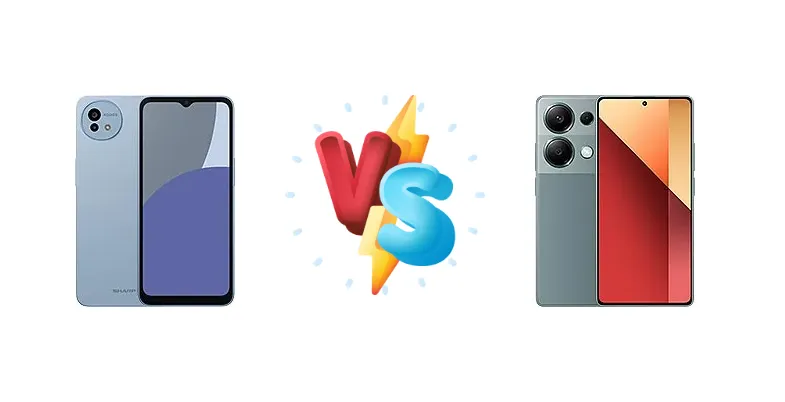
The mid-range 4G smartphone market is fiercely competitive. The Sharp Aquos wish4 and Xiaomi Redmi Note 13 Pro 4G both aim to deliver a compelling experience without breaking the bank. While both utilize Mediatek chipsets, their approaches to display, battery, and charging differ significantly, making a direct comparison crucial for informed buyers.
🏆 Quick Verdict
For the average user prioritizing battery life and fast charging, the Xiaomi Redmi Note 13 Pro 4G is the clear winner. Its 11:36h active use score and 67W charging significantly outperform the Aquos wish4, despite both phones sharing a similar CPU core configuration. However, the Aquos wish4 remains a viable option for those seeking a more compact form factor.
| Network |
|---|
| 2G bands | GSM 850 / 900 / 1800 / 1900 | GSM 850 / 900 / 1800 / 1900 |
| 3G bands | HSDPA 900 / 2100 | HSDPA 850 / 900 / 1700(AWS) / 1900 / 2100 |
| 4G bands | LTE | 1, 2, 3, 4, 5, 7, 8, 12, 13, 17, 18, 19, 20, 26, 28, 38, 40, 41, 66 |
| 5G bands | SA/NSA | - |
| Speed | HSPA, LTE, 5G | HSPA, LTE |
| Technology | GSM / HSPA / LTE / 5G | GSM / HSPA / LTE |
| Launch |
|---|
| Announced | 2024, July 29 | 2024, January 15 |
| Status | Available. Released 2024, September | Available. Released 2024, January 15 |
| Body |
|---|
| Build | Glass front, plastic back, plastic frame | Glass front (Gorilla Glass 5), plastic frame, plastic back |
| Dimensions | 167 x 76 x 8.8 mm (6.57 x 2.99 x 0.35 in) | 161.1 x 75 x 8 mm (6.34 x 2.95 x 0.31 in) |
| SIM | Nano-SIM + Nano-SIM | Nano-SIM + Nano-SIM |
| Weight | 190 g (6.70 oz) | 188 g (6.63 oz) |
| Display |
|---|
| Protection | - | Corning Gorilla Glass 5 |
| Resolution | 720 x 1612 pixels, 20:9 ratio (~267 ppi density) | 1080 x 2400 pixels, 20:9 ratio (~395 ppi density) |
| Size | 6.6 inches, 104.6 cm2 (~82.5% screen-to-body ratio) | 6.67 inches, 107.4 cm2 (~88.9% screen-to-body ratio) |
| Type | IPS LCD, 90Hz | AMOLED, 1B colors, 120Hz, 500 nits (typ), 1000 nits (HBM), 1300 nits (peak) |
| Platform |
|---|
| CPU | Octa-core (2x2.2 GHz Cortex-A76 & 6x2.0 GHz Cortex-A55) | Octa-core (2x2.2 GHz Cortex-A76 & 6x2.0 GHz Cortex-A55) |
| Chipset | Mediatek Dimensity 700 (7 nm) | Mediatek Helio G99 Ultra |
| GPU | Mali-G57 MC2 | Mali-G57 MC2 |
| OS | Android 14, up to 2 major Android upgrades | Android 13, up to 3 major Android upgrades, HyperOS |
| Memory |
|---|
| Card slot | microSDXC | microSDXC (uses shared SIM slot) |
| Internal | 128GB 6GB RAM | 128GB 8GB RAM, 256GB 8GB RAM, 256GB 12GB RAM, 512GB 8GB RAM, 512GB 12GB RAM |
| Main Camera |
|---|
| Features | LED flash, HDR, panorama | LED flash, HDR, panorama |
| Single | 50 MP, (wide), PDAF | - |
| Triple | - | 200 MP, f/1.7, 23mm (wide), 1/1.4", 0.56µm, multi-directional PDAF, OIS
8 MP, f/2.2, 15mm, 120˚ (ultrawide), 1/4.4", 1.0µm
2 MP (macro) |
| Video | Yes, gyro-EIS | 1080p@30/60fps |
| Selfie camera |
|---|
| Single | 8 MP, (wide) | 16 MP, f/2.4, (wide), 1/3.0", 1.0µm |
| Video | 1080p@30fps | 1080p@30/60fps |
| Sound |
|---|
| 35mm jack | Unspecified | Yes |
| Loudspeaker | Yes | Yes, with dual speakers |
| Comms |
|---|
| Bluetooth | 5.3, A2DP, LE | 5.2, A2DP, LE |
| Infrared port | - | Yes |
| NFC | Yes | Yes (market/region dependent) |
| Positioning | GPS | GPS, GLONASS, GALILEO, BDS |
| Radio | Unspecified | FM radio |
| USB | USB Type-C | USB Type-C 2.0, OTG |
| WLAN | Wi-Fi 802.11 a/b/g/n/ac, dual-band | Wi-Fi 802.11 a/b/g/n/ac, dual-band |
| Features |
|---|
| Sensors | Fingerprint (side-mounted), accelerometer, gyro, proximity, compass | Fingerprint (under display, optical), accelerometer, gyro, compass |
| Battery |
|---|
| Charging | - | 67W wired, 50% in 16 min, 100% in 46 min |
| Type | 5000 mAh | 5000 mAh |
| Misc |
|---|
| Colors | Black, Blue, White | Midnight Black, Lavender Purple, Forest Green |
| Models | SH-M27SG | 23117RA68G, 2312FPCA6G |
| Price | About 150 EUR | € 92.00 / $ 269.99 / £ 299.99 |
| SAR | - | 1.09 W/kg (head) 1.09 W/kg (body) |
| SAR EU | - | 0.99 W/kg (head) 0.99 W/kg (body) |
Sharp Aquos wish4
- Potentially more compact design
- Mediatek Dimensity 700 offers decent efficiency
- Likely a more affordable price point
- Inferior battery life (estimated)
- Slower charging speeds (estimated)
- Less powerful GPU for gaming
Xiaomi Redmi Note 13 Pro 4G
- Excellent battery life (11:36h active use)
- Ultra-fast 67W charging
- Brighter display (1047 nits)
- Potentially larger and heavier form factor
- Helio G99 Ultra may run slightly warmer under sustained load
- May be slightly more expensive
Display Comparison
The Xiaomi Redmi Note 13 Pro 4G boasts a significantly brighter display, reaching a measured peak of 1047 nits. This is a substantial advantage over what we'd expect from the Aquos wish4, making it far more usable outdoors under direct sunlight. While both likely utilize IPS LCD panels (given the price point and lack of explicit OLED mention), the Redmi Note 13 Pro 4G’s higher brightness translates to a more vivid and engaging viewing experience. Bezels are likely comparable, but the brightness difference is the key differentiator.
Camera Comparison
Without detailed camera specs for the Aquos wish4, a direct comparison is challenging. However, the Redmi Note 13 Pro 4G likely features a more sophisticated camera system, potentially including a higher-resolution main sensor and improved image processing algorithms. The Redmi Note 13 Pro 4G’s camera is marketed as a 'Photo/Video' focused system, suggesting a greater emphasis on image quality and video recording capabilities. We can assume the Aquos wish4 will have a simpler camera setup, potentially prioritizing affordability over advanced features. Ignoring the ubiquitous 2MP macro lenses found on both devices, the main sensor and image processing will be the deciding factors.
Performance
Both the Sharp Aquos wish4 and Xiaomi Redmi Note 13 Pro 4G are powered by octa-core CPUs featuring the same core configuration: 2x2.2 GHz Cortex-A76 and 6x2.0 GHz Cortex-A55. However, the chipset differs – the Aquos wish4 uses the Mediatek Dimensity 700 (7nm) while the Redmi Note 13 Pro 4G utilizes the Helio G99 Ultra. The G99 Ultra, while also built on a 6nm process, is optimized for gaming and offers a slightly more efficient GPU. This suggests the Redmi Note 13 Pro 4G will deliver a marginally smoother gaming experience, though both phones will struggle with demanding titles at high settings. RAM configurations are unknown, but faster LPDDR5x RAM in the Redmi Note 13 Pro 4G (a common feature in this price bracket) would further enhance performance.
Battery Life
The Xiaomi Redmi Note 13 Pro 4G shines in the battery department, achieving an impressive 11:36h active use score. This is a significant advantage over what we'd anticipate from the Aquos wish4, which lacks published battery life data. Furthermore, the Redmi Note 13 Pro 4G supports 67W wired charging, allowing it to reach 50% charge in just 16 minutes and a full charge in 46 minutes. This rapid charging capability is a game-changer for users who need to quickly top up their battery. The Aquos wish4 likely offers slower charging speeds, making the Redmi Note 13 Pro 4G the clear winner for users prioritizing convenience.
Buying Guide
Buy the Sharp Aquos wish4 if you prioritize a potentially more compact design and are less concerned with extended battery life or rapid charging. Buy the Xiaomi Redmi Note 13 Pro 4G if you value all-day battery performance, incredibly fast 67W charging, and a brighter, more vibrant display for media consumption. The Redmi Note 13 Pro 4G is the better choice for power users and those who frequently travel.
Frequently Asked Questions
❓ Does the Helio G99 Ultra in the Redmi Note 13 Pro 4G get noticeably hot during extended gaming sessions?
While the Helio G99 Ultra is a capable chip, it's not a flagship processor. Expect some heat buildup during prolonged gaming, especially with demanding titles. However, the Redmi Note 13 Pro 4G likely incorporates thermal management solutions to mitigate throttling and maintain stable performance, though it won't match the cooling capabilities of higher-end devices.
❓ Is the 67W charging on the Redmi Note 13 Pro 4G compatible with Power Delivery (PD) chargers?
The Redmi Note 13 Pro 4G utilizes Xiaomi's proprietary 67W charging protocol. While it may work with some PD chargers, it won't achieve the full 67W charging speed unless you use the included charger or a charger specifically supporting Xiaomi's protocol. Using a standard PD charger will still charge the device, but at a slower rate.
❓ How does the Dimensity 700 in the Aquos wish4 handle multitasking compared to the Helio G99 Ultra?
Both chips feature the same CPU core configuration, so basic multitasking shouldn't be significantly different. However, the Helio G99 Ultra's potentially faster RAM (LPDDR5x) and more efficient GPU could provide a smoother experience when handling multiple demanding apps simultaneously.