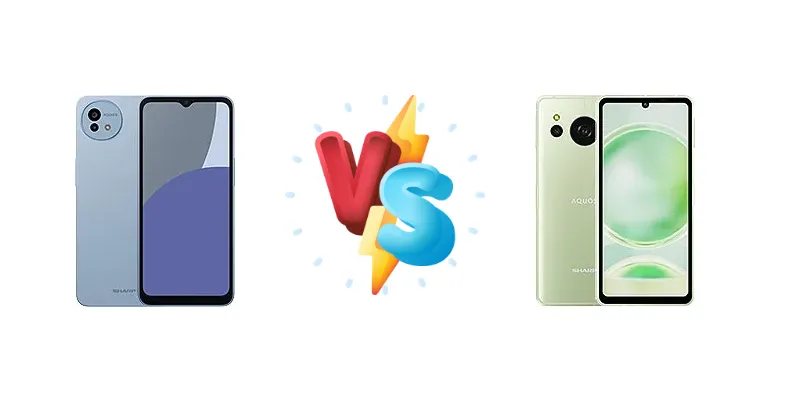
Sharp's Aquos line continues to offer compelling options in the mid-range segment. The wish4 and sense8 represent distinct approaches: the wish4 prioritizing affordability with a Mediatek Dimensity 700, while the sense8 steps up with Qualcomm's newer Snapdragon 6 Gen 1. This comparison dissects the core differences to determine which device delivers the best experience for your needs.
🏆 Quick Verdict
For most users, the Sharp Aquos sense8 is the superior choice. Its Snapdragon 6 Gen 1, built on a more efficient 4nm process, provides a noticeable performance uplift and better thermal management compared to the wish4’s Dimensity 700. While the wish4 is more affordable, the sense8’s improved chipset and 18W charging justify the price difference.
| Network |
|---|
| 2G bands | GSM 850 / 900 / 1800 / 1900 | GSM 850 / 900 / 1800 / 1900 |
| 3G bands | HSDPA 900 / 2100 | HSDPA 900 / 2100 |
| 4G bands | LTE | LTE |
| 5G bands | SA/NSA | SA/NSA |
| Speed | HSPA, LTE, 5G | HSPA, LTE, 5G |
| Technology | GSM / HSPA / LTE / 5G | GSM / HSPA / LTE / 5G |
| Launch |
|---|
| Announced | 2024, July 29 | 2024, January 17 |
| Status | Available. Released 2024, September | Available. Released 2024, January |
| Body |
|---|
| Build | Glass front, plastic back, plastic frame | Glass front, aluminum frame, aluminum back |
| Dimensions | 167 x 76 x 8.8 mm (6.57 x 2.99 x 0.35 in) | 153 x 71 x 8.4 mm (6.02 x 2.80 x 0.33 in) |
| SIM | Nano-SIM + Nano-SIM | Nano-SIM + eSIM |
| Weight | 190 g (6.70 oz) | 159 g (5.61 oz) |
| Display |
|---|
| Resolution | 720 x 1612 pixels, 20:9 ratio (~267 ppi density) | 1080 x 2340 pixels, 19.5:9 ratio (~422 ppi density) |
| Size | 6.6 inches, 104.6 cm2 (~82.5% screen-to-body ratio) | 6.1 inches, 91.3 cm2 (~84.1% screen-to-body ratio) |
| Type | IPS LCD, 90Hz | IGZO OLED, 1B colors, 90Hz, 1300 nits (peak) |
| Platform |
|---|
| CPU | Octa-core (2x2.2 GHz Cortex-A76 & 6x2.0 GHz Cortex-A55) | Octa-core (4x2.2 GHz Cortex-A78 & 4x1.8 GHz Cortex-A55) |
| Chipset | Mediatek Dimensity 700 (7 nm) | Qualcomm SM6450 Snapdragon 6 Gen 1 (4 nm) |
| GPU | Mali-G57 MC2 | Adreno 710 |
| OS | Android 14, up to 2 major Android upgrades | Android 13, upgradable to Android 15 |
| Memory |
|---|
| Card slot | microSDXC | microSDXC |
| Internal | 128GB 6GB RAM | 256GB 8GB RAM |
| Main Camera |
|---|
| Dual | - | 50 MP, f/1.9, 23mm (wide), 1/1.55", dual pixel PDAF, OIS
8 MP, f/2.4, 15mm, 120˚ (ultrawide) |
| Features | LED flash, HDR, panorama | LED flash, HDR, panorama |
| Single | 50 MP, (wide), PDAF | - |
| Video | Yes, gyro-EIS | Yes |
| Selfie camera |
|---|
| Single | 8 MP, (wide) | 8 MP, f/2.0, 26mm (wide) |
| Video | 1080p@30fps | 1080p@30fps |
| Sound |
|---|
| 35mm jack | Unspecified | Yes |
| Loudspeaker | Yes | Yes |
| Comms |
|---|
| Bluetooth | 5.3, A2DP, LE | 5.1, A2DP, LE, aptX HD, aptX Adaptive |
| NFC | Yes | Yes |
| Positioning | GPS | GPS |
| Radio | Unspecified | No |
| USB | USB Type-C | USB Type-C 3.2 |
| WLAN | Wi-Fi 802.11 a/b/g/n/ac, dual-band | Wi-Fi 802.11 a/b/g/n/ac/6, dual-band |
| Features |
|---|
| Sensors | Fingerprint (side-mounted), accelerometer, gyro, proximity, compass | Fingerprint (side-mounted), accelerometer, gyro, proximity, compass |
| Battery |
|---|
| Charging | - | 18W wired |
| Type | 5000 mAh | 5000 mAh |
| Misc |
|---|
| Colors | Black, Blue, White | Black, Green, Copper |
| Models | SH-M27SG | SH-M26ID, SH-M26 |
| Price | About 150 EUR | About 310 EUR |
Sharp Aquos wish4
- More affordable price point
- Decent performance for basic tasks
- Likely lighter weight due to simpler components
- Less powerful chipset
- Potentially shorter battery life
- Slower charging (if any)
Sharp Aquos sense8
- More powerful and efficient Snapdragon 6 Gen 1
- Faster 18W wired charging
- Improved image processing capabilities
- Higher price tag
- Potentially slightly heavier
- May not be significantly faster for very basic tasks
Display Comparison
Display specifications are not provided, so a direct comparison is limited. However, given the market positioning, the sense8 likely features a slightly higher quality panel with potentially better color accuracy and brightness. Both devices likely utilize LCD technology, common in this price bracket. Bezels are expected to be similar, focusing on maximizing screen real estate within their respective form factors.
Camera Comparison
Without detailed camera specs, analysis is limited. However, the sense8’s more powerful chipset allows for more sophisticated image processing, potentially resulting in better dynamic range and noise reduction. The Snapdragon 6 Gen 1’s ISP (Image Signal Processor) is more advanced, enabling features like faster autofocus and improved low-light performance. It's reasonable to assume the sense8 will offer a more refined camera experience, even if the sensor resolutions are similar. We can expect both phones to include standard features like HDR and portrait modes.
Performance
The core difference lies in the chipsets. The Aquos sense8’s Qualcomm Snapdragon 6 Gen 1 (4nm) boasts a more modern architecture with 4x Cortex-A78 cores clocked at 2.2 GHz, compared to the wish4’s Dimensity 700 (7nm) which uses 2x Cortex-A76 cores at the same speed. The 4nm fabrication process of the Snapdragon 6 Gen 1 translates to significantly improved power efficiency and thermal performance, reducing the likelihood of throttling during sustained workloads. The sense8’s CPU configuration suggests better multi-core performance, benefiting multitasking and demanding applications. While both are octa-core CPUs, the architectural improvements in the Snapdragon 6 Gen 1 provide a clear advantage.
Battery Life
Battery capacity is not specified for either device. However, the sense8’s 18W wired charging is a significant advantage over the wish4, which lacks this information. The Snapdragon 6 Gen 1’s superior power efficiency will also contribute to longer battery life, even with a similar capacity battery. The 18W charging on the sense8 will allow for a quicker top-up, reducing downtime and providing more flexibility throughout the day.
Buying Guide
Buy the Sharp Aquos wish4 if you prioritize absolute affordability and basic smartphone functionality, and are comfortable with potentially longer loading times and less demanding gaming. Buy the Sharp Aquos sense8 if you value smoother performance, improved efficiency, and faster charging, even if it means spending a bit more. The sense8 is ideal for users who multitask, enjoy mobile gaming occasionally, or simply want a more responsive experience.
Frequently Asked Questions
❓ Will the Snapdragon 6 Gen 1 in the sense8 handle demanding games like PUBG Mobile smoothly?
The Snapdragon 6 Gen 1 is capable of running PUBG Mobile, but likely at medium settings to maintain a stable frame rate. The improved GPU and CPU architecture compared to the Dimensity 700 in the wish4 will provide a noticeably smoother experience, especially during intense firefights. Expect some frame drops during very demanding scenarios.
❓ Does the Aquos sense8 support any form of fast charging beyond the 18W wired?
Based on available information, the Aquos sense8 only supports 18W wired charging. It does not appear to support wireless charging or any faster wired charging protocols. While 18W isn't the fastest available, it's a significant improvement over the wish4 and will provide a reasonable charging speed.
❓ How much of a real-world performance difference will I notice between the Dimensity 700 and Snapdragon 6 Gen 1?
You'll notice a difference in app loading times, multitasking smoothness, and overall responsiveness. The Snapdragon 6 Gen 1 will handle multiple apps open simultaneously with less lag. The difference will be most apparent when switching between apps or performing more demanding tasks like video editing or gaming.