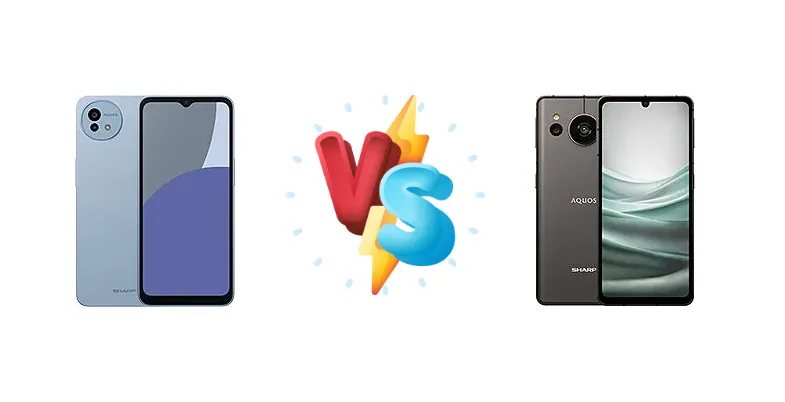
Sharp's Aquos wish4 and sense7 represent compelling options in the increasingly competitive mid-range 5G smartphone market. While both aim to deliver a balanced experience, they diverge significantly in their core processing power, relying on Mediatek's Dimensity 700 and Qualcomm's Snapdragon 695 respectively. This comparison dissects these differences, focusing on real-world implications for performance, battery life, and overall user experience.
🏆 Quick Verdict
For the average user prioritizing consistent performance and potentially better long-term software support, the Sharp Aquos sense7 emerges as the stronger choice. Its Snapdragon 695, built on a more efficient 6nm process, offers a slight edge in CPU and GPU performance, translating to smoother multitasking and gaming, despite the wish4's slightly higher CPU clock speeds.
| Network |
|---|
| 2G bands | GSM 850 / 900 / 1800 / 1900 | GSM 850 / 900 / 1800 / 1900 |
| 3G bands | HSDPA 900 / 2100 | HSDPA 900 / 2100 |
| 4G bands | LTE | 1, 3, 8, 28, 38, 41 |
| 5G bands | SA/NSA | 1, 28, 38, 41, 78 SA/NSA |
| Speed | HSPA, LTE, 5G | HSPA, LTE, 5G |
| Technology | GSM / HSPA / LTE / 5G | GSM / HSPA / LTE / 5G |
| Launch |
|---|
| Announced | 2024, July 29 | 2023, August |
| Status | Available. Released 2024, September | Available. Released 2023, September |
| Body |
|---|
| Build | Glass front, plastic back, plastic frame | - |
| Dimensions | 167 x 76 x 8.8 mm (6.57 x 2.99 x 0.35 in) | 152 x 70 x 8 mm (5.98 x 2.76 x 0.31 in) |
| SIM | Nano-SIM + Nano-SIM | · Nano-SIM + eSIM· Nano-SIM + Nano-SIM |
| Weight | 190 g (6.70 oz) | 158 g (5.57 oz) |
| Display |
|---|
| Resolution | 720 x 1612 pixels, 20:9 ratio (~267 ppi density) | 1080 x 2432 pixels (~436 ppi density) |
| Size | 6.6 inches, 104.6 cm2 (~82.5% screen-to-body ratio) | 6.1 inches, 89.0 cm2 (~83.7% screen-to-body ratio) |
| Type | IPS LCD, 90Hz | IGZO OLED, 1B colors, 1300 nits (peak) |
| Platform |
|---|
| CPU | Octa-core (2x2.2 GHz Cortex-A76 & 6x2.0 GHz Cortex-A55) | Octa-core (2x2.2 GHz Kryo 660 Gold & 6x1.7 GHz Kryo 660 Silver) |
| Chipset | Mediatek Dimensity 700 (7 nm) | Qualcomm SM6375 Snapdragon 695 5G (6 nm) |
| GPU | Mali-G57 MC2 | Adreno 619 |
| OS | Android 14, up to 2 major Android upgrades | Android 12, upgradable to Android 13 |
| Memory |
|---|
| Card slot | microSDXC | microSDXC |
| Internal | 128GB 6GB RAM | 128GB 6GB RAM |
| Main Camera |
|---|
| Dual | - | 50.3 MP, f/1.9, 23mm (wide), 1/1.55", dual pixel PDAF
8 MP, f/2.4, 15mm (ultrawide) |
| Features | LED flash, HDR, panorama | LED flash, HDR, panorama |
| Single | 50 MP, (wide), PDAF | - |
| Video | Yes, gyro-EIS | Yes |
| Selfie camera |
|---|
| Single | 8 MP, (wide) | 8 MP, f/2.0, (wide) |
| Video | 1080p@30fps | 1080p@30fps |
| Sound |
|---|
| 35mm jack | Unspecified | Yes |
| Loudspeaker | Yes | Yes |
| Comms |
|---|
| Bluetooth | 5.3, A2DP, LE | 5.1, A2DP, LE |
| NFC | Yes | Yes |
| Positioning | GPS | GPS |
| Radio | Unspecified | No |
| USB | USB Type-C | USB Type-C |
| WLAN | Wi-Fi 802.11 a/b/g/n/ac, dual-band | Wi-Fi 802.11 a/b/g/n/ac, dual-band |
| Features |
|---|
| Sensors | Fingerprint (side-mounted), accelerometer, gyro, proximity, compass | Fingerprint (side-mounted); unspecified sensors |
| Battery |
|---|
| Type | 5000 mAh | Li-Ion 4570 mAh |
| Misc |
|---|
| Colors | Black, Blue, White | Black |
| Models | SH-M27SG | - |
| Price | About 150 EUR | About 380 EUR |
Sharp Aquos wish4
- Potentially lower price point
- Decent performance for basic tasks
- 5G connectivity
- Less efficient chipset (7nm)
- Potentially lower GPU performance
- Likely less frequent software updates
Sharp Aquos sense7
- More efficient chipset (6nm)
- Superior GPU performance
- Potentially better camera image processing
- May be slightly more expensive
- Similar CPU clock speeds don't guarantee a massive performance leap
- Battery capacity not specified
Display Comparison
Unfortunately, display specifications are not provided. However, given the market positioning, we can infer both likely utilize LCD panels. The sense7, being positioned slightly higher, may benefit from a marginally higher peak brightness or improved color calibration. The 6nm Snapdragon 695's improved efficiency *could* allow for a slightly more power-efficient display implementation, though this is speculative without further data. Bezels are likely comparable, targeting a similar price bracket.
Camera Comparison
Without detailed camera specifications, a direct comparison is limited. However, the Snapdragon 695 typically offers superior image signal processing (ISP) capabilities compared to the Dimensity 700. This means the sense7 is likely to produce images with better dynamic range, noise reduction, and overall image quality, particularly in challenging lighting conditions. The ISP's efficiency also impacts video recording quality. While both phones likely feature a multi-camera setup, the sense7's image processing pipeline will likely be more refined. We can assume both will include standard features like HDR and portrait modes.
Performance
The core difference lies in the chipsets. The Aquos wish4's Mediatek Dimensity 700 (7nm) features an octa-core CPU with 2x2.2 GHz Cortex-A76 cores and 6x2.0 GHz Cortex-A55 cores. The sense7 utilizes the Qualcomm Snapdragon 695 5G (6nm) with 2x2.2 GHz Kryo 660 Gold cores and 6x1.7 GHz Kryo 660 Silver cores. While peak clock speeds are identical, the Snapdragon 695's 6nm fabrication process provides a significant advantage in power efficiency. This translates to less heat generation under sustained load, potentially mitigating thermal throttling during gaming or demanding tasks. The Snapdragon's Adreno 619 GPU is also generally considered more capable than the Dimensity 700's integrated GPU, offering a smoother gaming experience. The sense7's potential for LPDDR4X RAM (common in this segment) further contributes to faster application loading times.
Battery Life
Battery capacity is not specified. However, the Snapdragon 695's 6nm process offers a clear advantage in power efficiency. This means the sense7 will likely achieve longer battery life on a single charge, even with a similar battery capacity to the wish4. Charging wattage is also unknown, but the more efficient chipset in the sense7 could allow for faster charging times with the same wattage adapter, as less energy is lost as heat.
Buying Guide
Buy the Sharp Aquos wish4 if you need a budget-friendly 5G device primarily for basic communication, social media, and light web browsing, and are comfortable with potentially less frequent software updates. Buy the Sharp Aquos sense7 if you prefer a more responsive experience for multitasking, enjoy occasional mobile gaming, and value the potential for longer software support and a more refined user experience thanks to the Snapdragon chipset.
Frequently Asked Questions
❓ Will the Dimensity 700 in the Aquos wish4 struggle with graphically demanding games like PUBG Mobile?
While the Dimensity 700 can run PUBG Mobile, you'll likely need to lower the graphics settings to achieve a consistently smooth frame rate. The Snapdragon 695 in the sense7 offers a more comfortable gaming experience, allowing for higher settings without significant frame drops, thanks to its more powerful Adreno 619 GPU.
❓ How does the 6nm process of the Snapdragon 695 impact real-world battery life compared to the 7nm Dimensity 700?
The 6nm process is significantly more power-efficient than 7nm. This means the Snapdragon 695 consumes less power for the same level of performance, resulting in longer battery life. Expect to see a noticeable difference in standby time and overall usage duration on the Aquos sense7.
❓ Is the image processing on the Aquos sense7 noticeably better than on the wish4, even for casual photos?
Yes, even for casual photos, the Snapdragon 695's superior ISP will likely result in more vibrant colors, better dynamic range (especially in bright sunlight or low light), and reduced noise. This means your photos will generally look more polished and shareable without needing extensive editing.