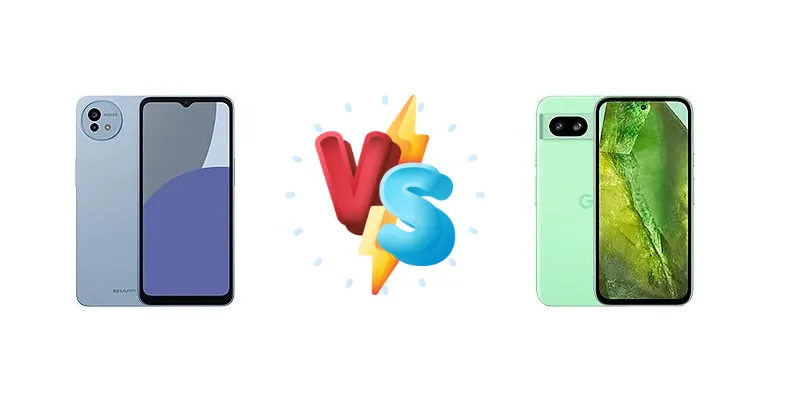
The Google Pixel 8a arrives as the latest iteration of Google’s accessible smartphone experience, bringing flagship-level camera capabilities and AI features to a more affordable price point. The Sharp Aquos wish4, meanwhile, represents a value-focused approach, aiming to deliver essential smartphone functionality at an even lower cost. This comparison dissects the key differences between these two devices, helping you determine which best suits your needs and budget.
🏆 Quick Verdict
For most users, the Google Pixel 8a is the superior choice. Its Google Tensor G3 chipset provides significantly faster performance and unlocks advanced AI features, while its brighter display and longer battery endurance offer a more refined user experience. However, the Aquos wish4 presents a compelling option for those prioritizing absolute affordability.
| Network |
|---|
| 2G bands | GSM 850 / 900 / 1800 / 1900 | GSM 850 / 900 / 1800 / 1900 |
| 3G bands | HSDPA 900 / 2100 | HSDPA 800 / 850 / 900 / 1700(AWS) / 1900 / 2100 |
| 4G bands | LTE | 1, 2, 3, 4, 5, 7, 8, 12, 17, 18, 19, 20, 26, 28, 32, 38, 40, 41, 42, 66 - G6GPR (International) |
| 5G bands | SA/NSA | 1, 2, 3, 5, 7, 8, 12, 20, 26, 28, 38, 40, 41, 66, 75, 76, 77, 78 SA/NSA/Sub6 - G6GPR (International) |
| Speed | HSPA, LTE, 5G | HSPA, LTE, 5G |
| Technology | GSM / HSPA / LTE / 5G | GSM / HSPA / LTE / 5G |
| Launch |
|---|
| Announced | 2024, July 29 | 2024, May 07 |
| Status | Available. Released 2024, September | Available. Released 2024, May 14 |
| Body |
|---|
| Build | Glass front, plastic back, plastic frame | Glass front (Gorilla Glass 3), aluminum frame, plastic back |
| Dimensions | 167 x 76 x 8.8 mm (6.57 x 2.99 x 0.35 in) | 152.1 x 72.7 x 8.9 mm (5.99 x 2.86 x 0.35 in) |
| SIM | Nano-SIM + Nano-SIM | Nano-SIM + eSIM |
| Weight | 190 g (6.70 oz) | 188 g (6.63 oz) |
| Display |
|---|
| Protection | - | Corning Gorilla Glass 3, Mohs level 5 |
| Resolution | 720 x 1612 pixels, 20:9 ratio (~267 ppi density) | 1080 x 2400 pixels, 20:9 ratio (~430 ppi density) |
| Size | 6.6 inches, 104.6 cm2 (~82.5% screen-to-body ratio) | 6.1 inches, 90.3 cm2 (~81.6% screen-to-body ratio) |
| Type | IPS LCD, 90Hz | OLED, HDR, 120Hz, 2000 nits (peak) |
| Platform |
|---|
| CPU | Octa-core (2x2.2 GHz Cortex-A76 & 6x2.0 GHz Cortex-A55) | Nona-core (1x3.0 GHz Cortex-X3 & 4x2.45 GHz Cortex-A715 & 4x2.15 GHz Cortex-A510) |
| Chipset | Mediatek Dimensity 700 (7 nm) | Google Tensor G3 (4 nm) |
| GPU | Mali-G57 MC2 | Immortalis-G715s MC10 |
| OS | Android 14, up to 2 major Android upgrades | Android 14, upgradable to Android 16, up to 7 major Android upgrades |
| Memory |
|---|
| Card slot | microSDXC | No |
| Internal | 128GB 6GB RAM | 128GB 8GB RAM, 256GB 8GB RAM |
| Main Camera |
|---|
| Dual | - | 64 MP (16 MP eff.), f/1.9, 26mm (wide), 1/1.73", 0.8µm, dual pixel PDAF, OIS
13 MP, f/2.2, 120˚ (ultrawide), 1.12µm |
| Features | LED flash, HDR, panorama | Dual-LED flash, Pixel Shift, Ultra HDR, panorama, Best Take |
| Single | 50 MP, (wide), PDAF | - |
| Video | Yes, gyro-EIS | 4K@30/60fps, 1080p@30/60/120/240fps, OIS |
| Selfie camera |
|---|
| Features | - | HDR, panorama |
| Single | 8 MP, (wide) | 13 MP, f/2.2, 20mm (ultrawide), 1.12µm |
| Video | 1080p@30fps | 4K@30fps, 1080p@30/60fps |
| Sound |
|---|
| 35mm jack | Unspecified | No |
| Loudspeaker | Yes | Yes, with stereo speakers |
| Comms |
|---|
| Bluetooth | 5.3, A2DP, LE | 5.3, A2DP, LE |
| NFC | Yes | Yes |
| Positioning | GPS | GPS, GLONASS, GALILEO, BDS, QZSS, NavIC |
| Radio | Unspecified | No |
| USB | USB Type-C | USB Type-C 3.2 |
| WLAN | Wi-Fi 802.11 a/b/g/n/ac, dual-band | Wi-Fi 802.11 a/b/g/n/ac/6e, dual/tri-band (market/region dependent) |
| Features |
|---|
| Sensors | Fingerprint (side-mounted), accelerometer, gyro, proximity, compass | Fingerprint (under display, optical), accelerometer, gyro, proximity, compass, barometer |
| Battery |
|---|
| Charging | - | 18W wired, PD3.0
7.5W wireless
Bypass charging |
| Type | 5000 mAh | Li-Po 4492 mAh |
| Misc |
|---|
| Colors | Black, Blue, White | Obsidian, Porcelain, Bay, Aloe |
| Models | SH-M27SG | GKV4X, G6GPR, G8HHN, G576D |
| Price | About 150 EUR | $ 229.98 / C$ 417.99 / £ 279.00 / € 299.99 / ₹ 33,300 |
| EU LABEL |
|---|
| Battery | - | 40:06h endurance, 1000 cycles |
| Energy | - | Class B |
| Free fall | - | Class A (270 falls) |
| Repairability | - | Class B |
Sharp Aquos wish4
- Superior performance with Google Tensor G3
- Exceptional camera capabilities and AI features
- Brighter and higher-quality display
- Longer battery life and faster charging
- Higher price point
- May be slightly larger and heavier
Google Pixel 8a
- More affordable price
- Functional for basic smartphone tasks
- Potentially more compact design (speculation)
- Simple and straightforward user experience
- Significantly slower performance
- Inferior camera quality
- Likely dimmer display
- Shorter battery life and slower charging
Display Comparison
The Pixel 8a boasts a significantly brighter display, reaching a measured peak of 1508 nits, ensuring excellent visibility even in direct sunlight. While the Aquos wish4’s display specifications are not provided, it’s likely to be considerably dimmer. The Pixel 8a’s panel technology is also likely to be superior, potentially offering better color accuracy and viewing angles. The Pixel 8a’s display is a clear advantage for media consumption and outdoor use.
Camera Comparison
The Pixel 8a is expected to excel in camera performance, leveraging Google’s renowned computational photography algorithms. While specific sensor details aren’t provided, Pixel phones consistently deliver exceptional image quality, particularly in challenging lighting conditions. The Aquos wish4’s camera specifications are not detailed enough to make a direct comparison, but it’s unlikely to match the Pixel 8a’s capabilities. The Pixel 8a’s image processing will likely offer superior dynamic range, detail, and noise reduction.
Performance
The core difference lies in the chipsets: the Pixel 8a utilizes Google’s 4nm Tensor G3, a nona-core processor with a Cortex-X3 prime core, designed for AI and machine learning tasks. This contrasts sharply with the Aquos wish4’s Mediatek Dimensity 700 (7nm). The Tensor G3’s more advanced architecture and smaller fabrication node translate to substantially higher processing power and improved energy efficiency. The Pixel 8a will handle demanding applications and multitasking with ease, while the Aquos wish4 may struggle with resource-intensive tasks. The Pixel 8a’s CPU configuration (1x3.0 GHz Cortex-X3, 4x2.45 GHz Cortex-A715, 4x2.15 GHz Cortex-A510) is a clear step up from the Aquos wish4’s (2x2.2 GHz Cortex-A76 & 6x2.0 GHz Cortex-A55).
Battery Life
The Pixel 8a demonstrates impressive battery endurance, achieving 40:06 hours of total usage and an active use score of 11:25 hours. It also supports 18W wired charging with PD3.0 and 7.5W wireless charging, alongside bypass charging. The Aquos wish4’s battery capacity and charging specifications are unknown, but given its lower price point, it’s likely to offer less overall endurance and slower charging speeds. The Pixel 8a’s 1000-cycle battery longevity also suggests a longer lifespan.
Buying Guide
Buy the Sharp Aquos wish4 if you need a functional smartphone for basic tasks like calling, texting, and light social media use, and your budget is extremely limited. You’ll appreciate its simplicity and affordability. Buy the Google Pixel 8a if you prioritize camera quality, smooth performance for demanding apps, and access to Google’s latest software features and AI enhancements. It’s a worthwhile investment for users who want a premium experience without the flagship price tag.
Frequently Asked Questions
❓ Does the Google Tensor G3 in the Pixel 8a get hot during extended gaming sessions?
While the Tensor G3 is a powerful chip, Google has implemented thermal management solutions to mitigate overheating. Users may experience some warmth during prolonged gaming, but it’s unlikely to result in significant throttling or performance degradation. The 4nm process helps with thermal efficiency compared to older nodes.
❓ How does the Pixel 8a's camera perform in low-light conditions compared to other phones in its price range?
The Pixel 8a is expected to excel in low-light photography, leveraging Google’s Night Sight mode and advanced image processing algorithms. It consistently outperforms competitors in its price bracket, delivering brighter, more detailed, and less noisy images in challenging lighting scenarios.
❓ Is the Sharp Aquos wish4 suitable for running multiple apps simultaneously?
The Aquos wish4’s Mediatek Dimensity 700 chipset and limited RAM may struggle with heavy multitasking. Running multiple demanding apps simultaneously could result in noticeable slowdowns and lag. It’s best suited for running one app at a time.
❓ What type of wireless charging does the Pixel 8a support, and how long does a full charge take?
The Pixel 8a supports 7.5W wireless charging using the Qi standard. A full wireless charge will take considerably longer than wired charging, likely exceeding 3 hours. Wired charging at 18W with PD3.0 is significantly faster.