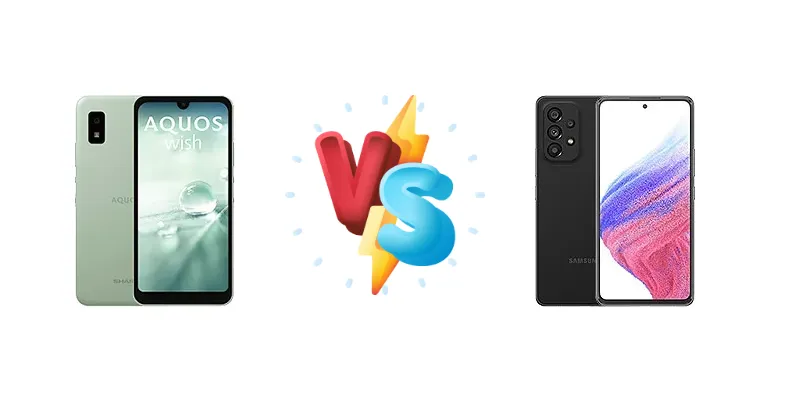
The Sharp Aquos wish and Samsung Galaxy A53 5G represent different approaches to the mid-range 5G smartphone market. The Aquos wish aims for affordability with a focus on essential features, while the Galaxy A53 5G targets a broader audience with a more polished experience and a higher price point. This comparison dissects their key differences to determine which device delivers the best value.
🏆 Quick Verdict
For the average user prioritizing a smoother overall experience and a brighter, more vibrant display, the Samsung Galaxy A53 5G is the better choice. However, the Sharp Aquos wish offers a compelling alternative for budget-conscious buyers who prioritize 5G connectivity and don't demand high-end performance.
| Network |
|---|
| 2G bands | GSM 850 / 900 / 1800 / 1900 | GSM 850 / 900 / 1800 / 1900 |
| 3G bands | HSDPA 900 / 2100 | HSDPA 850 / 900 / 1700(AWS) / 1900 / 2100 |
| 4G bands | 1, 3, 7, 8, 28, 38, 41 | 1, 2, 3, 4, 5, 7, 12, 14, 20, 29, 30, 38, 39, 40, 41, 46, 48, 66 - SM-A536U |
| 5G bands | 1, 3, 7, 28, 38, 41, 78 SA/NSA | 2, 5, 41, 66, 77, 78 SA/NSA/Sub6/mmWave - SM-A536U |
| Speed | HSPA, LTE, 5G | HSPA, LTE, 5G |
| Technology | GSM / HSPA / LTE / 5G | GSM / HSPA / LTE / 5G |
| | - | 2, 5, 48, 66, 77, 78, 260, 261 SA/NSA/Sub6/mmWave - SM-A536V |
| Launch |
|---|
| Announced | 2022, January 19 | 2022, March 17 |
| Status | Available. Released 2022, January 21 | Available. Released 2022, March 24 |
| Body |
|---|
| Build | Plastic body, plastic frame | Glass front (Gorilla Glass 5), plastic frame, plastic back |
| Dimensions | 147 x 71 x 8.9 mm (5.79 x 2.80 x 0.35 in) | 159.6 x 74.8 x 8.1 mm (6.28 x 2.94 x 0.32 in) |
| SIM | Nano-SIM + eSIM | · Nano-SIM· Nano-SIM + Nano-SIM |
| Weight | 162 g (5.71 oz) | 189 g (6.67 oz) |
| | IPX5/IP6X/IPX7 water/dust resistant (up to 1.5m for 30 min)
MIL-STD-810G compliant | IP67 dust/water resistant (up to 1m for 30 min) |
| Display |
|---|
| Protection | - | Corning Gorilla Glass 5 |
| Resolution | 720 x 1520 pixels, 19:9 ratio (~295 ppi density) | 1080 x 2400 pixels, 20:9 ratio (~405 ppi density) |
| Size | 5.7 inches, 81.1 cm2 (~77.7% screen-to-body ratio) | 6.5 inches, 102.0 cm2 (~85.4% screen-to-body ratio) |
| Type | IPS LCD | Super AMOLED, 120Hz, 800 nits (HBM) |
| Platform |
|---|
| CPU | Octa-core (2x2.0 GHz Kryo 460 & 6x1.8 GHz Kryo 460) | Octa-core (2x2.4 GHz Cortex-A78 & 6x2.0 GHz Cortex-A55) |
| Chipset | Qualcomm SM4350 Snapdragon 480 5G (8 nm) | Exynos 1280 (5 nm) |
| GPU | Adreno 619 | Mali-G68 |
| OS | Android 11 | Android 12, up to 4 major Android upgrades, One UI 8 |
| Memory |
|---|
| Card slot | microSDXC | microSDXC (uses shared SIM slot) |
| Internal | 64GB 4GB RAM | 128GB 4GB RAM, 128GB 6GB RAM, 128GB 8GB RAM, 256GB 6GB RAM, 256GB 8GB RAM |
| Main Camera |
|---|
| Features | LED flash | LED flash, panorama, HDR |
| Quad | - | 64 MP, f/1.8, 26mm (wide), 1/1.7X", 0.8µm, PDAF, OIS
12 MP, f/2.2, 123˚ (ultrawide), 1.12µm
5 MP (macro)
Auxiliary lens |
| Single | 13 MP, (wide), AF | 32 MP, f/2.2, 26mm (wide), 1/2.8", 0.8µm |
| Video | 1080p@30fps | 4K@30fps, 1080p@30/60fps; gyro-EIS |
| Selfie camera |
|---|
| Features | - | HDR |
| Single | 8 MP | 32 MP, f/2.2, 26mm (wide), 1/2.8", 0.8µm |
| Video | 1080p@30fps | 4K@30fps, 1080p@30fps |
| Sound |
|---|
| 3.5mm jack | Yes | No |
| 35mm jack | Yes | No |
| Loudspeaker | Yes | Yes, with stereo speakers |
| Comms |
|---|
| Bluetooth | 5.1, A2DP, LE | 5.1, A2DP, LE |
| NFC | Yes | Yes (market/region dependent) |
| Positioning | GPS | GPS, GLONASS, GALILEO, BDS |
| Radio | No | No |
| USB | USB Type-C | USB Type-C 2.0, OTG |
| WLAN | Wi-Fi 802.11 a/b/g/n/ac, dual-band, Wi-Fi Direct | Wi-Fi 802.11 a/b/g/n/ac, dual-band, Wi-Fi Direct |
| Features |
|---|
| Sensors | Fingerprint (side-mounted), accelerometer | Fingerprint (under display, optical), accelerometer, gyro, compass, barometer (market/region dependent) |
| | - | Virtual proximity sensing |
| Battery |
|---|
| Charging | - | 25W wired |
| Type | Li-Ion 3730 mAh | Li-Po 5000 mAh |
| Misc |
|---|
| Colors | Spring Bud Green, Foggy Black | Black, White, Blue, Peach |
| Models | - | SM-A536B, SM-A536B/DS, SM-A536U, SM-A536U1, SM-A5360, SM-A536E, SM-A536E/DS, SM-A536V, SM-A536W, SM-A536N, SM-S536DL |
| Price | About 230 EUR | $ 151.42 / £ 185.00 / € 169.14 |
| SAR | - | 0.75 W/kg (head) 1.58 W/kg (body) |
| SAR EU | - | 0.89 W/kg (head) 1.60 W/kg (body) |
| Tests |
|---|
| Battery life | - |
Endurance rating 113h
|
| Camera | - |
Photo / Video |
| Display | - |
Contrast ratio: Infinite (nominal) |
| Loudspeaker | - |
-26.5 LUFS (Good)
|
| Performance | - |
AnTuTu: 329802 (v8), 379313 (v9)
GeekBench: 1891 (v5.1)
GFXBench: 19fps (ES 3.1 onscreen) |
Sharp Aquos wish
- Affordable price point
- 5G connectivity
- Simple and straightforward user experience
- Less powerful processor
- Likely lower-quality display
- Basic camera system
Samsung Galaxy A53 5G
- Brighter and more vibrant display
- More powerful processor for smoother performance
- Faster 25W charging
- Higher price
- Exynos 1280 can exhibit some throttling under sustained load
- Software bloatware (typical of Samsung)
Display Comparison
The Samsung Galaxy A53 5G boasts a significantly brighter display, reaching a measured peak brightness of 830 nits, compared to an unstated value for the Aquos wish. This makes the A53 far more usable outdoors under direct sunlight. While the A53’s contrast ratio is listed as ‘Infinite’ (nominal), this is typical marketing speak; the real benefit is the Super AMOLED panel’s inherent contrast advantage over the likely LCD panel in the Aquos wish. The A53’s larger screen size and higher resolution also contribute to a sharper, more immersive viewing experience. We expect the Aquos wish to have a more basic display, suitable for everyday tasks but lacking the vibrancy and clarity of the A53.
Camera Comparison
Both devices offer photo and video capabilities, but the specifics are limited. The Galaxy A53 5G likely benefits from Samsung’s well-regarded image processing algorithms and potentially a larger main sensor (though sensor size is unspecified). The Aquos wish, given its price point, likely features a more basic camera setup. The presence of a 2MP macro camera on the A53 is largely inconsequential; image quality from such sensors is typically poor. The A53’s advantage will be in dynamic range, low-light performance, and overall image clarity. We anticipate the A53 to offer more consistent and higher-quality results across various shooting scenarios.
Performance
The core difference lies in the chipsets: the Samsung Galaxy A53 5G utilizes the Exynos 1280 (5nm), while the Sharp Aquos wish is powered by the Qualcomm Snapdragon 480 5G (8nm). The Exynos 1280, built on a smaller 5nm process, offers superior power efficiency and performance. Its octa-core configuration, with 2x2.4 GHz Cortex-A78 cores, provides a noticeable boost in CPU performance compared to the Aquos wish’s 2x2.0 GHz Kryo 460 cores. This translates to faster app loading times, smoother multitasking, and a more responsive user interface on the A53. While both support 5G, the A53’s more powerful processor will handle data-intensive tasks and 5G connectivity more efficiently. The 8nm Snapdragon 480 is adequate for basic tasks, but will likely struggle with demanding games or applications.
Battery Life
Both phones share an endurance rating of 113 hours, suggesting comparable battery life under similar usage conditions. However, the Galaxy A53 5G’s 25W wired charging capability provides a significant advantage over the Aquos wish, which likely has a slower charging speed. This means the A53 can be topped up much faster, minimizing downtime. While the mAh capacity isn’t specified for either device, the Exynos 1280’s 5nm efficiency could contribute to slightly better real-world battery performance despite the similar endurance rating.
Buying Guide
Buy the Sharp Aquos wish if you need a reliable 5G connection on a tight budget and prioritize simplicity over advanced features. It's ideal for users who primarily browse the web, use social media, and make calls. Buy the Samsung Galaxy A53 5G if you prefer a more refined user experience, a superior display for media consumption, and a more versatile camera system, and are willing to pay a premium for these enhancements.
Frequently Asked Questions
❓ Does the Exynos 1280 in the Galaxy A53 5G tend to overheat during prolonged gaming sessions?
The Exynos 1280 is known to exhibit some thermal throttling under sustained heavy load, such as extended gaming. While it won't shut down, you may experience a slight drop in frame rates after 30-45 minutes of intensive gameplay. This is less of a concern for casual gaming or everyday tasks.
❓ Is the 2MP macro camera on the Samsung Galaxy A53 5G actually useful for taking detailed close-up photos?
Unfortunately, 2MP macro cameras are generally not very effective. The low resolution results in images that lack detail and often appear blurry. It's best to rely on the main camera for close-up shots, utilizing digital zoom instead.
❓ Can the Sharp Aquos wish handle popular games like PUBG Mobile at a playable frame rate?
The Snapdragon 480 5G in the Aquos wish can run PUBG Mobile, but you'll likely need to lower the graphics settings to medium or low to achieve a consistently smooth frame rate. Expect some occasional stuttering or frame drops during intense action sequences.
❓ How long does it realistically take to fully charge the Samsung Galaxy A53 5G from 0% to 100% using the 25W charger?
With the included 25W charger, the Samsung Galaxy A53 5G typically takes around 1 hour and 30 minutes to fully charge from 0% to 100%. This is significantly faster than the charging time expected for the Aquos wish, which likely uses a slower charger.