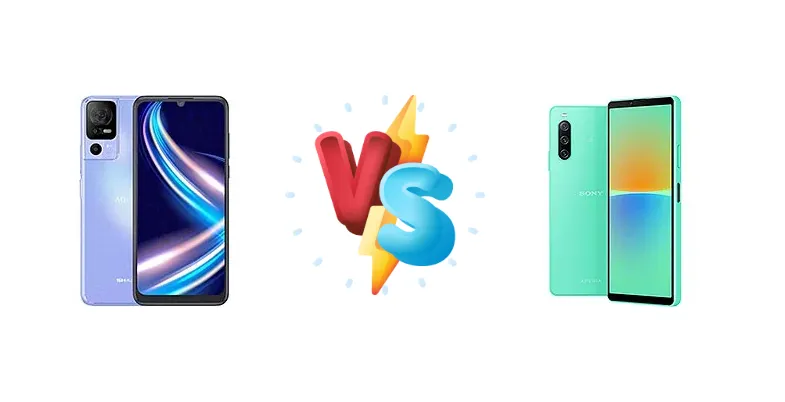
The Sharp Aquos V7 Plus and Sony Xperia 10 IV represent distinct approaches to the mid-range smartphone market. The Aquos V7 Plus aims for value with a more basic chipset, while the Xperia 10 IV prioritizes 5G connectivity and a refined user experience. This comparison dissects their key differences to determine which device best suits your needs.
🏆 Quick Verdict
For the average user, the Sony Xperia 10 IV is the stronger choice. Its Snapdragon 695 5G chipset, built on a 6nm process, offers superior efficiency and 5G connectivity compared to the Aquos V7 Plus’s Helio G37. While the Aquos V7 Plus is more affordable, the Xperia 10 IV’s overall package delivers a more future-proof and polished experience.
| Network |
|---|
| 2G bands | GSM 850 / 900 / 1800 / 1900 | GSM 850 / 900 / 1800 / 1900 |
| 3G bands | HSDPA 900 / 2100 | HSDPA 850 / 900 / 1700(AWS) / 2100 |
| 4G bands | LTE | 1, 3, 4, 5, 7, 8, 20, 28, 38, 39, 40, 41 |
| 5G bands | - | 1, 3, 7, 8, 28, 38, 41, 77, 78, 79 SA/NSA |
| Speed | HSPA, LTE | HSPA, LTE, 5G |
| Technology | GSM / HSPA / LTE | GSM / HSPA / LTE / 5G |
| Launch |
|---|
| Announced | 2023, July | 2022, May 11 |
| Status | Available. Released 2023, July | Available. Released 2022, June 30 |
| Body |
|---|
| Build | Glass front, plastic frame, plastic back | Glass front (Gorilla Glass Victus), plastic frame, plastic back |
| Dimensions | 167.9 x 76.5 x 8.5 mm (6.61 x 3.01 x 0.33 in) | 153 x 67 x 8.3 mm (6.02 x 2.64 x 0.33 in) |
| SIM | Nano-SIM + Nano-SIM | · Nano-SIM + eSIM· Nano-SIM + Nano-SIM |
| Weight | 190 g (6.70 oz) | 161 g (5.68 oz) |
| | - | IP65/IP68 dust/water resistant (up to 1.5m for 30 min) |
| Display |
|---|
| Protection | - | Corning Gorilla Glass Victus |
| Resolution | 720 x 1600 pixels, 20:9 ratio (~260 ppi density) | 1080 x 2520 pixels, 21:9 ratio (~457 ppi density) |
| Size | 6.74 inches, 109.7 cm2 (~85.4% screen-to-body ratio) | 6.0 inches, 84.1 cm2 (~82.0% screen-to-body ratio) |
| Type | IPS LCD, 90Hz | OLED, 1B colors, HDR |
| | - | Triluminos display |
| Platform |
|---|
| CPU | Octa-core (4x2.3 GHz Cortex-A53 & 4x1.7 GHz Cortex-A53) | Octa-core (2x2.2 GHz Kryo 660 Gold & 6x1.7 GHz Kryo 660 Silver) |
| Chipset | Mediatek MT6765 Helio G37 (12 nm) | Qualcomm SM6375 Snapdragon 695 5G (6 nm) |
| GPU | PowerVR GE8320 | Adreno 619 |
| OS | Android 13 | Android 12, upgradable to Android 14 |
| Memory |
|---|
| Card slot | microSDXC | microSDXC (uses shared SIM slot) |
| Internal | 128GB 4GB RAM, 256GB 6GB RAM | 128GB 6GB RAM |
| | - | UFS |
| Main Camera |
|---|
| Features | LED flash | LED flash, HDR, panorama |
| Single | - | 8 MP, f/2.0, 27mm (wide), 1/4.0" |
| Triple | 50 MP, (wide)
2 MP (macro)
Auxiliary lens | 12 MP, f/1.8, 27mm (wide), 1/2.8", PDAF, OIS
8 MP, f/2.2, 54mm (telephoto), 1/4.4", PDAF, 2x optical zoom
8 MP, f/2.2, 120˚, 16mm (ultrawide), 1/4.0" |
| Video | 1080p@30fps | 1080p@30fps |
| Selfie camera |
|---|
| Features | - | HDR |
| Single | 8 MP | 8 MP, f/2.0, 27mm (wide), 1/4.0" |
| Video | 1080p@30fps | 1080p@30fps |
| Sound |
|---|
| 3.5mm jack | - | Yes |
| 35mm jack | Yes | Yes |
| Loudspeaker | Yes, with stereo speakers | Yes |
| | - | 24-bit/192kHz audio
|
| Comms |
|---|
| Bluetooth | 5.1, A2DP, LE | 5.1, A2DP, LE, aptX HD, aptX Adaptive |
| NFC | Yes | Yes |
| Positioning | GPS (L1+L5), GLONASS, BDS, GALILEO, QZSS | GPS, GLONASS, GALILEO, BDS, QZSS |
| Radio | No | No |
| USB | USB Type-C 3.0 | USB Type-C 2.0, OTG |
| WLAN | Wi-Fi 802.11 a/b/g/n/ac, dual-band | Wi-Fi 802.11 a/b/g/n/ac, dual-band, Wi-Fi Direct |
| Features |
|---|
| Sensors | Fingerprint (side-mounted), accelerometer, proximity, compass | Fingerprint (side-mounted), accelerometer, proximity, compass |
| Battery |
|---|
| Charging | 18W wired | 21W wired (unofficial rating), PD, QC |
| Type | Li-Ion 5010 mAh | Li-Po 5000 mAh |
| Misc |
|---|
| Colors | Blue, Dark Blue | Black, White, Mint, Lavender |
| Models | SH-C06 | XQ-CC54, XQ-CC72, SOG07 |
| Price | About 180 EUR | £ 99.99 / € 112.89 |
| Tests |
|---|
| Battery life | - |
Endurance rating 163h
|
| Camera | - |
Photo / Video |
| Display | - |
Contrast ratio: Infinite (nominal) |
| Loudspeaker | - |
-30.6 LUFS (Below average)
|
| Performance | - |
AnTuTu: 396008 (v9)
GeekBench: 1908 (v5.1)
GFXBench: 16fps (ES 3.1 onscreen) |
Sharp Aquos V7 Plus
- More affordable price point
- Decent battery life for basic use
- Simple and straightforward user experience
- Outdated Helio G37 chipset
- Lacks 5G connectivity
- Potentially lower camera quality
Sony Xperia 10 IV
- 5G connectivity for faster data speeds
- More efficient Snapdragon 695 chipset
- Brighter and potentially more accurate display
- Faster and more versatile charging
- Higher price tag
- May not offer a significant camera upgrade over competitors
- Software updates may be limited compared to some brands
Display Comparison
The Sony Xperia 10 IV boasts a significantly brighter display, reaching a measured 683 nits, compared to an unspecified brightness for the Aquos V7 Plus. This higher peak brightness translates to better visibility outdoors. While both displays have an 'infinite' contrast ratio (typical for OLED/AMOLED, though the Aquos V7 Plus likely uses IPS LCD), the Xperia 10 IV’s brightness advantage is a clear win. Bezels are similarly slim on both devices, but the Xperia 10 IV’s panel technology likely offers superior color accuracy and viewing angles.
Camera Comparison
Both phones feature photo and video capabilities, but details are limited. Without specific sensor sizes or aperture information, it’s difficult to make a definitive judgment. However, Sony’s image processing algorithms are generally more refined, and the Xperia 10 IV likely benefits from better software optimization. The Aquos V7 Plus may offer a lower-cost camera experience, but the Xperia 10 IV is expected to deliver more consistent and higher-quality results, especially in challenging lighting conditions. We can assume the Xperia 10 IV will have better video stabilization.
Performance
The core difference lies in the chipsets. The Sony Xperia 10 IV’s Qualcomm Snapdragon 695 5G (6nm) is a more modern and efficient processor than the Sharp Aquos V7 Plus’s MediaTek Helio G37 (12nm). The 6nm process node of the Snapdragon 695 allows for better thermal management and power efficiency, reducing throttling during sustained workloads. While both CPUs utilize an octa-core configuration, the Snapdragon 695’s Kryo 660 Gold cores (2x2.2 GHz) offer a performance advantage over the Aquos V7 Plus’s Cortex-A53 cores (4x2.3 GHz). The Aquos V7 Plus’s older architecture will struggle with demanding tasks and multitasking.
Battery Life
Both devices share an endurance rating of 163 hours, suggesting comparable battery life in typical usage scenarios. However, the Xperia 10 IV’s more efficient Snapdragon 695 chipset will likely translate to longer real-world battery life, especially during demanding tasks. The Xperia 10 IV also supports 21W wired charging with PD and QC, offering faster charging speeds than the Aquos V7 Plus’s 18W charging. While not exceptionally fast, the Xperia 10 IV’s charging capabilities are more versatile and convenient.
Buying Guide
Buy the Sharp Aquos V7 Plus if you prioritize absolute affordability and don't require 5G connectivity. It's a solid option for basic smartphone tasks and users on a tight budget. Buy the Sony Xperia 10 IV if you value 5G, longer software support, a brighter display, and a more efficient processor, even if it means spending a bit more. It’s ideal for users who want a reliable and capable mid-range device.
Frequently Asked Questions
❓ Does the MediaTek Helio G37 in the Aquos V7 Plus struggle with graphically intensive games?
Yes, the Helio G37 is a budget-oriented chipset. While it can handle casual gaming, demanding titles will likely require reduced graphics settings and may still experience frame drops. The Snapdragon 695 in the Xperia 10 IV offers a significantly smoother gaming experience.
❓ Is the 21W charging on the Xperia 10 IV considered fast charging?
21W is not exceptionally fast by today's standards, but it's faster than the Aquos V7 Plus's 18W charging. It will still take over an hour to fully charge the device, but the inclusion of Power Delivery (PD) and Quick Charge (QC) support offers greater compatibility with various chargers.
❓ How does the 5G connectivity of the Xperia 10 IV impact real-world usage?
5G connectivity allows for significantly faster download and upload speeds when connected to a 5G network. This is particularly beneficial for streaming high-resolution video, downloading large files, and online gaming. However, 5G availability varies by region and carrier.
❓ What type of display technology does the Sharp Aquos V7 Plus use?
While not explicitly stated, given the price point and specifications, the Sharp Aquos V7 Plus likely utilizes an IPS LCD panel. This means it won't offer the same vibrant colors and deep blacks as the OLED/AMOLED displays found in higher-end smartphones like the Xperia 10 IV.