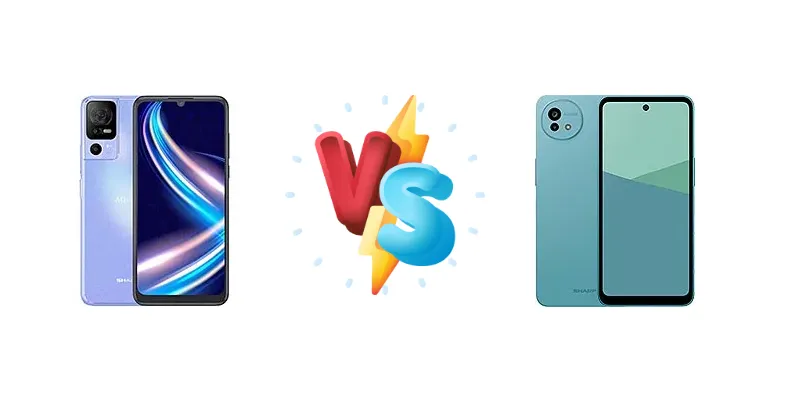
Sharp's Aquos line continues to offer compelling budget options, but the V7 Plus and wish5 represent distinct approaches. The V7 Plus, while established, relies on older silicon, while the wish5 introduces a newer, more efficient chipset. This comparison dissects the core differences to help you determine which device best suits your needs.
🏆 Quick Verdict
For most users, the Sharp Aquos wish5 is the superior choice. Its Dimensity 6300 chipset delivers a noticeable performance boost over the V7 Plus’ Helio G37, coupled with faster 27W charging. While both phones target the budget segment, the wish5 offers a more future-proof experience.
| Network |
|---|
| 2G bands | GSM 850 / 900 / 1800 / 1900 | GSM 850 / 900 / 1800 / 1900 |
| 3G bands | HSDPA 900 / 2100 | HSDPA 900 / 2100 |
| 4G bands | LTE | LTE |
| 5G bands | - | SA/NSA |
| Speed | HSPA, LTE | HSPA, LTE, 5G |
| Technology | GSM / HSPA / LTE | GSM / HSPA / LTE / 5G |
| Launch |
|---|
| Announced | 2023, July | 2025, May 29 |
| Status | Available. Released 2023, July | Available. Released 2025, June 26 |
| Body |
|---|
| Build | Glass front, plastic frame, plastic back | Glass front, plastic back, plastic frame |
| Dimensions | 167.9 x 76.5 x 8.5 mm (6.61 x 3.01 x 0.33 in) | 166 x 76 x 8.8 mm (6.54 x 2.99 x 0.35 in) |
| SIM | Nano-SIM + Nano-SIM | Nano-SIM + eSIM |
| Weight | 190 g (6.70 oz) | 187 g (6.60 oz) |
| Display |
|---|
| Resolution | 720 x 1600 pixels, 20:9 ratio (~260 ppi density) | 720 x 1612 pixels, 20:9 ratio (~267 ppi density) |
| Size | 6.74 inches, 109.7 cm2 (~85.4% screen-to-body ratio) | 6.6 inches, 104.6 cm2 (~82.9% screen-to-body ratio) |
| Type | IPS LCD, 90Hz | IPS LCD, 120Hz |
| Platform |
|---|
| CPU | Octa-core (4x2.3 GHz Cortex-A53 & 4x1.7 GHz Cortex-A53) | Octa-core (2x2.4 GHz Cortex-A76 & 6x2.0 GHz Cortex-A55) |
| Chipset | Mediatek MT6765 Helio G37 (12 nm) | Mediatek Dimensity 6300 (6 nm) |
| GPU | PowerVR GE8320 | Mali-G57 MC2 |
| OS | Android 13 | Android 15, up to 2 major Android upgrades |
| Memory |
|---|
| Card slot | microSDXC | microSDXC |
| Internal | 128GB 4GB RAM, 256GB 6GB RAM | 64GB 4GB RAM, 128GB 4GB RAM, 128GB 6GB RAM, 256GB 8GB RAM |
| Main Camera |
|---|
| Dual | - | 50 MP, f/1.8, 25mm (wide), PDAF
Auxiliary lens |
| Features | LED flash | LED flash, HDR, panorama |
| Triple | 50 MP, (wide)
2 MP (macro)
Auxiliary lens | - |
| Video | 1080p@30fps | Yes, gyro-EIS |
| Selfie camera |
|---|
| Single | 8 MP | 8 MP, f/2.0, 26mm (wide) |
| Video | 1080p@30fps | 1080p@30fps |
| Sound |
|---|
| 35mm jack | Yes | Yes |
| Loudspeaker | Yes, with stereo speakers | Yes |
| Comms |
|---|
| Bluetooth | 5.1, A2DP, LE | 5.3, A2DP, LE |
| NFC | Yes | Yes |
| Positioning | GPS (L1+L5), GLONASS, BDS, GALILEO, QZSS | GPS |
| Radio | No | Unspecified |
| USB | USB Type-C 3.0 | USB Type-C 2.0 |
| WLAN | Wi-Fi 802.11 a/b/g/n/ac, dual-band | Wi-Fi 802.11 a/b/g/n/ac, dual-band |
| Features |
|---|
| Sensors | Fingerprint (side-mounted), accelerometer, proximity, compass | Fingerprint (side-mounted), accelerometer, gyro, proximity, compass |
| Battery |
|---|
| Charging | 18W wired | 27W wired |
| Type | Li-Ion 5010 mAh | 5000 mAh |
| Misc |
|---|
| Colors | Blue, Dark Blue | Black, Blue, White, Green, Pink |
| Models | SH-C06 | SH-AC05, SH-M32 |
| Price | About 180 EUR | About 200 EUR |
Sharp Aquos V7 Plus
- Potentially lower price point (depending on market)
- Established software ecosystem (potentially)
- Familiar design language
- Outdated Helio G37 chipset
- Slower 18W charging
- Less efficient 12nm process
Sharp Aquos wish5
- More powerful Dimensity 6300 chipset
- Faster 27W wired charging
- More efficient 6nm process
- Improved ISP for better image processing
- May be slightly more expensive
- Newer device, potentially less software maturity
Display Comparison
Neither device boasts a standout display. Given the context data focuses on processing power, we can infer both likely utilize LCD panels common in this price bracket. The V7 Plus may have slightly better color calibration based on Sharp’s historical display tuning, but the wish5’s newer chipset could potentially support more efficient display power management. Bezels are likely comparable, and neither is expected to feature high refresh rates.
Camera Comparison
Without detailed camera specs, a direct comparison is difficult. However, the chipset plays a role. The Dimensity 6300 includes a more advanced Image Signal Processor (ISP) than the Helio G37, enabling better noise reduction, dynamic range, and potentially faster image processing. This doesn’t guarantee better photos, as sensor size and lens quality are critical, but the wish5 has a hardware advantage in image processing capabilities. We can assume both phones will feature a primary camera and potentially depth/macro sensors, but the wish5’s ISP will likely extract more detail from the main sensor.
Performance
The core difference lies in the chipsets. The Aquos wish5’s Mediatek Dimensity 6300, fabricated on a 6nm process, is a significant upgrade over the V7 Plus’ 12nm Helio G37. The Dimensity 6300’s CPU configuration – 2x2.4 GHz Cortex-A76 and 6x2.0 GHz Cortex-A55 – provides a substantial performance advantage over the V7 Plus’ 4x2.3 GHz Cortex-A53 & 4x1.7 GHz Cortex-A53. The Cortex-A76 cores in the wish5 are architecturally superior, offering better single-core performance crucial for app responsiveness. This translates to snappier multitasking and smoother gaming. The 6nm process also contributes to improved thermal efficiency, reducing the likelihood of throttling during sustained workloads.
Battery Life
While battery capacity isn’t specified, the charging wattage difference is significant. The wish5’s 27W wired charging is considerably faster than the V7 Plus’ 18W. This means a quicker top-up, reducing downtime. The Dimensity 6300’s 6nm efficiency also contributes to better battery life, potentially offsetting any capacity differences. Users who frequently find themselves needing to charge mid-day will greatly benefit from the wish5’s faster charging and potentially improved power efficiency.
Buying Guide
Buy the Sharp Aquos V7 Plus if you prioritize a known quantity and are on an extremely tight budget, accepting compromises in performance and charging speed. Buy the Sharp Aquos wish5 if you value a smoother user experience, faster charging, and a chipset capable of handling more demanding tasks, even if it means a slightly newer device with potentially less established software support.
Frequently Asked Questions
❓ Will the Dimensity 6300 in the Aquos wish5 handle demanding games like PUBG Mobile smoothly?
The Dimensity 6300 is a capable chipset for mid-range gaming. While it won't deliver flagship-level performance, it should handle PUBG Mobile at medium settings with a stable frame rate. The 6nm process also helps mitigate thermal throttling, allowing for longer gaming sessions.
❓ Is the 27W charging on the Aquos wish5 significantly faster than the 18W charging on the V7 Plus in real-world use?
Yes, the difference is noticeable. 27W charging will reduce the time to fully charge the Aquos wish5 by a considerable margin – potentially shaving off 30-60 minutes compared to the V7 Plus, depending on battery capacity. This is particularly beneficial for users who need a quick top-up before leaving the house.
❓ Does the Aquos wish5's Dimensity 6300 offer any advantages for video playback or streaming?
The Dimensity 6300 includes hardware decoding for common video codecs, resulting in smoother playback and reduced battery drain during video streaming. This is especially noticeable with high-resolution content like 1080p or even 4K videos.