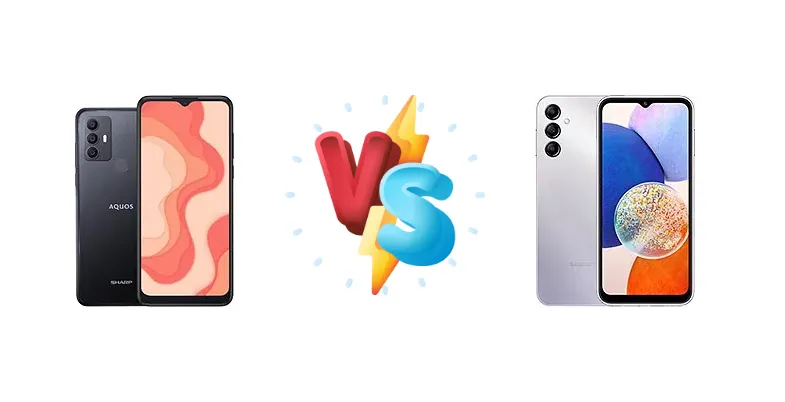
The sub-$200 5G smartphone market is fiercely competitive. The Sharp Aquos V6 and Samsung Galaxy A14 5G represent two distinct approaches to delivering affordable connectivity. The Aquos V6 focuses on a streamlined experience, while the A14 5G aims for broader feature parity with Samsung’s wider ecosystem. This comparison dissects their key differences to determine which device offers the best value.
🏆 Quick Verdict
For most users, the Samsung Galaxy A14 5G is the better choice. Its significantly more powerful Exynos 1330 chipset (or Dimensity 700 depending on region) provides a smoother user experience and better long-term performance, outweighing the Aquos V6’s USB Power Delivery charging.
| Network |
|---|
| 2G bands | GSM 850 / 900 / 1800 / 1900 | GSM 850 / 900 / 1800 / 1900 |
| 3G bands | HSDPA 900 / 2100 | HSDPA 850 / 900 / 1700(AWS) / 1900 / 2100 |
| 4G bands | LTE | 1, 2, 3, 4, 5, 7, 8, 12, 17, 20, 26, 28, 38, 40, 41, 66 - International |
| 5G bands | - | 2, 5, 66, 77 Sub6/mmWave - USA |
| Speed | HSPA, LTE | HSPA, LTE, 5G |
| Technology | GSM / HSPA / LTE | GSM / HSPA / LTE / 5G |
| | - | 1, 3, 5, 7, 8, 20, 28, 40, 41, 78 SA/NSA/Sub6 - India |
| Launch |
|---|
| Announced | 2022, February 16 | 2023, January 04 |
| Status | Available. Released 2022, February 16 | Available. Released 2023, January 12 |
| Body |
|---|
| Build | Glass front, plastic frame, plastic back | Glass front, plastic back, plastic frame |
| Dimensions | 165.2 x 75.5 x 8.9 mm (6.50 x 2.97 x 0.35 in) | 167.7 x 78 x 9.1 mm (6.60 x 3.07 x 0.36 in) |
| SIM | Nano-SIM + Nano-SIM | · Nano-SIM· Nano-SIM + Nano-SIM |
| Weight | 190 g (6.70 oz) | 202 g (7.13 oz) |
| Display |
|---|
| Resolution | 720 x 1600 pixels, 20:9 ratio (~269 ppi density) | 1080 x 2408 pixels, 20:9 ratio (~400 ppi density) |
| Size | 6.52 inches, 102.6 cm2 (~82.3% screen-to-body ratio) | 6.6 inches, 104.9 cm2 (~80.2% screen-to-body ratio) |
| Type | IPS LCD | PLS LCD, 90Hz |
| Platform |
|---|
| CPU | Octa-core (4x2.0 GHz Cortex-A53 & 4x1.5 GHz Cortex-A53) | Octa-core (2x2.4 GHz Cortex-A78 & 6x2.0 GHz Cortex-A55) - SM-A146BOcta-core (2x2.2 GHz Cortex-A76 & 6x2.0 GHz Cortex-A55) - SM-A146P |
| Chipset | Mediatek MT6762G Helio G25 (12 nm) | Exynos 1330 (5 nm) - SM-A146BMediatek Dimensity 700 (7 nm) - SM-A146P |
| GPU | PowerVR GE8320 | Mali-G68 MP2 - SM-A146BMali-G57 MC2 - SM-A146P |
| OS | Android 12 | Android 13, upgradable to Android 15, One UI Core 7 |
| Memory |
|---|
| Card slot | microSDXC | microSDXC (uses shared SIM slot) - USA onlymicroSDXC (dedicated slot) - International |
| Internal | 32GB 3GB RAM | 64GB 4GB RAM, 128GB 4GB RAM, 128GB 6GB RAM, 128GB 8GB RAM |
| Main Camera |
|---|
| Features | LED flash | LED flash, panorama, HDR |
| Single | - | 13 MP, f/2.0, (wide) |
| Triple | 13 MP, (wide)
2 MP (macro)
Auxiliary lens | 50 MP, f/1.8, 26mm (wide), 1/2.76", 0.64µm, PDAF
2 MP (macro)
Auxiliary lens |
| Video | 1080p@30fps | 1080p@30fps |
| Selfie camera |
|---|
| Single | 5 MP | 13 MP, f/2.0, 26mm (wide), 1.12µm |
| Video | Yes | 1080p@30fps |
| Sound |
|---|
| 3.5mm jack | Yes | Yes |
| 35mm jack | Yes | Yes |
| Loudspeaker | Yes | Yes |
| Comms |
|---|
| Bluetooth | 5.0, A2DP, LE, aptX HD, aptX Adaptive | 5.2, A2DP, LE |
| NFC | Yes | Yes |
| Positioning | GPS | GPS, GLONASS, GALILEO |
| Radio | No | FM radio (Exynos 1330 chipset only), recording |
| USB | USB Type-C 3.0 | USB Type-C 2.0 |
| WLAN | Wi-Fi 802.11 a/b/g/n/ac, dual-band | Wi-Fi 802.11 a/b/g/n/ac, dual-band, Wi-Fi Direct |
| Features |
|---|
| Sensors | Fingerprint (rear-mounted), accelerometer, gyro, proximity, compass | Fingerprint (side-mounted), accelerometer, gyro, proximity, compass, barometer (USA only) |
| Battery |
|---|
| Charging | USB Power Delivery 3.0 | 15W wired |
| Type | Li-Ion 5000 mAh | Li-Po 5000 mAh |
| Misc |
|---|
| Colors | Grey Sand, Deep Blue Sea | Black, Light Green, Dark Red, Silver |
| Models | - | SM-A146B, SM-A146B/DS, SM-A146P, SM-A146P/DS, SM-A146U, SM-A146U1, SM-A146U1/DS, SM-A146W, SM-A146P/N, SM-A146P/DSN, SM-S146VL, SM-A146M |
| Price | About 130 EUR | $ 77.63 / C$ 151.00 / £ 97.00 / € 159.79 / ₹ 14,990 |
| SAR | - | 1.00 W/kg (head) 1.00 W/kg (body) |
| SAR EU | - | 0.56 W/kg (head) 1.28 W/kg (body) |
| Tests |
|---|
| Battery life | - |
Endurance rating 130h
|
| Camera | - |
Photo / Video |
| Display | - |
Contrast ratio: 1334:1 (nominal) |
| Loudspeaker | - |
-26.8 LUFS (Good)
|
| Performance | - |
AnTuTu: 307886 (v9)
GeekBench: 1727 (v5.1)
GFXBench: 12fps (ES 3.1 onscreen) |
Sharp Aquos V6
- USB Power Delivery 3.0 for potentially faster charging
- Simpler, less bloated software experience
- Potentially lower price point
- Significantly weaker processor performance
- Less efficient chipset
- Likely inferior camera performance
Samsung Galaxy A14 5G
- More powerful Exynos 1330 or Dimensity 700 chipset
- Brighter display for better outdoor visibility
- Samsung’s One UI software with added features
- Slower 15W charging
- Potentially more software bloat
- May be slightly more expensive
Display Comparison
Both phones feature a 1334:1 contrast ratio, suggesting similar panel characteristics in terms of black levels. However, the Galaxy A14 5G boasts a measured peak brightness of 519 nits, significantly brighter than what’s likely available on the Aquos V6 (no data provided). This brightness advantage translates to better outdoor visibility. While both likely use LCD panels, the A14 5G’s higher brightness makes it the clear winner for users who frequently use their phones in sunlight.
Camera Comparison
Both devices offer 'Photo / Video' capabilities, but lack detailed camera specifications. Given the price point, image quality will likely be similar in good lighting conditions. However, the A14 5G’s potential for better image processing, thanks to its more powerful chipset, gives it an edge. The Aquos V6’s camera system is likely more basic, and the A14 5G will likely offer more features and better low-light performance. The presence of a 2MP macro camera on the A14 5G is unlikely to be a significant benefit, given the limitations of such sensors.
Performance
The performance gap is substantial. The Samsung Galaxy A14 5G, depending on the region, utilizes either the Exynos 1330 (5nm) or the Mediatek Dimensity 700 (7nm). Both are built on more advanced process nodes than the Sharp Aquos V6’s Mediatek Helio G25 (12nm). The Exynos 1330’s Cortex-A78 cores provide a significant performance uplift over the Aquos V6’s Cortex-A53 cores, especially in demanding applications. The A14 5G’s CPU architecture is also more modern, leading to improved efficiency. This translates to faster app loading times, smoother multitasking, and a more responsive overall experience for the A14 5G.
Battery Life
Both phones share an endurance rating of 130 hours, indicating comparable battery life under similar usage scenarios. However, the Galaxy A14 5G’s 15W charging is slower than the Aquos V6’s USB Power Delivery 3.0 support. USB Power Delivery allows for potentially faster charging speeds with compatible chargers, offering a convenience advantage to the Aquos V6. Despite the slower charging, the A14 5G’s more efficient chipset may offset this, providing similar real-world usage time despite a potentially smaller battery capacity (data not provided).
Buying Guide
Buy the Sharp Aquos V6 if you prioritize fast charging via USB Power Delivery and a simple, uncluttered Android experience. It’s a good option for users who primarily need a reliable phone for basic tasks. Buy the Samsung Galaxy A14 5G if you value performance for multitasking, streaming, and light gaming, alongside the benefits of Samsung’s One UI software and broader 5G band support. It’s ideal for users who want a more versatile device.
Frequently Asked Questions
❓ Does the Exynos 1330 in the Galaxy A14 5G tend to overheat during prolonged gaming sessions?
The Exynos 1330, built on a 5nm process, is relatively efficient. While it will get warm during extended gaming, it’s unlikely to experience significant thermal throttling, unlike the Aquos V6’s Helio G25 which will likely throttle sooner due to its less efficient 12nm process.
❓ Is the 2MP macro camera on the Galaxy A14 5G actually useful for taking detailed close-up photos?
Generally, 2MP macro cameras on budget phones offer limited detail and image quality. The small sensor size and fixed focus often result in soft, noisy images. It's usable for casual snapshots, but don't expect professional-level macro photography.
❓ Can the Samsung Galaxy A14 5G handle popular games like PUBG Mobile at 60fps with medium graphics settings?
Yes, the Exynos 1330 or Dimensity 700 should be capable of running PUBG Mobile at 60fps with medium graphics settings. However, sustained performance may vary depending on the specific model (SM-A146B vs SM-A146P) and thermal conditions.
❓ What type of USB-C charging protocol does the Sharp Aquos V6 support beyond USB Power Delivery 3.0?
Specific details beyond USB Power Delivery 3.0 are not provided. However, it's likely to support standard USB-C Power Delivery profiles for charging other devices and data transfer.