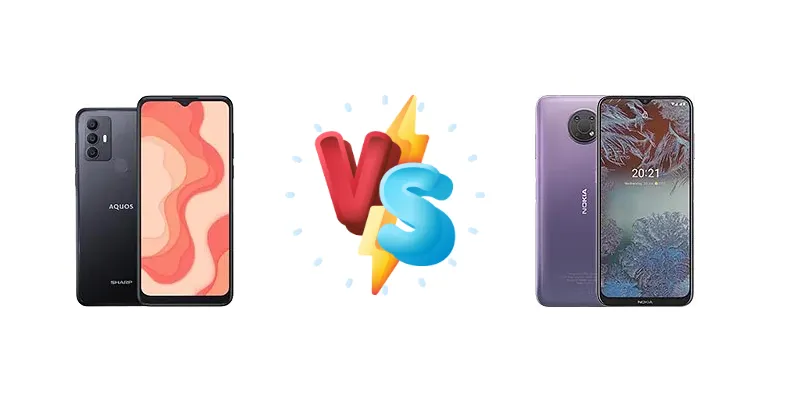
Looking for an affordable smartphone that doesn't completely break the bank? The Sharp Aquos V6 and Nokia G10 are both contenders in the budget segment, offering essential features at attractive price points. But which one comes out on top? Let's dive into a detailed comparison.
🏆 Quick Verdict
The Sharp Aquos V6 edges out the Nokia G10 thanks to its significantly faster charging with USB Power Delivery 3.0. While both share the same processor, the Aquos V6's charging advantage makes it a more convenient daily driver, especially for those short on time. Both are solid budget options, though.
| Network |
|---|
| 2G bands | GSM 850 / 900 / 1800 / 1900 | GSM 850 / 900 / 1800 / 1900 |
| 3G bands | HSDPA 900 / 2100 | HSDPA 850 / 900 / 2100 - ROW |
| 4G bands | LTE | 1, 3, 5, 7, 8, 20, 28, 38, 40, 41 - ROW |
| Speed | HSPA, LTE | HSPA 42.2/5.76 Mbps, LTE Cat4 150/50 Mbps |
| Technology | GSM / HSPA / LTE | GSM / HSPA / LTE |
| | - | 1, 2, 3, 4, 5, 7, 8, 12, 17, 28, 66 - LATAM |
| Launch |
|---|
| Announced | 2022, February 16 | 2021, April 08 |
| Status | Available. Released 2022, February 16 | Available. Released 2021, April 26 |
| Body |
|---|
| Build | Glass front, plastic frame, plastic back | - |
| Dimensions | 165.2 x 75.5 x 8.9 mm (6.50 x 2.97 x 0.35 in) | 164.9 x 76 x 9.2 mm (6.49 x 2.99 x 0.36 in) |
| SIM | Nano-SIM + Nano-SIM | · Nano-SIM· Nano-SIM + Nano-SIM |
| Weight | 190 g (6.70 oz) | 194 g (6.84 oz) |
| | - | Splash protection |
| Display |
|---|
| Resolution | 720 x 1600 pixels, 20:9 ratio (~269 ppi density) | 720 x 1600 pixels, 20:9 ratio (~269 ppi density) |
| Size | 6.52 inches, 102.6 cm2 (~82.3% screen-to-body ratio) | 6.52 inches, 102.6 cm2 (~81.9% screen-to-body ratio) |
| Type | IPS LCD | IPS LCD |
| Platform |
|---|
| CPU | Octa-core (4x2.0 GHz Cortex-A53 & 4x1.5 GHz Cortex-A53) | Octa-core (4x2.0 GHz Cortex-A53 & 4x1.5 GHz Cortex-A53) |
| Chipset | Mediatek MT6762G Helio G25 (12 nm) | Mediatek MT6762G Helio G25 (12 nm) |
| GPU | PowerVR GE8320 | PowerVR GE8320 |
| OS | Android 12 | Android 11, upgradable to Android 13 |
| Memory |
|---|
| Card slot | microSDXC | microSDXC (dedicated slot) |
| Internal | 32GB 3GB RAM | 32GB 3GB RAM, 32GB 4GB RAM, 64GB 3GB RAM, 64GB 4GB RAM |
| | - | eMMC 5.1 |
| Main Camera |
|---|
| Features | LED flash | LED flash, HDR, panorama |
| Single | - | 8 MP, (wide) |
| Triple | 13 MP, (wide)
2 MP (macro)
Auxiliary lens | 13 MP, (wide), AF
2 MP (macro)
Auxiliary lens |
| Video | 1080p@30fps | 1080p@30fps |
| Selfie camera |
|---|
| Single | 5 MP | 8 MP, (wide) |
| Video | Yes | 1080p@30fps |
| Sound |
|---|
| 3.5mm jack | Yes | Yes |
| 35mm jack | Yes | Yes |
| Loudspeaker | Yes | Yes |
| Comms |
|---|
| Bluetooth | 5.0, A2DP, LE, aptX HD, aptX Adaptive | 5.0, A2DP, LE |
| NFC | Yes | No |
| Positioning | GPS | GPS, GLONASS, BDS |
| Radio | No | FM radio |
| USB | USB Type-C 3.0 | USB Type-C 2.0, OTG |
| WLAN | Wi-Fi 802.11 a/b/g/n/ac, dual-band | Wi-Fi 802.11 b/g/n |
| Features |
|---|
| Sensors | Fingerprint (rear-mounted), accelerometer, gyro, proximity, compass | Fingerprint (side-mounted), accelerometer, proximity |
| Battery |
|---|
| Charging | USB Power Delivery 3.0 | 10W wired |
| Type | Li-Ion 5000 mAh | Li-Po 5050 mAh |
| Misc |
|---|
| Colors | Grey Sand, Deep Blue Sea | Dusk, Night |
| Models | - | TA-1334, TA-1351, TA-1346, TA-1338 |
| Price | About 130 EUR | About 110 EUR |
| SAR | - | 1.06 W/kg (head) 1.51 W/kg (body) |
| SAR EU | - | 0.46 W/kg (head) 1.51 W/kg (body) |
Sharp Aquos V6
- Faster Charging (USB PD 3.0)
- Potentially more modern design
- Decent display for the price
- Likely smaller battery
- Basic performance
- Limited camera capabilities
Nokia G10
- Larger battery capacity
- Clean Android experience
- Durable build quality (typical of Nokia)
- Triple camera system
- Slow 10W charging
- Basic performance
- Camera performance can be inconsistent
Display Comparison
Both phones feature a 6.5-inch IPS LCD display, likely with a resolution around 720 x 1600 pixels. Expect decent viewing angles and color accuracy for everyday use, but don't anticipate flagship-level vibrancy or sharpness. The Aquos V6 might have a slightly more modern design, potentially with a smaller bezel, but detailed display specs are often limited in this price range.
Camera Comparison
The Nokia G10 typically features a triple-camera setup (48MP main, 5MP ultrawide, 2MP depth sensor) while the Aquos V6 likely has a dual-camera setup (13MP main, 2MP depth sensor). The Nokia G10's higher resolution main sensor *could* offer slightly better detail in good lighting conditions, but image processing and overall quality will depend heavily on software optimization. Both will struggle in low light.
Performance
Performance is largely identical. Both devices are powered by the Mediatek Helio G25, which is a basic entry-level chipset. Expect smooth performance for basic tasks like browsing, social media, and light gaming. Demanding games and multitasking will likely result in noticeable slowdowns. Don't expect blazing speeds from either phone.
Battery Life
The Nokia G10 typically packs a larger 5000mAh battery, offering potentially longer battery life than the Aquos V6's likely smaller battery (around 4500mAh). However, the Aquos V6's USB Power Delivery 3.0 charging significantly reduces charging times, offsetting some of the battery capacity difference.
Buying Guide
The Sharp Aquos V6 is ideal for users who prioritize fast charging and a slightly more modern design. The Nokia G10 is a good choice for those seeking a reliable, durable phone with a clean Android experience and a focus on longevity, even if charging is slower.
Frequently Asked Questions
❓ Which phone has better battery life?
The Nokia G10 generally offers better battery life due to its larger 5000mAh battery, although real-world usage will vary.
❓ Is the Helio G25 processor good for gaming?
The Helio G25 is a basic processor suitable for light gaming. Demanding games will likely require lower graphics settings and may experience performance issues.