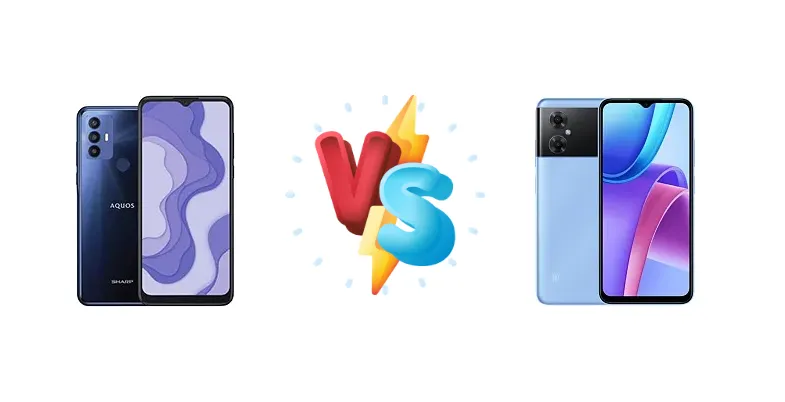
The Xiaomi Redmi Note 11R and Sharp Aquos V6 Plus represent compelling options in the ultra-budget smartphone segment. While both aim to deliver essential smartphone functionality at a low price, they diverge significantly in their core hardware, particularly in the chipset department. This comparison dissects these differences to determine which device offers the best value for your money.
🏆 Quick Verdict
For the average user prioritizing performance and future-proofing, the Xiaomi Redmi Note 11R is the clear winner. Its Dimensity 700 chipset provides a substantial performance uplift over the Aquos V6 Plus’ Helio G25, making it better suited for multitasking, gaming, and 5G connectivity. However, the Aquos V6 Plus’ USB Power Delivery support is a notable advantage for those who prefer faster, standardized charging.
| Network |
|---|
| 2G bands | GSM 850 / 900 / 1800 / 1900 | GSM 850 / 900 / 1800 / 1900 |
| 3G bands | HSDPA 900 / 2100 | HSDPA 850 / 900 / 1900 / 2100 |
| 4G bands | LTE | 1, 3, 5, 7, 8, 34, 38, 39, 40, 41 |
| 5G bands | - | 1, 5, 8, 28, 41, 78 |
| Speed | HSPA, LTE | HSPA, LTE, 5G |
| Technology | GSM / HSPA / LTE | GSM / CDMA / HSPA / LTE / 5G |
| | - | CDMA 800 |
| Launch |
|---|
| Announced | 2022, February 16 | 2022, September 30 |
| Status | Available. Released 2022, February 16 | Available. Released 2022, September 30 |
| Body |
|---|
| Build | Glass front, plastic frame, plastic back | Glass front, plastic frame, plastic back |
| Dimensions | 165.2 x 75.5 x 8.9 mm (6.50 x 2.97 x 0.35 in) | 164 x 76.1 x 8.9 mm (6.46 x 3.00 x 0.35 in) |
| SIM | Nano-SIM + Nano-SIM | Nano-SIM + Nano-SIM |
| Weight | 190 g (6.70 oz) | 201 g (7.09 oz) |
| Display |
|---|
| Resolution | 720 x 1600 pixels, 20:9 ratio (~269 ppi density) | 1080 x 2408 pixels, 20:9 ratio (~401 ppi density) |
| Size | 6.52 inches, 102.6 cm2 (~82.3% screen-to-body ratio) | 6.58 inches, 104.3 cm2 (~83.6% screen-to-body ratio) |
| Type | IPS LCD | IPS LCD, 90Hz, 400 nits (typ) |
| Platform |
|---|
| CPU | Octa-core (4x2.0 GHz Cortex-A53 & 4x1.5 GHz Cortex-A53) | Octa-core (2x2.2 GHz Cortex-A76 & 6x2.0 GHz Cortex-A55) |
| Chipset | Mediatek MT6762G Helio G25 (12 nm) | Mediatek Dimensity 700 (7 nm) |
| GPU | PowerVR GE8320 | Mali-G57 MC2 |
| OS | Android 12 | Android 12, MIUI 13 |
| Memory |
|---|
| Card slot | microSDXC | microSDXC (dedicated slot) |
| Internal | 64GB 4GB RAM | 128GB 4GB RAM, 128GB 6GB RAM, 128GB 8GB RAM |
| | - | UFS 2.2 |
| Main Camera |
|---|
| Dual | - | 13 MP, f/2.2, (wide), PDAF
Auxiliary lens |
| Features | LED flash | LED flash, HDR, panorama |
| Triple | 50 MP, (wide)
2 MP (macro)
Auxiliary lens | - |
| Video | 1080p@30fps | 1080p@30fps |
| Selfie camera |
|---|
| Features | - | HDR |
| Single | 8 MP | 5 MP, f/2.2, (wide) |
| Video | 1080p@30fps | 1080p@30fps |
| Sound |
|---|
| 3.5mm jack | Yes | Yes |
| 35mm jack | Yes | Yes |
| Loudspeaker | Yes | Yes |
| | - | 24-bit/192kHz audio |
| Comms |
|---|
| Bluetooth | 5.0, A2DP, LE, aptX HD, aptX Adaptive | 5.1, A2DP, LE |
| Infrared port | - | Yes |
| NFC | Yes | No |
| Positioning | GPS (L1+L5), GLONASS, BDS, GALILEO, QZSS | GPS, GLONASS, GALILEO, BDS |
| Radio | No | No |
| USB | USB Type-C 3.0 | USB Type-C 2.0, OTG |
| WLAN | Wi-Fi 802.11 a/b/g/n/ac, dual-band | Wi-Fi 802.11 a/b/g/n/ac, dual-band, Wi-Fi Direct |
| Features |
|---|
| Sensors | Fingerprint (rear-mounted), accelerometer, gyro, proximity, compass | Fingerprint (side-mounted), accelerometer, proximity, compass |
| Battery |
|---|
| Charging | USB Power Delivery 3.0 | 18W wired |
| Type | Li-Ion 5000 mAh | Li-Po 5000 mAh |
| Misc |
|---|
| Colors | Grey Sand, Deep Blue Sea | Black, Blue, Gray |
| Models | SH-C04 | 22095RA98C |
| Price | About 150 EUR | About 160 EUR |
Sharp Aquos V6 Plus
- USB Power Delivery 3.0 for faster charging with compatible adapters.
- Potentially lower price point depending on region.
- Simple and straightforward user experience.
- Significantly weaker performance due to the Helio G25 chipset.
- Less efficient processor leading to potentially shorter battery life.
- Limited 5G connectivity.
Xiaomi Redmi Note 11R
- Much faster performance thanks to the Dimensity 700 chipset.
- 5G connectivity for faster data speeds.
- More efficient processor for better battery life.
- Slower 18W charging compared to Aquos V6 Plus with USB-PD.
- May be slightly more expensive.
- Xiaomi’s MIUI software can be resource-intensive.
Display Comparison
Neither device boasts a standout display. Given the limited data, we can assume both utilize LCD panels common in this price bracket. The key difference lies under the hood. The Redmi Note 11R’s Dimensity 700 is built on a more efficient 7nm process, potentially leading to better power management and sustained performance during graphically intensive tasks, indirectly impacting display responsiveness. While neither manufacturer specifies peak brightness, the Redmi Note 11R’s more modern chipset suggests a greater capacity for driving a brighter display.
Camera Comparison
Without detailed camera specifications, a direct comparison is difficult. However, the Redmi Note 11R’s more powerful chipset allows for more sophisticated image processing algorithms, potentially resulting in better dynamic range and noise reduction. It’s reasonable to assume both phones feature a primary camera and depth sensor, but the Redmi Note 11R’s processing capabilities will likely yield superior image quality, especially in challenging lighting conditions. The Aquos V6 Plus’s older chipset may struggle with complex computational photography features.
Performance
The performance gap between these two devices is substantial. The Xiaomi Redmi Note 11R’s Mediatek Dimensity 700 (7nm) features two Cortex-A76 cores clocked at 2.2 GHz, alongside six Cortex-A55 cores. This architecture is significantly more powerful than the Sharp Aquos V6 Plus’ Mediatek Helio G25 (12nm), which relies on four slower Cortex-A53 cores at 2.0 GHz and another four at 1.5 GHz. The 7nm process node of the Dimensity 700 also contributes to improved thermal efficiency, reducing the likelihood of performance throttling during prolonged use. This translates to a smoother experience for gaming, video editing, and multitasking on the Redmi Note 11R.
Battery Life
Battery life will depend heavily on usage patterns. While the mAh capacity isn’t specified for either device, the Redmi Note 11R’s more efficient Dimensity 700 chipset should translate to better battery endurance despite its 18W charging. The Aquos V6 Plus supports USB Power Delivery 3.0, offering faster charging speeds with compatible chargers, but this advantage is offset by the less efficient Helio G25. A full charge cycle on the Aquos V6 Plus may take longer overall, even with a higher wattage PD charger, due to the chipset’s power draw.
Buying Guide
Buy the Sharp Aquos V6 Plus if you prioritize USB Power Delivery charging compatibility and are primarily focused on basic smartphone tasks like calls, messaging, and light social media use. Buy the Xiaomi Redmi Note 11R if you need a phone capable of handling more demanding applications, enjoy mobile gaming, or want the benefits of 5G connectivity, even if it means sacrificing USB-PD charging.
Frequently Asked Questions
❓ Will the Redmi Note 11R be able to run demanding games like PUBG Mobile smoothly?
Yes, the Dimensity 700 chipset in the Redmi Note 11R is capable of running PUBG Mobile at medium to high settings with reasonable frame rates. While it won't deliver a flagship gaming experience, it's a significant improvement over the Aquos V6 Plus’ Helio G25, which would likely struggle with consistent performance.
❓ Does the Aquos V6 Plus’ USB Power Delivery support mean I can use any USB-C charger with it?
While USB Power Delivery is a standardized protocol, not all USB-C chargers fully support it. To take full advantage of USB-PD, you’ll need a charger specifically designed to deliver the Power Delivery profile. Standard USB-C chargers will still work, but charging speeds may be limited.
❓ Is the 5G connectivity on the Redmi Note 11R useful if 5G isn't widely available in my area?
Even if 5G coverage is limited, the Redmi Note 11R will fall back to 4G LTE. The 5G modem also offers improved network performance and efficiency on 4G networks, potentially resulting in faster data speeds and better signal strength compared to devices without 5G support.