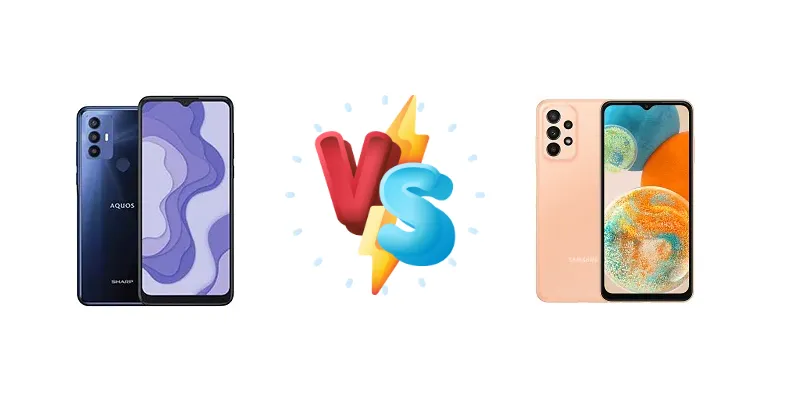
The sub-$200 smartphone market is fiercely competitive. The Sharp Aquos V6 Plus and Samsung Galaxy A23 5G both aim to deliver essential features at an accessible price point, but they take distinctly different approaches. The Aquos V6 Plus focuses on a streamlined experience, while the A23 5G adds 5G connectivity and a more modern chipset. This comparison dissects their key differences to determine which device offers the best value.
🏆 Quick Verdict
For the average user, the Samsung Galaxy A23 5G is the better choice. Its Qualcomm Snapdragon 695 5G chipset, built on a 6nm process, provides significantly improved performance and efficiency compared to the Aquos V6 Plus’s Mediatek Helio G25. While both phones offer similar battery endurance ratings, the A23 5G’s 25W charging is a notable advantage.
| Network |
|---|
| 2G bands | GSM 850 / 900 / 1800 / 1900 | GSM 850 / 900 / 1800 / 1900 |
| 3G bands | HSDPA 900 / 2100 | HSDPA 850 / 900 / 1700(AWS) / 1900 / 2100 |
| 4G bands | LTE | 1, 2, 3, 4, 5, 7, 8, 12, 17, 20, 26, 28, 32, 38, 40, 41, 66 - International |
| 5G bands | - | 1, 3, 7, 8, 20, 28, 38, 40, 41, 77, 78 SA/NSA/Sub6 - International |
| Speed | HSPA, LTE | HSPA, LTE, 5G |
| Technology | GSM / HSPA / LTE | GSM / HSPA / LTE / 5G |
| | - | 2, 5, 30, 66, 77 SA/NSA/Sub6/mmWave - USA |
| Launch |
|---|
| Announced | 2022, February 16 | 2022, August 05 |
| Status | Available. Released 2022, February 16 | Available. Released 2022, September 02 |
| Body |
|---|
| Build | Glass front, plastic frame, plastic back | Glass front (Gorilla Glass 5), plastic frame, plastic back |
| Dimensions | 165.2 x 75.5 x 8.9 mm (6.50 x 2.97 x 0.35 in) | 165.4 x 76.9 x 8.4 mm (6.51 x 3.03 x 0.33 in) |
| SIM | Nano-SIM + Nano-SIM | · Nano-SIM· Nano-SIM + Nano-SIM |
| Weight | 190 g (6.70 oz) | 197 g (6.95 oz) |
| Display |
|---|
| Protection | - | Corning Gorilla Glass 5 |
| Resolution | 720 x 1600 pixels, 20:9 ratio (~269 ppi density) | 1080 x 2408 pixels, 20:9 ratio (~400 ppi density) |
| Size | 6.52 inches, 102.6 cm2 (~82.3% screen-to-body ratio) | 6.6 inches, 104.9 cm2 (~82.5% screen-to-body ratio) |
| Type | IPS LCD | PLS LCD, 120Hz |
| Platform |
|---|
| CPU | Octa-core (4x2.0 GHz Cortex-A53 & 4x1.5 GHz Cortex-A53) | Octa-core (2x2.2 GHz Kryo 660 Gold & 6x1.7 GHz Kryo 660 Silver) |
| Chipset | Mediatek MT6762G Helio G25 (12 nm) | Qualcomm SM6375 Snapdragon 695 5G (6 nm) |
| GPU | PowerVR GE8320 | Adreno 619 |
| OS | Android 12 | Android 12, upgradable to Android 14, One UI 6 |
| Memory |
|---|
| Card slot | microSDXC | microSDXC (dedicated slot) |
| Internal | 64GB 4GB RAM | 64GB 4GB RAM, 64GB 6GB RAM, 128GB 4GB RAM, 128GB 6GB RAM, 128GB 8GB RAM |
| Main Camera |
|---|
| Features | LED flash | LED flash, panorama, HDR |
| Quad | - | 50 MP, f/1.8, 26mm (wide), 1/2.76", 0.64µm, PDAF, OIS
5 MP, f/2.2, 13mm, 123˚ (ultrawide), 1/5.0", 1.12µm
2 MP (macro)
Auxiliary lens |
| Triple | 50 MP, (wide)
2 MP (macro)
Auxiliary lens | - |
| Video | 1080p@30fps | 1080p@30fps |
| Selfie camera |
|---|
| Single | 8 MP | 8 MP, f/2.0, 25mm (wide), 1/4.0", 1.12µm - USA
8 MP, f/2.2, 25mm (wide), 1/4.0", 1.12µm - International |
| Video | 1080p@30fps | 1080p@30fps |
| Sound |
|---|
| 3.5mm jack | Yes | Yes |
| 35mm jack | Yes | Yes |
| Loudspeaker | Yes | Yes |
| Comms |
|---|
| Bluetooth | 5.0, A2DP, LE, aptX HD, aptX Adaptive | 5.1, A2DP, LE |
| NFC | Yes | Yes |
| Positioning | GPS (L1+L5), GLONASS, BDS, GALILEO, QZSS | GPS, GLONASS, GALILEO, BDS |
| Radio | No | FM radio (market/region dependent) |
| USB | USB Type-C 3.0 | USB Type-C 2.0 |
| WLAN | Wi-Fi 802.11 a/b/g/n/ac, dual-band | Wi-Fi 802.11 a/b/g/n/ac, dual-band, Wi-Fi Direct |
| Features |
|---|
| Sensors | Fingerprint (rear-mounted), accelerometer, gyro, proximity, compass | Fingerprint (side-mounted), accelerometer, gyro, compass, barometer (USA only) |
| | - | Virtual proximity sensing |
| Battery |
|---|
| Charging | USB Power Delivery 3.0 | 25W wired |
| Type | Li-Ion 5000 mAh | Li-Po 5000 mAh |
| Misc |
|---|
| Colors | Grey Sand, Deep Blue Sea | Black, White, Peach, Blue |
| Models | SH-C04 | SM-A236U, SM-A236U1, SM-A236B, SM-A236B/DS, SM-A236B/DSN, SM-A236E, SM-S236DL |
| Price | About 150 EUR | $ 84.44 / £ 129.00 / € 125.28 / ₹ 21,000 |
| SAR | - | 0.68 W/kg (head) 0.57 W/kg (body) |
| SAR EU | - | 1.49 W/kg (head) 1.25 W/kg (body) |
| Tests |
|---|
| Battery life | - |
Endurance rating 138h
|
| Camera | - |
Photo / Video |
| Display | - |
Contrast ratio: 1328:1 (nominal) |
| Loudspeaker | - |
-25.9 LUFS (Very good)
|
| Performance | - |
AnTuTu: 318821 (v9)
GeekBench: 1940 (v5.1)
GFXBench: 16fps (ES 3.1 onscreen) |
Sharp Aquos V6 Plus
- Potentially lower price point
- Simple and streamlined user experience
- USB Power Delivery 3.0 support
- Less powerful Mediatek Helio G25 chipset
- Likely lower display brightness
- Slower charging speeds
Samsung Galaxy A23 5G
- More powerful Qualcomm Snapdragon 695 5G chipset
- Faster 25W charging
- 5G connectivity
- Potentially higher price
- Similar battery endurance rating to the Aquos V6 Plus
- May include unnecessary 2MP macro lens
Display Comparison
Both the Sharp Aquos V6 Plus and Samsung Galaxy A23 5G feature displays with a 1328:1 contrast ratio, suggesting similar visual pop. However, the A23 5G boasts a measured peak brightness of 508 nits, which will translate to better visibility outdoors compared to the Aquos V6 Plus, for which brightness data is unavailable. While both likely utilize LCD panels given the price bracket, the A23 5G’s higher brightness is a clear advantage for outdoor use and HDR content viewing.
Camera Comparison
Both devices are listed as having Photo/Video capabilities, but detailed camera specifications are lacking for the Aquos V6 Plus. The A23 5G likely features a more sophisticated camera system, benefiting from Qualcomm’s image signal processor (ISP) within the Snapdragon 695. While both may include a 2MP macro lens (a common inclusion in this price range), the A23 5G’s main sensor and image processing algorithms will likely deliver superior image quality, particularly in challenging lighting conditions. Without specific sensor details for the Aquos V6 Plus, it’s difficult to make a precise comparison, but the A23 5G has a clear advantage based on its chipset.
Performance
The core difference lies in the chipsets. The Samsung Galaxy A23 5G’s Qualcomm Snapdragon 695 5G (6nm) is a substantial upgrade over the Sharp Aquos V6 Plus’s Mediatek Helio G25 (12nm). The 6nm process node of the Snapdragon 695 results in significantly improved power efficiency and thermal management, meaning less throttling during sustained tasks. The Snapdragon 695’s CPU configuration – 2x2.2 GHz Kryo 660 Gold & 6x1.7 GHz Kryo 660 Silver – also offers a performance edge over the Aquos V6 Plus’s Octa-core (4x2.0 GHz Cortex-A53 & 4x1.5 GHz Cortex-A53). This translates to smoother multitasking, faster app loading times, and a better gaming experience on the A23 5G.
Battery Life
Both phones share an endurance rating of 138 hours, indicating comparable battery life under similar usage scenarios. However, the Samsung Galaxy A23 5G supports 25W wired charging, a significant advantage over the Aquos V6 Plus, which only supports USB Power Delivery 3.0 without a specified wattage. 25W charging will allow the A23 5G to recharge much faster, minimizing downtime and providing greater convenience. While battery capacity isn’t specified for either device, the more efficient Snapdragon 695 in the A23 5G will likely contribute to longer real-world usage.
Buying Guide
Buy the Sharp Aquos V6 Plus if you prioritize simplicity and are primarily focused on basic smartphone tasks like calling, texting, and light social media use. Its lower price point makes it an attractive option for first-time smartphone buyers or those on a very tight budget. Buy the Samsung Galaxy A23 5G if you want a phone capable of handling more demanding apps, enjoy the benefits of 5G connectivity, and appreciate faster charging speeds. It’s the better all-rounder for most users.
Frequently Asked Questions
❓ Is the Snapdragon 695 in the Galaxy A23 5G powerful enough for modern mobile games?
The Snapdragon 695 is capable of running many popular mobile games at medium settings. While it won't deliver flagship-level performance, it's a significant step up from the Helio G25 and provides a smoother gaming experience, especially in less demanding titles. Expect playable frame rates in games like PUBG Mobile and Call of Duty: Mobile.
❓ Does the Samsung Galaxy A23 5G support VoLTE and VoWiFi calling?
Support for VoLTE (Voice over LTE) and VoWiFi (Voice over Wi-Fi) varies by carrier. The Samsung Galaxy A23 5G *generally* supports these features, but it's crucial to check with your specific mobile carrier to confirm compatibility before purchasing. These features are essential for maintaining call quality in areas with poor cellular coverage.
❓ How does the Mediatek Helio G25 handle multitasking on the Sharp Aquos V6 Plus?
The Helio G25 is a basic processor and can struggle with heavy multitasking. Running multiple apps simultaneously may result in noticeable slowdowns and app reloading. It's best suited for users who primarily use one app at a time.
❓ What type of charging protocol does the Sharp Aquos V6 Plus use with USB Power Delivery 3.0, and what wattage is supported?
While the Aquos V6 Plus supports USB Power Delivery 3.0, the specific wattage isn't officially stated. It's likely to be a lower wattage (around 10-15W) compared to the A23 5G's 25W, resulting in significantly slower charging times. You'll need a compatible USB-PD charger to utilize this feature.