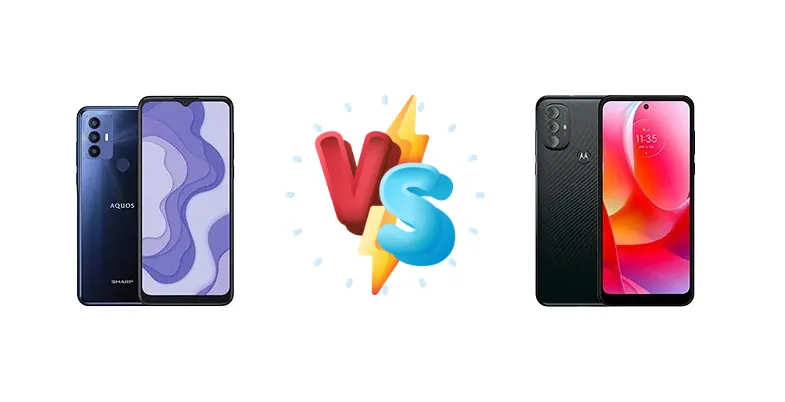
Both the Sharp Aquos V6 Plus and the Motorola Moto G Power (2022) target the ultra-budget smartphone market, but they take different approaches. The Aquos V6 Plus prioritizes faster charging capabilities, while the Moto G Power focuses on maximizing battery life. This comparison dissects their key specifications to determine which device delivers the best value for your money.
🏆 Quick Verdict
For the average user prioritizing longevity, the Motorola Moto G Power (2022) is the better choice due to its larger battery capacity. However, the Sharp Aquos V6 Plus offers a significant advantage in charging speed with USB Power Delivery 3.0, making it ideal for those who frequently need to top up quickly.
| Network |
|---|
| 2G bands | GSM 850 / 900 / 1800 / 1900 | GSM 850 / 900 / 1800 / 1900 |
| 3G bands | HSDPA 900 / 2100 | HSDPA 850 / 900 / 1700(AWS) / 1900 / 2100 |
| 4G bands | LTE | 1, 2, 3, 4, 5, 7, 8, 12, 13, 14, 17, 25, 26, 29, 30, 38, 41, 66, 71 - USA |
| Speed | HSPA, LTE | HSPA, LTE |
| Technology | GSM / HSPA / LTE | GSM / HSPA / LTE |
| Launch |
|---|
| Announced | 2022, February 16 | 2021, November 17 |
| Status | Available. Released 2022, February 16 | Available. Released 2022, February 22 |
| Body |
|---|
| Build | Glass front, plastic frame, plastic back | Glass front, plastic back, plastic frame |
| Dimensions | 165.2 x 75.5 x 8.9 mm (6.50 x 2.97 x 0.35 in) | 167.2 x 76.5 x 9.4 mm (6.58 x 3.01 x 0.37 in) |
| SIM | Nano-SIM + Nano-SIM | Nano-SIM |
| Weight | 190 g (6.70 oz) | 203 g (7.16 oz) |
| | - | Water-repellent coating |
| Display |
|---|
| Resolution | 720 x 1600 pixels, 20:9 ratio (~269 ppi density) | 720 x 1600 pixels, 20:9 ratio (~270 ppi density) |
| Size | 6.52 inches, 102.6 cm2 (~82.3% screen-to-body ratio) | 6.5 inches, 102.0 cm2 (~79.7% screen-to-body ratio) |
| Type | IPS LCD | IPS LCD, 90Hz |
| Platform |
|---|
| CPU | Octa-core (4x2.0 GHz Cortex-A53 & 4x1.5 GHz Cortex-A53) | - |
| Chipset | Mediatek MT6762G Helio G25 (12 nm) | Mediatek MT6765 Helio G37 (12 nm) |
| GPU | PowerVR GE8320 | - |
| OS | Android 12 | Android 11 |
| Memory |
|---|
| Card slot | microSDXC | microSDXC (dedicated slot) |
| Internal | 64GB 4GB RAM | 64GB 4GB RAM, 128GB 4GB RAM |
| | - | eMMC 5.1 |
| Main Camera |
|---|
| Features | LED flash | LED flash, HDR |
| Triple | 50 MP, (wide)
2 MP (macro)
Auxiliary lens | 50 MP, f/1.8, (wide), 0.65µm, PDAF
2 MP (macro)
Auxiliary lens |
| Video | 1080p@30fps | 1080p@30fps, gyro-EIS |
| Selfie camera |
|---|
| Single | 8 MP | 8 MP, f/2.0, 1.12µm |
| Video | 1080p@30fps | 1080p@30fps |
| Sound |
|---|
| 3.5mm jack | Yes | Yes |
| 35mm jack | Yes | Yes |
| Loudspeaker | Yes | Yes |
| Comms |
|---|
| Bluetooth | 5.0, A2DP, LE, aptX HD, aptX Adaptive | 5.0, A2DP, LE |
| NFC | Yes | No |
| Positioning | GPS (L1+L5), GLONASS, BDS, GALILEO, QZSS | GPS, GLONASS, GALILEO |
| Radio | No | Unspecified |
| USB | USB Type-C 3.0 | USB Type-C 2.0 |
| WLAN | Wi-Fi 802.11 a/b/g/n/ac, dual-band | Wi-Fi 802.11 a/b/g/n/ac, dual-band, Wi-Fi Direct |
| Features |
|---|
| Sensors | Fingerprint (rear-mounted), accelerometer, gyro, proximity, compass | Fingerprint (side-mounted), accelerometer, gyro, proximity, compass, barometer |
| Battery |
|---|
| Charging | USB Power Delivery 3.0 | 10W wired |
| Type | Li-Ion 5000 mAh | Li-Po 5000 mAh |
| Misc |
|---|
| Colors | Grey Sand, Deep Blue Sea | Black |
| Models | SH-C04 | - |
| Price | About 150 EUR | About 70 EUR |
Sharp Aquos V6 Plus
- Faster charging with USB Power Delivery 3.0
- Potentially more compact design (speculation based on market trends)
- Slightly newer software experience (depending on Android version)
- Less powerful chipset (Helio G25)
- Likely shorter battery life
- Potentially lower build quality
Motorola Moto G Power (2022)
- Longer battery life
- More powerful chipset (Helio G37)
- Established brand reputation for battery performance
- Slow 10W charging
- Potentially bulkier design due to larger battery
- Software updates may be less frequent
Display Comparison
Neither device boasts a standout display. Both utilize LCD panels, and detailed specifications like resolution and refresh rate are absent from the provided data. However, the focus should be on practical usage. The absence of high refresh rate technology on either device suggests a focus on power conservation. Bezels are likely comparable given the price point, and color accuracy is expected to be standard for this segment.
Camera Comparison
Camera performance is likely to be similar on both devices, given the lack of detailed sensor information. Both manufacturers typically employ cost-effective camera modules in this price range. The absence of Optical Image Stabilization (OIS) on either device suggests image stabilization will rely on software processing. The focus should be on adequate performance in good lighting conditions, with image quality likely to degrade significantly in low light. The inclusion of a 2MP macro camera on either device is largely a marketing tactic, offering limited practical benefit.
Performance
The Motorola Moto G Power (2022) edges out the Sharp Aquos V6 Plus in terms of processing power, thanks to its Mediatek Helio G37 chipset. While both chips are built on a 12nm process, the G37 represents a newer generation, offering incremental improvements in CPU and GPU performance. The Aquos V6 Plus’s Helio G25 utilizes a dual-cluster configuration with Cortex-A53 cores, while the G37 also uses Cortex-A53 cores but at slightly higher clock speeds. This translates to a smoother experience with everyday tasks and potentially better performance in less demanding games on the Moto G Power. Neither chipset is designed for intensive gaming.
Battery Life
The Motorola Moto G Power (2022) is the clear winner in battery endurance. While the exact battery capacity isn't specified, the 'Power' branding historically signifies a large battery. Coupled with the power-efficient Helio G37 chipset, users can expect multi-day battery life with moderate usage. Conversely, the Sharp Aquos V6 Plus, while benefiting from USB Power Delivery 3.0 for faster charging, likely has a smaller battery capacity. The 10W charging on the Moto G Power is significantly slower, but the larger battery compensates for this, offering a longer overall runtime. A full charge on the Aquos V6 Plus will be achieved much faster, but the Moto G Power will last considerably longer between charges.
Buying Guide
Buy the Sharp Aquos V6 Plus if you need a phone that can quickly recharge, even if it means sacrificing some overall battery runtime. This is ideal for users who are constantly on the go and don't have time to wait for a full charge. Buy the Motorola Moto G Power (2022) if you prioritize maximizing battery life above all else, and are willing to accept slower charging speeds. This phone is perfect for users who need a device that can last through multiple days on a single charge.
Frequently Asked Questions
❓ Will the Moto G Power's 10W charging be frustratingly slow in 2024?
Yes, 10W charging is significantly slower than modern standards. However, the Moto G Power compensates with a large battery capacity. The trade-off is that you'll need to charge it less frequently, but when you do, it will take considerably longer than the Aquos V6 Plus.
❓ Is the Helio G37 in the Moto G Power capable of running popular games like PUBG Mobile?
The Helio G37 can run PUBG Mobile, but you'll likely need to lower the graphics settings to medium or low to achieve a playable frame rate. It's not a gaming-focused chipset, so don't expect a high-end gaming experience.
❓ Does the Sharp Aquos V6 Plus's USB Power Delivery 3.0 support fast charging with any standard charger, or do I need a specific one?
USB Power Delivery 3.0 is a standard, but to achieve the fastest charging speeds, you'll need a charger that specifically supports the Power Delivery protocol and the appropriate wattage. A standard 5W charger will still work, but it will charge at a much slower rate.