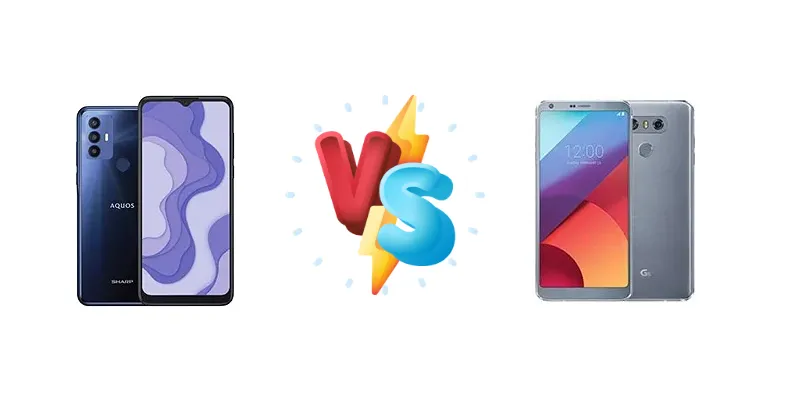
The smartphone landscape is constantly evolving, and sometimes the best value lies in comparing a modern budget phone with an older flagship. Today, we pit the Sharp Aquos V6 Plus against the LG G6, examining their strengths and weaknesses to help you decide which one is right for you.
🏆 Quick Verdict
The LG G6, despite its age, boasts a significantly more powerful processor and faster charging. While the Aquos V6 Plus offers a more modern design and potentially better software support, the G6's performance and display quality give it a clear edge for most users. It's a battle of age versus affordability.
| Network |
|---|
| 2G bands | GSM 850 / 900 / 1800 / 1900 | GSM 850 / 900 / 1800 / 1900 - SIM 1 & SIM 2 (dual-SIM model only) |
| 3G bands | HSDPA 900 / 2100 | HSDPA 850 / 900 / 1700(AWS) / 1900 / 2100 |
| 4G bands | LTE | 1, 2, 3, 4, 5, 7, 8, 12, 13, 17, 20, 28, 38, 40 |
| Speed | HSPA, LTE | HSPA 42.2/5.76 Mbps, LTE (3CA) Cat12 600/150 Mbps |
| Technology | GSM / HSPA / LTE | GSM / HSPA / LTE |
| Launch |
|---|
| Announced | 2022, February 16 | 2017, February 26. Released 2017, April 07 |
| Status | Available. Released 2022, February 16 | Discontinued |
| Body |
|---|
| Build | Glass front, plastic frame, plastic back | Glass front (Gorilla Glass 3), glass back (Gorilla Glass 5), aluminum frame |
| Dimensions | 165.2 x 75.5 x 8.9 mm (6.50 x 2.97 x 0.35 in) | 148.9 x 71.9 x 7.9 mm (5.86 x 2.83 x 0.31 in) |
| SIM | Nano-SIM + Nano-SIM | · Nano-SIM· Nano-SIM + Nano-SIM |
| Weight | 190 g (6.70 oz) | 163 g (5.75 oz) |
| | - | IP68 dust/water resistant (up to 1.5m for 30 mins)
MIL-STD-810G compliant*
*does not guarantee ruggedness or use in extreme conditions |
| Display |
|---|
| Protection | - | Corning Gorilla Glass 3 |
| Resolution | 720 x 1600 pixels, 20:9 ratio (~269 ppi density) | 1440 x 2880 pixels, 18:9 ratio (~564 ppi density) |
| Size | 6.52 inches, 102.6 cm2 (~82.3% screen-to-body ratio) | 5.7 inches, 84.1 cm2 (~78.6% screen-to-body ratio) |
| Type | IPS LCD | IPS LCD, HDR10, Dolby Vision |
| | - | Always-on display |
| Platform |
|---|
| CPU | Octa-core (4x2.0 GHz Cortex-A53 & 4x1.5 GHz Cortex-A53) | Quad-core (2x2.35 GHz Kryo & 2x1.6 GHz Kryo) |
| Chipset | Mediatek MT6762G Helio G25 (12 nm) | Qualcomm MSM8996 Snapdragon 821 (14 nm) |
| GPU | PowerVR GE8320 | Adreno 530 |
| OS | Android 12 | Android 7.0 (Nougat), upgradable to Android 9.0 (Pie), LG UX 8 UI |
| Memory |
|---|
| Card slot | microSDXC | microSDXC (uses shared SIM slot) - dual SIM model only |
| Internal | 64GB 4GB RAM | 32GB 4GB RAM, 64GB 4GB RAM, 128GB 4GB RAM |
| | - | UFS 2.0 |
| Main Camera |
|---|
| Dual | - | 13 MP, f/1.8, 30mm (standard), 1/3.1", 1.12µm, PDAF, 3-axis OIS
13 MP, f/2.4, 12mm (ultrawide), no AF |
| Features | LED flash | Dual-LED flash, HDR, panorama |
| Triple | 50 MP, (wide)
2 MP (macro)
Auxiliary lens | - |
| Video | 1080p@30fps | 4K@30fps, 1080p@30/60fps, HDR, 24-bit/192kHz stereo sound rec. |
| Selfie camera |
|---|
| Single | 8 MP | 5 MP, f/2.2, 18mm |
| Video | 1080p@30fps | 1080p@30fps |
| Sound |
|---|
| 3.5mm jack | Yes | Yes |
| 35mm jack | Yes | Yes |
| Loudspeaker | Yes | Yes |
| | - | 32-bit/192kHz audio
|
| Comms |
|---|
| Bluetooth | 5.0, A2DP, LE, aptX HD, aptX Adaptive | 4.2, A2DP, LE, aptX HD |
| NFC | Yes | Yes |
| Positioning | GPS (L1+L5), GLONASS, BDS, GALILEO, QZSS | GPS, GLONASS, BDS |
| Radio | No | FM radio (market dependent) |
| USB | USB Type-C 3.0 | USB Type-C 3.1, OTG |
| WLAN | Wi-Fi 802.11 a/b/g/n/ac, dual-band | Wi-Fi 802.11 a/b/g/n/ac, dual-band, Wi-Fi Direct, DLNA |
| Features |
|---|
| Sensors | Fingerprint (rear-mounted), accelerometer, gyro, proximity, compass | Fingerprint (rear-mounted), accelerometer, gyro, proximity, compass, barometer |
| Battery |
|---|
| Charging | USB Power Delivery 3.0 | 18W wired, QC3, 50% in 30 min
Wireless (USA) |
| Type | Li-Ion 5000 mAh | Li-Po 3300 mAh, non-removable |
| Misc |
|---|
| Colors | Grey Sand, Deep Blue Sea | Astro Black, Ice Platinum, Terra Gold, Marine Blue, Mystic White, Raspberry Rose, Moroccan Blue, Lavender Violet |
| Models | SH-C04 | H870, H870DS, H873, H870S, LGM-G600L, H872, H871, LS993, US997, vs988, VS988, LGM-G600K, LGM-G600S, AS993, LGUS997, H870AR, H872PR, H871S, H870I |
| Price | About 150 EUR | About 240 EUR |
| SAR | - | 0.65 W/kg (head) 1.23 W/kg (body) |
| SAR EU | - | 0.23 W/kg (head) 0.15 W/kg (body) |
| Tests |
|---|
| Audio quality | - |
Noise -93.3dB / Crosstalk -94.4dB |
| Battery life | - | Endurance rating 72h |
| Camera | - |
Photo / Video |
| Display | - |
Contrast ratio: 2053 (nominal), 3.556 (sunlight) |
| Loudspeaker | - |
Voice 66dB / Noise 68dB / Ring 74dB |
| Performance | - |
AnTuTu: 158785 (v7)
GeekBench: 4175 (v4.4)
GFXBench: 8.5fps (ES 3.1 onscreen) |
Sharp Aquos V6 Plus
- Modern Design
- Potentially Longer Software Support
- USB Power Delivery 3.0 Charging
- Affordable Price
- Weaker Processor
- Limited Performance
- Unknown Display Specs
- Slower Charging
LG G6
- Powerful Snapdragon 821 Processor
- Excellent Display Quality
- Fast Charging (QC3)
- Premium Build Quality
- Older Device
- Potentially Limited Software Updates
- Older Battery Technology (though endurance is good)
- Larger Bezels
Display Comparison
The LG G6's display is a standout feature, boasting an impressive contrast ratio of 2053 (nominal) and 3.556 (sunlight), making it exceptionally readable even in bright conditions. While the Aquos V6 Plus likely has a modern panel, details on its contrast ratio are scarce. The G6's wider aspect ratio (18:9) also offers a more immersive viewing experience.
Camera Comparison
Both phones offer 'Photo / Video' capabilities, but the LG G6's older but still capable camera benefits from the Snapdragon 821's image processing. The Aquos V6 Plus may have newer sensor technology, but likely lacks the processing power to fully utilize it. Image quality will likely be better on the G6, especially in low light.
Performance
Here, the LG G6 shines. Its Snapdragon 821 chipset is considerably more powerful than the Aquos V6 Plus's Helio G25. Expect smoother multitasking, faster app loading times, and better gaming performance on the G6. The Aquos V6 Plus will handle basic tasks adequately, but struggles with demanding applications.
Battery Life
Both phones claim an impressive 72-hour endurance rating. However, the LG G6's 18W wired charging with QC3 support allows for significantly faster charging (50% in 30 minutes) compared to the Aquos V6 Plus's USB Power Delivery 3.0. This is a crucial advantage for users who value quick top-ups.
Buying Guide
The Sharp Aquos V6 Plus is ideal for users on a tight budget who prioritize a modern design and extended software support. The LG G6 is a better choice for those who value performance, a vibrant display, and a more premium feel, even if it means dealing with an older device.
Frequently Asked Questions
❓ Is the LG G6 still worth buying in 2024?
Yes, if you prioritize performance and a great display over the latest features and design. It offers excellent value for its price.
❓ Will the Sharp Aquos V6 Plus receive software updates for a long time?
Sharp generally provides decent software support, but it's unlikely to match the longevity of flagship devices. Check Sharp's official website for update information.