
Sharp Aquos V vs Xiaomi 12: A Generational Leap or Diminishing Returns?
| Phones Images | |||||
|---|---|---|---|---|---|
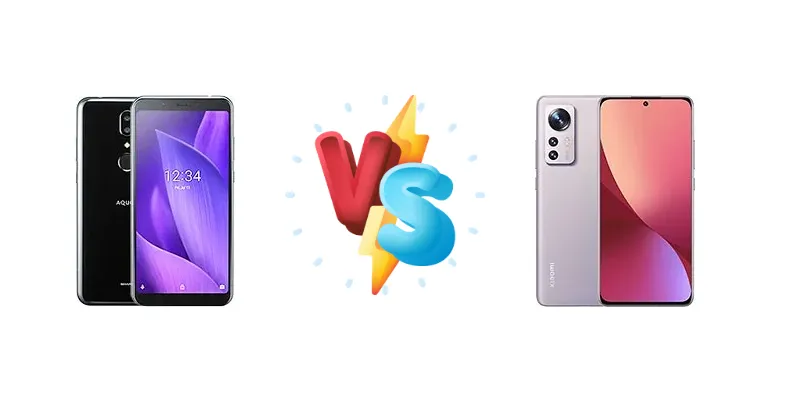
|
🏆 Quick Verdict
For the average user, the Xiaomi 12 is the superior choice. Its Snapdragon 8 Gen 1 chipset delivers substantially faster performance, and the 67W charging is a game-changer. However, the Aquos V offers a surprisingly capable experience for budget-conscious users who don't demand the absolute latest in mobile technology.
| PHONES | ||
|---|---|---|
| Phone Names | Sharp Aquos V | Xiaomi 12 |
| Network | ||
|---|---|---|
| 2G bands | GSM 850 / 900 / 1800 / 1900 | GSM 850 / 900 / 1800 / 1900 |
| 3G bands | HSDPA 850 / 900 / 1900 / 2100 | HSDPA 800 / 850 / 900 / 1700(AWS) / 1900 / 2100 |
| 4G bands | 1, 3, 5, 7, 8, 13, 20, 38, 40 | 1, 2, 3, 4, 5, 7, 8, 12, 13, 17, 18, 19, 20, 25, 26, 28, 32, 38, 39, 40, 41, 42, 48, 66 - International |
| 5G bands | - | 1, 3, 5, 7, 8, 20, 28, 38, 40, 41, 66, 77, 78, 79 SA/NSA - International |
| Speed | HSPA 42.2/5.76 Mbps, LTE (2CA) Cat9 450/50 Mbps | HSPA, LTE, 5G |
| Technology | GSM / HSPA / LTE | GSM / CDMA / HSPA / EVDO / LTE / 5G |
| - | 1, 3, 5, 8, 28, 41, 77, 78, 79 SA/NSA - China | |
| Launch | ||
|---|---|---|
| Announced | 2019, November. Released 2019, November | 2021, December 28 |
| Status | Discontinued | Available. Released 2021, December 31 |
| Body | ||
|---|---|---|
| Build | - | Glass front (Gorilla Glass Victus), glass back (Gorilla Glass 5), aluminum frame |
| Dimensions | 157 x 76 x 9 mm (6.18 x 2.99 x 0.35 in) | 152.7 x 69.9 x 8.2 mm (6.01 x 2.75 x 0.32 in) |
| SIM | Nano-SIM + Nano-SIM | Nano-SIM + Nano-SIM |
| Weight | 173 g (6.10 oz) | 179 g or 180 g (6.31 oz) |
| Display | ||
|---|---|---|
| Protection | Corning Gorilla Glass 5 | Corning Gorilla Glass Victus |
| Resolution | 1080 x 2160 pixels, 18:9 ratio (~409 ppi density) | 1080 x 2400 pixels, 20:9 ratio (~419 ppi density) |
| Size | 5.9 inches, 89.8 cm2 (~75.3% screen-to-body ratio) | 6.28 inches, 95.2 cm2 (~89.2% screen-to-body ratio) |
| Type | IPS LCD | AMOLED, 68B colors, 120Hz, Dolby Vision, HDR10+, 1100 nits (peak) |
| Platform | ||
|---|---|---|
| CPU | Octa-core (4x2.35 GHz Kryo & 4x1.9 GHz Kryo) | Octa-core (1x3.00 GHz Cortex-X2 & 3x2.50 GHz Cortex-A710 & 4x1.80 GHz Cortex-A510) |
| Chipset | Qualcomm MSM8998 Snapdragon 835 (10 nm) | Qualcomm SM8450 Snapdragon 8 Gen 1 (4 nm) |
| GPU | Adreno 540 | Adreno 730 |
| OS | Android 9.0 (Pie) | Android 12, MIUI 13 |
| Memory | ||
|---|---|---|
| Card slot | microSDXC (uses shared SIM slot) | No |
| Internal | 64GB 4GB RAM | 128GB 8GB RAM, 256GB 8GB RAM, 256GB 12GB RAM |
| - | UFS 3.1 | |
| Main Camera | ||
|---|---|---|
| Dual | 13 MP, f/2.0, PDAF, OIS 13 MP B/W | - |
| Features | LED flash, HDR, panorama | Color spectrum sensor, Dual-LED dual-tone flash, HDR, panorama |
| Single | - | 32 MP, f/2.5, 26mm (wide), 0.7µm |
| Triple | - | 50 MP, f/1.9, 26mm (wide), 1/1.56", 1.0µm, PDAF, OIS 13 MP, f/2.4, 12mm, 123˚ (ultrawide), 1/3.06", 1.12µm 5 MP, f/2.4, 50mm (telephoto macro), AF |
| Video | 4K@30fps, 1080p@30fps (gyro-EIS) | 8K@24fps (HDR), 4K@30/60fps (HDR10+), 1080p@30/120/240/960fps, 720p@1920fps, gyro-EIS |
| Selfie camera | ||
|---|---|---|
| Features | HDR | HDR, panorama |
| Single | 8 MP, f/2.0 | 32 MP, f/2.5, 26mm (wide), 0.7µm |
| Video | 1080p@30fps (gyro-EIS) | 1080p@30/60fps, 720p@120fps, HDR |
| Sound | ||
|---|---|---|
| 3.5mm jack | Yes | No |
| 35mm jack | Yes | No |
| Loudspeaker | Yes | Yes, with stereo speakers |
| - | 24-bit/192kHz audio Tuned by Harman Kardon | |
| Comms | ||
|---|---|---|
| Bluetooth | 5.0, A2DP, LE | 5.2, A2DP, LE, aptX HD, aptX Adaptive |
| Infrared port | - | Yes |
| NFC | No | Yes (market/region dependent) |
| Positioning | GPS, GLONASS, GALILEO, QZSS | GPS (L1+L5), GLONASS (L1), BDS (B1I+B1c+B2a), GALILEO (E1+E5a), QZSS (L1+L5), NavIC (L5) |
| Radio | No | No |
| USB | USB Type-C 2.0 | USB Type-C 2.0, OTG |
| WLAN | Wi-Fi 802.11 a/b/g/n/ac, dual-band, Wi-Fi Direct | Wi-Fi 802.11 a/b/g/n/ac/6 or 6e (market dependent), dual-band, Wi-Fi Direct |
| Features | ||
|---|---|---|
| Sensors | Fingerprint (rear-mounted), accelerometer, proximity, compass | Fingerprint (under display, optical), accelerometer, gyro, compass |
| - | Virtual Proximity Sensing | |
| Battery | ||
|---|---|---|
| Charging | - | 67W wired, PD3.0, QC4, 100% in 39 min 50W wireless, 100% in 53 min 10W reverse wireless |
| Type | Li-Ion 3090 mAh, non-removable | Li-Po 4500 mAh |
| Misc | ||
|---|---|---|
| Colors | Black | Gray, Blue, Purple, Green |
| Models | SH-C02 | 2201123G, 2201123C |
| Price | About 210 EUR | $ 284.99 / € 149.99 |
| SAR | - | 1.09 W/kg (head) 0.91 W/kg (body) |
| SAR EU | - | 0.60 W/kg (head) 1.00 W/kg (body) |
| Tests | ||
|---|---|---|
| Battery life | - | Endurance rating 82h |
| Camera | - | Photo / Video |
| Display | - | Contrast ratio: Infinite (nominal) |
| Loudspeaker | - | -25.3 LUFS (Very good) |
| Performance | - | AnTuTu: 985115 (v9) GeekBench: 3652 (v5.1) GFXBench: 75fps (ES 3.1 onscreen) |
Sharp Aquos V
- Significantly lower price point
- Reliable Snapdragon 835 performance for everyday tasks
- Potentially more durable build quality (depending on materials)
- Outdated chipset compared to the Snapdragon 8 Gen 1
- Slower charging speeds
- Likely inferior display quality
Xiaomi 12
- Blazing-fast Snapdragon 8 Gen 1 performance
- 67W wired and 50W wireless charging
- Brighter and higher-quality display
- Higher price tag
- Potential for thermal throttling under heavy load
- May require more frequent charging due to demanding features
Display Comparison
The Xiaomi 12 boasts a significantly brighter display, reaching 896 nits measured, compared to an unknown peak brightness for the Aquos V. This translates to better visibility in direct sunlight. While the Aquos V’s display quality is likely good for its time, the Xiaomi 12’s panel offers a more vibrant and readable experience. The Xiaomi 12’s ‘Infinite’ (nominal) contrast ratio suggests a superior viewing experience with deeper blacks, likely utilizing an OLED panel, while the Aquos V likely uses an LCD.
Camera Comparison
Both devices offer photo and video capabilities, but specifics are limited. The Xiaomi 12 likely benefits from a more advanced image signal processor (ISP) within the Snapdragon 8 Gen 1, resulting in better image processing, noise reduction, and dynamic range. Sensor size and lens apertures are unknown for both, but the Xiaomi 12, being a newer flagship, is expected to have a more sophisticated camera system with features like optical image stabilization (OIS) and advanced computational photography algorithms. The Aquos V’s camera is likely competent for its time, but will struggle to match the Xiaomi 12’s capabilities in challenging lighting conditions.
Performance
The core difference lies in the chipsets. The Xiaomi 12’s Snapdragon 8 Gen 1 (4nm) represents a massive leap over the Aquos V’s Snapdragon 835 (10nm). The 8 Gen 1 features a tri-cluster architecture with a Cortex-X2 prime core clocked at 3.00 GHz, alongside Cortex-A710 and A510 cores, offering significantly improved multi-core and single-core performance. The 835’s Kryo cores, while capable, are simply outmatched. The 4nm process node of the 8 Gen 1 also provides better thermal efficiency, potentially reducing throttling during sustained workloads. The Xiaomi 12 likely benefits from faster LPDDR5 RAM, further enhancing performance.
Battery Life
Both phones have an endurance rating of 82h, which is unusual. However, the Xiaomi 12’s charging capabilities are a standout feature. With 67W wired charging, it can reach 100% in just 39 minutes, and 50W wireless charging takes 53 minutes. The Aquos V’s charging speed is unknown, but will almost certainly be significantly slower. The Xiaomi 12 also offers 10W reverse wireless charging, a convenient feature for topping up accessories. While battery capacity isn’t specified, the faster charging speeds of the Xiaomi 12 mitigate any potential disadvantage from a smaller battery.
Buying Guide
Buy the Sharp Aquos V if you need a reliable smartphone for everyday tasks, prioritize affordability, and are comfortable with a slightly older chipset. It’s ideal for users who don’t heavily game or require the fastest processing speeds. Buy the Xiaomi 12 if you demand top-tier performance for demanding applications, value fast charging (67W wired, 50W wireless), and want a more modern feature set, including a brighter display and potentially better camera processing.