
Sharp Aquos V vs Sony Xperia 5 III: A Generational Leap or Diminishing Returns?
| Phones Images | |||||
|---|---|---|---|---|---|
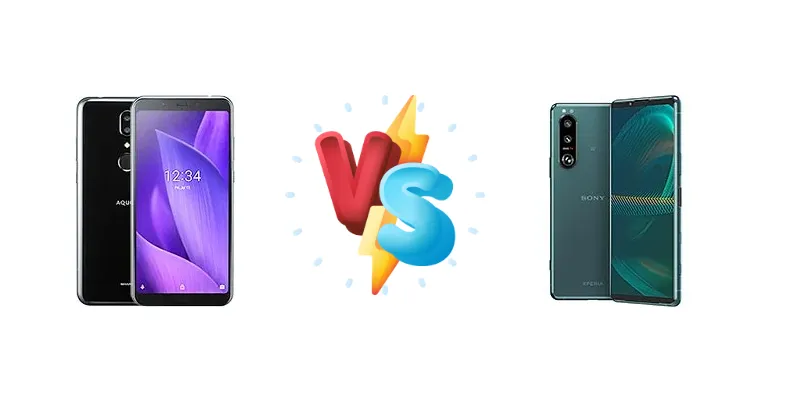
|
🏆 Quick Verdict
For the average user, the Sony Xperia 5 III is the superior device. The Snapdragon 888 offers a significant performance uplift, coupled with faster charging and a brighter display. However, the Aquos V remains a viable option for budget-conscious users who don't demand the latest processing power.
| PHONES | ||
|---|---|---|
| Phone Names | Sharp Aquos V | Sony Xperia 5 III |
| Network | ||
|---|---|---|
| 2G bands | GSM 850 / 900 / 1800 / 1900 | GSM 850 / 900 / 1800 / 1900 |
| 3G bands | HSDPA 850 / 900 / 1900 / 2100 | HSDPA 800 / 850 / 900 / 1700(AWS) / 1900 / 2100 |
| 4G bands | 1, 3, 5, 7, 8, 13, 20, 38, 40 | 1, 2, 3, 4, 5, 7, 8, 12, 13, 17, 19, 20, 25, 26, 28, 29, 32, 34, 38, 39, 40, 41, 46, 48, 66, 71 - USA |
| 5G bands | - | 1, 2, 3, 5, 7, 8, 20, 28, 38, 40, 41, 66, 71, 77, 78 SA/NSA/Sub6 - USA |
| Speed | HSPA 42.2/5.76 Mbps, LTE (2CA) Cat9 450/50 Mbps | HSPA, LTE, 5G |
| Technology | GSM / HSPA / LTE | GSM / HSPA / LTE / 5G |
| - | 1, 3, 5, 7, 8, 28, 38, 40, 41, 77, 78, 79 SA/NSA/Sub6 - Asia | |
| Launch | ||
|---|---|---|
| Announced | 2019, November. Released 2019, November | 2021, April 14 |
| Status | Discontinued | Available. Released 2021, October 08 |
| Body | ||
|---|---|---|
| Build | - | Glass front (Gorilla Glass 6), glass back (Gorilla Glass 6), aluminum frame |
| Dimensions | 157 x 76 x 9 mm (6.18 x 2.99 x 0.35 in) | 157 x 68 x 8.2 mm (6.18 x 2.68 x 0.32 in) |
| SIM | Nano-SIM + Nano-SIM | · Nano-SIM· Nano-SIM + Nano-SIM |
| Weight | 173 g (6.10 oz) | 168 g (5.93 oz) |
| - | IP65/IP68 dust/water resistant (up to 1.5m for 30 min) | |
| Display | ||
|---|---|---|
| Protection | Corning Gorilla Glass 5 | Corning Gorilla Glass 6 |
| Resolution | 1080 x 2160 pixels, 18:9 ratio (~409 ppi density) | 1080 x 2520 pixels, 21:9 ratio (~449 ppi density) |
| Size | 5.9 inches, 89.8 cm2 (~75.3% screen-to-body ratio) | 6.1 inches, 86.9 cm2 (~81.4% screen-to-body ratio) |
| Type | IPS LCD | OLED, 1B colors, 120Hz, HDR BT.2020 |
| Platform | ||
|---|---|---|
| CPU | Octa-core (4x2.35 GHz Kryo & 4x1.9 GHz Kryo) | Octa-core (1x2.84 GHz Cortex-X1 & 3x2.42 GHz Cortex-A78 & 4x1.80 GHz Cortex-A55) |
| Chipset | Qualcomm MSM8998 Snapdragon 835 (10 nm) | Qualcomm SM8350 Snapdragon 888 5G (5 nm) |
| GPU | Adreno 540 | Adreno 660 |
| OS | Android 9.0 (Pie) | Android 11, upgradable to Android 13 |
| Memory | ||
|---|---|---|
| Card slot | microSDXC (uses shared SIM slot) | microSDXC (uses shared SIM slot) |
| Internal | 64GB 4GB RAM | 128GB 8GB RAM, 256GB 8GB RAM |
| - | UFS 3.X | |
| Main Camera | ||
|---|---|---|
| Dual | 13 MP, f/2.0, PDAF, OIS 13 MP B/W | - |
| Features | LED flash, HDR, panorama | Zeiss optics, Zeiss T* lens coating, color spectrum sensor, LED flash, panorama, HDR, eye tracking |
| Single | - | 8 MP, f/2.0, 24mm (wide), 1/4", 1.12µm |
| Triple | - | 12 MP, f/1.7, 24mm (wide), 1/1.7", 1.8µm, dual pixel PDAF, OIS 12 MP, f/2.3, 70mm (telephoto), f/2.8, 105mm (telephoto), 1/2.9", dual pixel PDAF, 3x/4.4x optical zoom, OIS 12 MP, f/2.2, 124˚, 16mm (ultrawide), 1/2.6", dual pixel PDAF |
| Video | 4K@30fps, 1080p@30fps (gyro-EIS) | 4K@24/25/30/60/120fps HDR, 1080p@30/60/120fps; 5-axis gyro-EIS, OIS |
| Selfie camera | ||
|---|---|---|
| Features | HDR | HDR |
| Single | 8 MP, f/2.0 | 8 MP, f/2.0, 24mm (wide), 1/4.0", 1.12µm |
| Video | 1080p@30fps (gyro-EIS) | 1080p@30fps, 5-axis gyro-EIS |
| Sound | ||
|---|---|---|
| 3.5mm jack | Yes | Yes |
| 35mm jack | Yes | Yes |
| Loudspeaker | Yes | Yes, with stereo speakers |
| - | 24-bit/192kHz audio Dynamic vibration system | |
| Comms | ||
|---|---|---|
| Bluetooth | 5.0, A2DP, LE | 5.2, A2DP, LE, aptX HD, aptX Adaptive |
| NFC | No | Yes |
| Positioning | GPS, GLONASS, GALILEO, QZSS | GPS, GLONASS, BDS, GALILEO, QZSS |
| Radio | No | No |
| USB | USB Type-C 2.0 | USB Type-C 3.1, OTG, video output |
| WLAN | Wi-Fi 802.11 a/b/g/n/ac, dual-band, Wi-Fi Direct | Wi-Fi 802.11 a/b/g/n/ac/6, dual-band, Wi-Fi Direct, DLNA |
| Features | ||
|---|---|---|
| Sensors | Fingerprint (rear-mounted), accelerometer, proximity, compass | Fingerprint (side-mounted), accelerometer, gyro, proximity, barometer, compass |
| - | Native Sony Alpha camera support | |
| Battery | ||
|---|---|---|
| Charging | - | Wired, PD, 50% in 30 min |
| Type | Li-Ion 3090 mAh, non-removable | Li-Po 4500 mAh |
| Misc | ||
|---|---|---|
| Colors | Black | Black, Green, Pink |
| Models | SH-C02 | XQBQ62/G, XQBQ52G.UKCX, XQBQ52B.UKCX, XQ-BQ52, XQ-BQ72, XQ-BQ42, XQ-BQ62, SO-53B |
| Price | About 210 EUR | € 431.90 / £ 199.99 |
| Tests | ||
|---|---|---|
| Battery life | - | Endurance rating 100h |
| Camera | - | Photo / Video |
| Display | - | Contrast ratio: Infinite (nominal) |
| Loudspeaker | - | -26.7 LUFS (Good) |
| Performance | - | AnTuTu: 708394 (v9) GeekBench: 3549 (v5.1) GFXBench: 53fps (ES 3.1 onscreen) |
Sharp Aquos V
- Significantly lower price point
- Functional and reliable performance for basic tasks
- Potentially more durable build quality (based on Sharp's reputation)
- Outdated Snapdragon 835 chipset
- Likely inferior display quality
- Slower charging speeds
Sony Xperia 5 III
- Powerful Snapdragon 888 processor
- Bright and vibrant display
- Fast charging with PD support
- Higher price tag
- Potential for thermal throttling under heavy load
- Compact size may not suit all users
Display Comparison
The Sony Xperia 5 III boasts a significantly brighter display at 590 nits, compared to an assumed lower brightness on the Aquos V (typical for its era). While the Aquos V’s panel technology isn’t specified, the Xperia 5 III’s infinite contrast ratio suggests a high-quality OLED panel. This translates to deeper blacks and more vivid colors. The Xperia 5 III’s display is better suited for outdoor visibility and HDR content consumption. The Aquos V likely uses an LCD panel, which, while adequate, won't match the color accuracy and contrast of the Xperia.
Camera Comparison
Both devices offer photo and video capabilities, but details are limited for the Aquos V. The Xperia 5 III benefits from Sony’s expertise in camera technology, likely featuring advanced image processing algorithms and potentially a larger sensor. While sensor size and aperture details are missing, the Xperia 5 III’s focus on photography and videography suggests a more refined camera experience. The Aquos V’s camera is likely competent for casual snapshots, but won’t match the Xperia’s low-light performance or dynamic range. The absence of specific camera specs for the Aquos V makes a detailed comparison difficult, but Sony’s brand reputation in this area is a clear advantage.
Performance
The core difference lies in the chipsets. The Snapdragon 888 (5nm) in the Xperia 5 III represents a substantial architectural leap over the Snapdragon 835 (10nm) in the Aquos V. The 888’s Cortex-X1 prime core, coupled with improved A78 and A55 cores, delivers a roughly 25-30% performance increase in CPU-intensive tasks. The Adreno 660 GPU in the 888 also provides a significant boost in graphics performance. While the Aquos V is capable of handling everyday tasks, the Xperia 5 III excels in demanding applications like gaming and video editing. The 5nm process also contributes to better thermal efficiency, potentially reducing throttling during sustained workloads.
Battery Life
Interestingly, both phones share a 100-hour endurance rating, suggesting similar real-world battery life despite the more powerful chipset in the Xperia 5 III. This is likely due to the Snapdragon 888’s improved power efficiency and the Xperia 5 III’s optimized software. However, the Xperia 5 III offers significantly faster charging with PD support and a 50% charge in 30 minutes, a feature absent in the Aquos V. This faster charging is a crucial convenience factor for users who need to quickly top up their battery.
Buying Guide
Buy the Sharp Aquos V if you need a functional, reliable smartphone with decent performance for everyday tasks and are constrained by a tight budget. It’s ideal for users who prioritize simplicity and aren’t heavy gamers or content creators. Buy the Sony Xperia 5 III if you prefer a compact flagship with top-tier performance, a vibrant display, and advanced camera capabilities, and are willing to pay a premium for those features. This phone caters to power users, photographers, and mobile gamers.