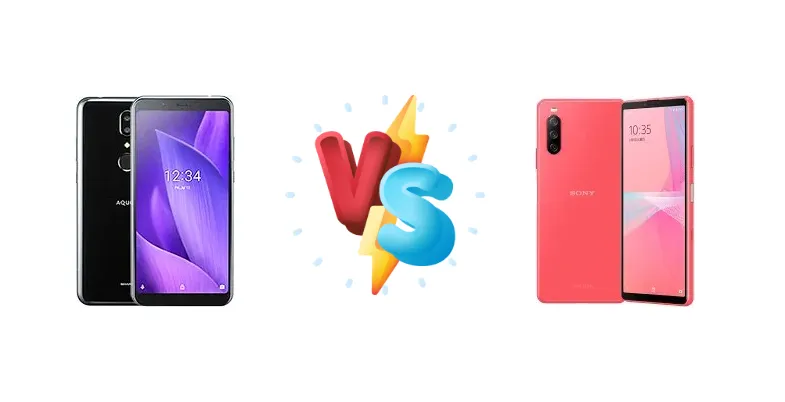
The Sharp Aquos V and Sony Xperia 10 III Lite represent different approaches to the mid-range market. The Aquos V, powered by the older Snapdragon 835, offers a glimpse of flagship performance from 2017. The Xperia 10 III Lite, with its Snapdragon 690 5G, prioritizes modern connectivity and efficiency. This comparison dissects their strengths and weaknesses to determine which phone delivers the best experience for today's user.
🏆 Quick Verdict
For the average user prioritizing 5G connectivity and efficient power management, the Sony Xperia 10 III Lite is the better choice. While the Aquos V's Snapdragon 835 offers raw performance advantages, the 690's 8nm process and 30W charging provide a more balanced and modern experience.
| Network |
|---|
| 2G bands | GSM 850 / 900 / 1800 / 1900 | GSM 850 / 900 / 1800 / 1900 |
| 3G bands | HSDPA 850 / 900 / 1900 / 2100 | HSDPA 850 / 1900 |
| 4G bands | 1, 3, 5, 7, 8, 13, 20, 38, 40 | 1, 3, 4, 12, 18, 19, 38, 41 |
| 5G bands | - | 77, 78 SA/NSA |
| Speed | HSPA 42.2/5.76 Mbps, LTE (2CA) Cat9 450/50 Mbps | HSPA, LTE, 5G |
| Technology | GSM / HSPA / LTE | GSM / HSPA / LTE / 5G |
| Launch |
|---|
| Announced | 2019, November. Released 2019, November | 2021, August 20 |
| Status | Discontinued | Available. Released 2021, August 27 |
| Body |
|---|
| Build | - | Glass front (Gorilla Glass 6), glass back (Gorilla Glass 6), plastic frame |
| Dimensions | 157 x 76 x 9 mm (6.18 x 2.99 x 0.35 in) | 154 x 68 x 8.3 mm (6.06 x 2.68 x 0.33 in) |
| SIM | Nano-SIM + Nano-SIM | Nano-SIM + eSIM |
| Weight | 173 g (6.10 oz) | 169 g (5.96 oz) |
| Display |
|---|
| Protection | Corning Gorilla Glass 5 | Corning Gorilla Glass 6 |
| Resolution | 1080 x 2160 pixels, 18:9 ratio (~409 ppi density) | 1080 x 2520 pixels, 21:9 ratio (~457 ppi density) |
| Size | 5.9 inches, 89.8 cm2 (~75.3% screen-to-body ratio) | 6.0 inches, 84.1 cm2 (~80.3% screen-to-body ratio) |
| Type | IPS LCD | OLED, 1B colors, HDR |
| Platform |
|---|
| CPU | Octa-core (4x2.35 GHz Kryo & 4x1.9 GHz Kryo) | Octa-core (2x2.0 GHz Kryo 560 Gold & 6x1.7 GHz Kryo 560 Silver) |
| Chipset | Qualcomm MSM8998 Snapdragon 835 (10 nm) | Qualcomm SM6350 Snapdragon 690 5G (8 nm) |
| GPU | Adreno 540 | Adreno 619 |
| OS | Android 9.0 (Pie) | Android 11 |
| Memory |
|---|
| Card slot | microSDXC (uses shared SIM slot) | microSDXC (uses shared SIM slot) |
| Internal | 64GB 4GB RAM | 64GB 6GB RAM |
| Main Camera |
|---|
| Dual | 13 MP, f/2.0, PDAF, OIS
13 MP B/W | - |
| Features | LED flash, HDR, panorama | LED flash, HDR, panorama |
| Triple | - | 12 MP, f/1.8, 27mm (wide), 1/2.8", PDAF
8 MP, f/2.4, 54mm (telephoto), 1/4.0", PDAF, 2x optical zoom
8 MP, f/2.2, 16mm, 120˚ (ultrawide), 1/4.0" |
| Video | 4K@30fps, 1080p@30fps (gyro-EIS) | 4K@30fps, 1080p@30fps |
| Selfie camera |
|---|
| Features | HDR | HDR |
| Single | 8 MP, f/2.0 | 8 MP, f/2.0, 24mm (wide), 1/4.0" |
| Video | 1080p@30fps (gyro-EIS) | 1080p@30fps |
| Sound |
|---|
| 3.5mm jack | Yes | Yes |
| 35mm jack | Yes | Yes |
| Loudspeaker | Yes | Yes |
| Comms |
|---|
| Bluetooth | 5.0, A2DP, LE | 5.1, A2DP, LE, aptX HD |
| NFC | No | Yes |
| Positioning | GPS, GLONASS, GALILEO, QZSS | GPS, GLONASS, GALILEO, BDS, QZSS |
| Radio | No | No |
| USB | USB Type-C 2.0 | USB Type-C 3.1, OTG, video output |
| WLAN | Wi-Fi 802.11 a/b/g/n/ac, dual-band, Wi-Fi Direct | Wi-Fi 802.11 a/b/g/n/ac, dual-band, Wi-Fi Direct |
| Features |
|---|
| Sensors | Fingerprint (rear-mounted), accelerometer, proximity, compass | Fingerprint (side-mounted), accelerometer, proximity, compass |
| Battery |
|---|
| Charging | - | 30W wired, PD, QC |
| Type | Li-Ion 3090 mAh, non-removable | Li-Po 4500 mAh |
| Misc |
|---|
| Colors | Black | Black, White, Blue, Pink |
| Models | SH-C02 | XQ-BT44 |
| Price | About 210 EUR | About 370 EUR |
Sharp Aquos V
- Potentially higher raw CPU performance with Snapdragon 835
- May be available at a significantly lower price point due to age
- Proven chipset architecture (Snapdragon 835)
- Older chipset lacks 5G connectivity
- Likely slower charging speeds
- Potentially shorter battery life due to less efficient 10nm process
Sony Xperia 10 III Lite
- 5G connectivity for future-proofed network access
- Faster 30W charging with PD and QC support
- More efficient 8nm Snapdragon 690 processor
- Lower peak CPU performance compared to Snapdragon 835
- May be slightly more expensive than the Aquos V
- Potentially less RAM depending on configuration
Display Comparison
Neither device's display specifications are provided, so a direct comparison is limited. However, given the Aquos V's age, it likely utilizes an LCD panel, while the Xperia 10 III Lite, being a more recent device, may benefit from OLED technology. The Xperia 10 III Lite's newer manufacturing process likely allows for thinner bezels and potentially better color accuracy. The absence of refresh rate data suggests neither phone targets gamers with high-refresh-rate displays.
Camera Comparison
Without specific camera sensor details, a detailed comparison is difficult. However, the Aquos V, being an older device, likely features a less sophisticated image signal processor (ISP) than the Xperia 10 III Lite. Sony's expertise in camera technology suggests the 10 III Lite will deliver superior image quality, particularly in low-light conditions, due to advancements in image processing algorithms. The absence of OIS information for both devices suggests neither prioritizes advanced stabilization features.
Performance
The core difference lies in the chipsets. The Aquos V's Snapdragon 835 (10nm) boasts a more powerful CPU – an octa-core configuration with 4x2.35 GHz Kryo cores and 4x1.9 GHz Kryo cores – compared to the Xperia 10 III Lite's Snapdragon 690 5G (8nm) with 2x2.0 GHz Kryo 560 Gold and 6x1.7 GHz Kryo 560 Silver. While the 835 has a theoretical performance edge, the 690 benefits from a smaller 8nm process, leading to improved thermal efficiency and potentially sustained performance under load. The 690 also integrates a 5G modem, a feature absent in the 835. This means the Xperia 10 III Lite is future-proofed for 5G networks, while the Aquos V is limited to 4G LTE.
Battery Life
Battery capacity data is missing for both devices. However, the Xperia 10 III Lite's 30W wired charging with Power Delivery (PD) and Quick Charge (QC) support is a significant advantage. This allows for significantly faster charging times compared to the Aquos V, which likely supports slower charging speeds. The 8nm process of the Snapdragon 690 also contributes to better power efficiency, potentially resulting in longer battery life for the Xperia 10 III Lite despite potentially having a similar or smaller battery capacity.
Buying Guide
Buy the Sharp Aquos V if you need maximum processing power for demanding applications and don't mind an older chipset and potentially shorter battery life. This phone suits users who prioritize performance over 5G and fast charging. Buy the Sony Xperia 10 III Lite if you prefer a modern, 5G-enabled device with efficient power consumption and faster charging capabilities, making it ideal for everyday use and media consumption.
Frequently Asked Questions
❓ Will the Snapdragon 690 in the Xperia 10 III Lite struggle with graphically demanding games?
While not a flagship chipset, the Snapdragon 690 is capable of handling most mobile games at medium to high settings. Its Adreno 640 GPU provides a decent gaming experience, and the 8nm process helps prevent significant throttling during extended gaming sessions. However, it won't match the performance of the Snapdragon 835 in the Aquos V for the most demanding titles.
❓ Is the lack of 5G on the Aquos V a dealbreaker in 2024?
That depends on your location and future plans. If you live in an area with widespread 5G coverage and anticipate upgrading your data plan to take advantage of it, the lack of 5G on the Aquos V is a significant drawback. However, if 5G isn't available or a priority, the Aquos V remains a viable option.
❓ How does the thermal management compare between the two devices?
The Xperia 10 III Lite's Snapdragon 690, built on an 8nm process, is inherently more thermally efficient than the Aquos V's Snapdragon 835 (10nm). This means the Xperia 10 III Lite is less likely to overheat under sustained load, resulting in more consistent performance.